

Where Suicide sought to reduce, compress, focus and minimise music in order to maximise its emotional charge, Ryuichi Sakamoto goes in completely the opposite direction in his remarkable debut album Thousand Knives. Two aspects of it are particularly striking. First is its diversity, an absolute panoply of polystylism that nonetheless coheres incredibly well; second is the way it embraces synth technology so completely, which in 1978 was relatively unusual in music of this kind.
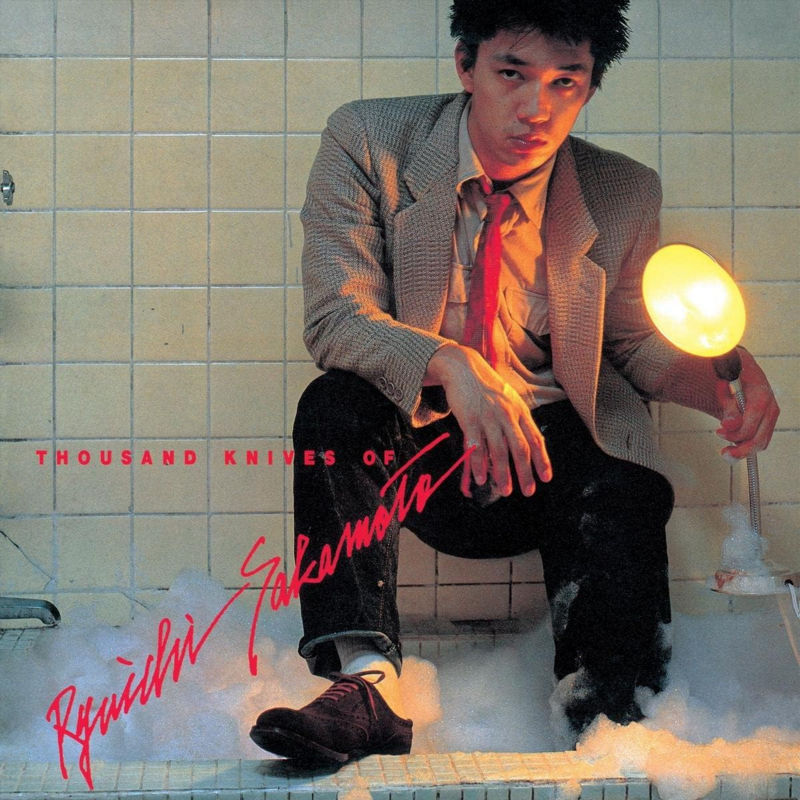
The album is book-ended by complementary tracks that demonstrate real eclecticism in their own right. The title track opens with a brief bit of vocoded poetry, before setting up playful beats and synth gymnastics heralding the main tune. One of the album’s characteristics is Sakamoto’s fondness for middle 8s and instrumental passages that tilt away from primary ideas into more harmonically roaming territory. That happens here, around three minutes in, seeming as if it wants to go its own way. But we somehow end up back where we were, only now an electric guitar has appeared, adding an increasingly flamboyant solo to the otherwise synthesized proceedings. By now the chuntering percussion has a real relentlessness, in the best sense, as if the music wanted to keep going forever. A synth countermelody responds, the big tune comes back, and so does the guitar, unleashing a second solo. Rather than building to a big finish, though, Sakamoto appears to switch into repeat-to-fade mode, but the track becomes filled with dancing electronic motes, before ending, literally, with a bang. Quite a stunning creation, and as early as 1978 it’s more than a little sensational.
At the other end of the album, ‘The End of Asia’ follows a similar path. Again the playful beats and spritely synth embellishments, percussion chuntering away at a laidback pace, funky bassline gymnastics; again the tilt sideways into slightly jazz-tinged roaming harmonic asides; and again the electric guitar eager not to be left out. It’s a lovely alternate take on the attitude of the title track, though here with more of a sense of party atmosphere, wanting to keep going for the sheer fun of it. Here too, though, Sakamoto pulls the rug out, abruptly shifting – just 40 seconds from the end – into a curiously sombre evocation of a Japanese melody.
In between these standout pillars, the four central tracks explore highly diverse musical environments. ‘Grasshoppers’ is one of the strongest indications of where Sakamoto would gravitate in future. Based on a lively, repetitive piano idea, he deliberately combines the instrument with a synth, to form not so much a duet as a weird kind of timbral hybrid. This liminality begs the question of whether the piano is itself real or a synthesized imitation (spoiler alert: according to the list of instruments, it is real); elsewhere things are slightly clearer, the synths acting to double and radiate the piano’s ideas. Even though it’s original, not an arrangement, i always find myself thinking of Wendy Carlos and Tomita during this track, forerunners who demonstrated how classical thinking could lend itself so well to synths and electronics.
‘Plastic Bamboo’, another laidback track, reads as a kind of proto-synth-pop instrumental. Bearing in mind the album’s title, there’s something quite cutting about the spiky percussion, though it’s mitigated by the playful pops and boops that leap left and right. The main melody follows a nicely twisting harmonic journey, and the middle 8 ramps up the spike, with hard metallic strikes, like hammering nails (with perhaps just a hint of Kraftwerk’s ‘Metal on Metal‘, from the previous year). But what’s most striking about the track is the way the relatively spare first half of its ‘verses’ is fleshed out and supported by synth chords, making it sound rich and full. There’s another of Sakamoto’s rug pulls here too; 60 seconds before the end everything is suspended, then reduced to a single tone that slowly rises high before falling a few tones at the end. It’s a curious, unexpected shift away from the homogeneity of what went before, emphasising something purely electronic.
And Kraftwerk were clearly in Sakamoto’s mind when he created ‘Das Neue Japanische Elektronische Volkslied’ [the new Japanese electronic folk song], the title of which is an obvious evocation. The Japanese-style melody plays out over chugging beats strongly redolent of ‘Showroom Dummies’, though beyond this Sakamoto makes no attempt to emulate. There are some lovely swirling embellishments in between each melodic section, and a delightfully strange bass timbre that occasionally doubles the line several octaves below, bearing some resemblance to a heavily vocoded voice. Yet again Sakamoto renders things askew in the middle 8, which here enters into a harmonically and behaviourally strange place, at the sonic equivalent of a Dutch angle. Whereupon, improbably, we’re back on track, chugging onward again.
For me, the highlight of Thousand Knives is its most unusual track, ‘Island of Woods’. Here, Sakamoto sets himself the task of using synths to generate an entirely artificial ‘natural’ habitat. The result is a beautifully atmospheric work, replete with synthetic birds and insects, alongside abstract bursts of rapid, energetic notes, not representative of anything obvious. Walls of noise emerge periodically, and the fauna increases to include flute-like calls and rhythmic squelching like digital frogs, and later, Sakamoto’s use of burbling arpeggios suggests water digitized into pitches. Chords start to take over, seeming to shine, whereupon a whole collection of assorted pulsing repetitions breaks out, all at different speeds. It’s incredibly immersive, forming a kind of electronic version of Roger Waters’ ‘Several Species of Small Furry Animals…‘. In a mischievous closing twist, Sakamoto builds this to a climax before cancelling it out abruptly, leaving just the real sounds of the sea, synthetic finally meeting reality at the end.
While his collaborative work with Yellow Magic Orchestra – particularly BGM (1981) – continued to push at the possibilities of electronics, Ryuichi Sakamoto’s follow-up albums, B-2 Unit (1980) and Left Handed Dream (1981), retreat from the same kind of progressive compositional ambition. Diversity, unpredictability and creative mischief have been replaced by music much narrower in scope and vision, increasingly focusing on gentle repetitive structures emphasising polite, untroubled accessibility – which, after all, was largely the trajectory Sakamoto would follow thereafter. Yet that takes nothing away from Thousand Knives, a stunning, singular demonstration of what synth tech was capable of, in terms of both range and seriousness, when impelled by an imaginative, eclectic and ambitious musical mind.

