

Though synthesizer technology was new, throughout the 1970s various artists began to demonstrate its potential in serious, thoughtful ways. As early as 1971, Tonto’s Expanding Head Band created Zero Time, showcasing an astonishing array of dramatically intimate and immersive soundworlds, the kind of which would be explored further in years to come by Wendy Carlos. Giorgio Moroder, in a dazzling one-off (fluke?) display of creative ingenuity – worlds apart from his earlier, low-effort pop and later, even more low-effort disco – released Einzelgänger (1975), a genuinely radical electronic album anticipating Jean-Michel Jarre.
Nonetheless, as synths and drum machines began to infiltrate the world of pop and rock, their existence as something literally novel resulted in a lot of artists responding in kind, producing electronic novelty music. Hot Butter set the bar pretty low back in 1972 with their disposable self-titled album, most of which – ‘Popcorn’ and ‘Telstar’ excepted – sounds like those execrable, one-button demonstrations included on cheap ’80s keyboards. After a few years lying dormant, novelty returned in abundance, in such albums as Devo’s relentlessly goofy Q: Are We Not Men? A: We Are Devo! (1978); M’s cavalcade of banality New York, London, Paris, Munich (1979); Telex’s Neurovision (1980), the daft follow-up to their enjoyable debut Looking for Saint Tropez the previous year; the Buggles’ The Age of Plastic (1980), unctuous, cheesy and smug in equal measure; and surely one of the worst of them all, Music for Parties (1980) by fictitious group Silicon Teens – actually Daniel Miller, who evidently felt his creations ‘T.V.O.D.’ and ‘Warm Leatherette’ weren’t wretched enough, and aimed to outdo himself with an album that leaves one feeling nothing but pity for anyone who actually attended parties where that abysmal music was playing.
Despite the merits of his debut (explored last time), Ryuichi Sakamoto fell foul in the Yellow Magic Orchestra’s LP ×∞Multiplies (1980), a travesty of unfocused irritation interspersed with, of all things, comedy sketches. Sakamoto’s YMO sidekick Haruomi Hosono steered close to novelty territory on Philharmony in 1982, but the most startling Japanese example from this period was the 1980 eponymous debut from Hikashu, 42 minutes of rudimentary arrangements and cover versions that even managed to mess up the basic harmonies of Kraftwerk’s ‘The Model’.
More interesting by far were artists who positioned themselves in the vicinity of, yet sufficiently distant from, the novelty border, rather than mindlessly launching themselves across it. In the early ’80s, the likes of Men Without Hats, Fad Gadget (who, incidentally, was called upon to pretend to be the lead singer of Silicon Teens) and Yello would flirt and play with elements of such novelty liminality. In Japan, Plastics touched on it in their superb debut Welcome Plastics (1980), but the most supremely effective example came the previous year, in another debut release, In a Model Room by P-Model.
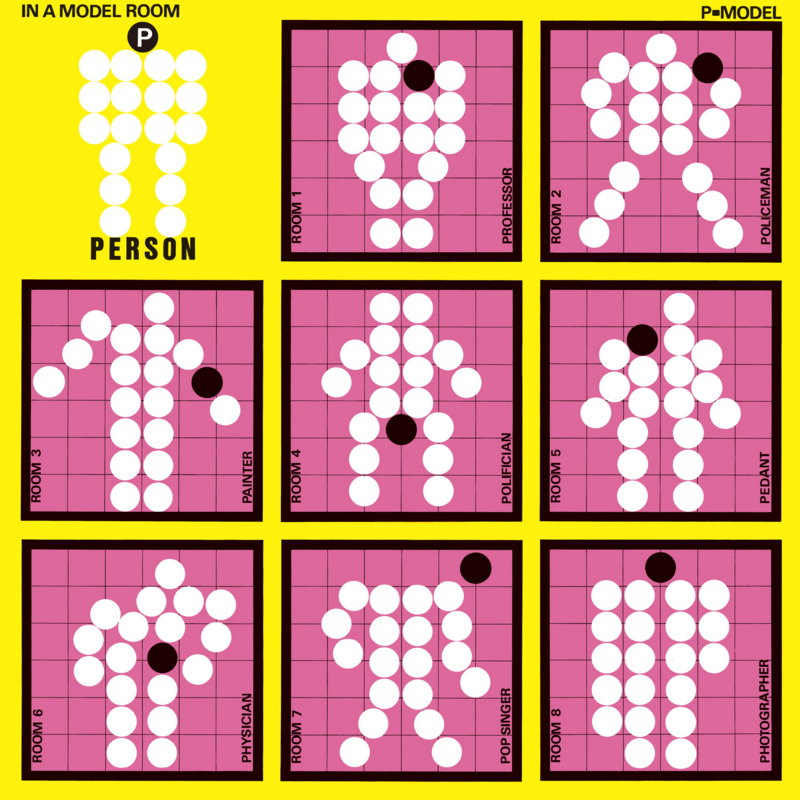
One of the most stunning aspects of In a Model Room is its fusion of punk and New Wave rock tropes with those of nascent synth-pop. Opening track ‘美術館で会った人だろ’ [art mania] at first seems completely incongruous: light plunky machine beats and a fast-fluttering synth tune, together with familiar, fast driving rock trappings. From one perspective it’s a mash-up, though what it projects more than anything is enjoyment rather than silliness. Validation for this comes in the middle 8, where the synths practically invoke the ghost of ‘Popcorn’ yet exist in an entirely different world from it.
The track functions as a statement of intent: no mere stylistic cut and shut, or even a proof of concept, but a fully-realised, working demonstration of then and now, old and new, melded not welded, merged and integrated into a cohesive, convincing whole. Its pace and vocalist Susumu Hirasawa’s breathlessness together suggest a barely-contained chaos, and that persists through ‘ヘルス・エンジェル’ [health angel], continuing where the opener left off, as well as ‘子供たちどうも’ [for kids], more straightforward new wave, rocking out while the synths lurk at the fringes, climaxing in group chanted choruses that make you want to sing and stomp along. Its breakneck speed is one of the album’s defining features, and in a way this helps the acoustic-electronic fusion to sound all the more naturalistic. Everything is fluid, flowing like a torrent.
The most extreme example is ‘サンシャイン・シティー’ [sunshine city] which is as close as P-Model get to novelty, yet even here they remain endearing, keeping it short and punchy. Likewise ‘偉大なる頭脳’ [the great brain], a joyously weird song that’s permanently askew. It’s never allowed to get into a groove, tilting left and right while its forward momentum lurches through an irregular metre; Hirasawa is all over the place, the rest of the group egging him on, periodically chanting. ‘ホワイト・シガレット’ [white cigarettes] tilts toward ska punk, while the middle 8 bizarrely introduces the Arabian Riff over snuffling machine beats, ultimately overwhelmed by the recurring, ever more unhinged refrain, “Shiga Shiga Shiga Shiga Shiga White Cigarette!”
In ‘ルームランナー’ [roomrunner] the relationship between acoustic and electronic is playful, with heavy emphasis on pounding rock tropes until a strange, unexpected sequence at the end when they all break down. Hirasawa is left panting for breath while a gentle drum machine gleefully takes centre stage to finish the song. Similar is ‘MOMO色トリック’ [pinky trick] where the drum machines are literally placed at the periphery (hard panned left and right), plunking out brief percussive moments while the band does their thing in the centre. It’s a deliriously intense track where, even though pitches are present, they feel more or less arbitrary in such a shouty context.
It doesn’t seem a likely environment for more serious exploration but In a Model Room does a lot more than just rock hard and shout a lot. The aptly-named ‘ソフィスティケイテッド’ [sophisticated] switches to a much slower pace, conventional drums and guitar to the left, burbling electronics and vocals to the right, a light drum machine in between. The track locks into this groove, which is essentially dronal, elaborated with wild electronic squelches and burps filling the bridge passages. And ‘Kameari Pop’ is really progressive, laidback but with heavy electronic beats – not far removed (but predating) early hip-hop – and a deep bassline redolent of funk, punctuated with synth blips, bleeps and stings. It’s P-Model’s most stylistically eclectic track, and a sign of many things to come (though not from them); and every time the refrain returns – “Hey you, this song is pop, Kameari pop” – it’s hard not to think ahead (7 years!) to Kraftwerk’s similarly self-referential, “Musique non-stop, Techno pop“.
Closing track ‘アート・ブラインド’ [art blind] seems at first like a red herring amid such eclectica, a curious, mid-tempo chugging track, far from the momentum and play from before. But we soon realise that now, at the end, all historical traces have been erased: no more new wave, no punk, no rock-adjacent elements at all – just synths and drum machines gently driving things while, as if to reinforce the point, everything stops halfway through and Hirasawa’s voice emerges through a vocoder, bringing to mind the austere, computerised speech in Kraftwerk’s ‘The Voice of Energy’.
In many respects, In a Model Room was a complete one-off. That’s partly the case due to the vicissitudes of the band itself. P-Model evolved out of the ruins of prog rock band Mandrake, and that inclination to rock evidently never went away. By the time of Landsale (1980), essentially any signs of emergent synth-pop had vanished, and through their subsequent albums Potpourri (1981) and Perspective (1982) electronics as a distinct sonic element were essentially expunged completely (they would return, discreetly, in 1984’s Another Game, a turning point for the group). As such, In a Model Room is a rare and unusual experiment at bringing together two stylistic starting points, and finding that, against the odds, they could form something wonderfully new.

