

Through the 1970s, Bill Nelson was the driving force behind Be-Bop Deluxe, a band that took art rock in some highly progressive directions. Futurama (1975), though conventional, had as its highlight ‘Sound Track’, energised, expansive and imaginative, showing off Nelson’s outstanding guitar skill. Sunburst Finish (1976) included ‘Sleep That Burns’, demonstrating a much more stylistically eclectic approach. Best of all was Modern Music (also 1976), which more than anything – even more than their 1978 follow-up Drastic Plastic – introduced a level of invention that pointed toward something a lot more ambitious. Featuring subtle electronic flourishes, the music no longer sounded rooted in generic rock tropes but altogether more lyrical, imaginative and downright beautiful, suggestive, in the 10-minute ‘Modern Music’ medley, of Pink Floyd, and in the four-part harmonies and piano accompaniment of ‘The Bird Charmers Destiny’, of Queen.
Following Drastic Plastic, Nelson dismantled the band as it then stood and reconstituted it with new musicians as Red Noise. Ultimately this configuration would only release a single album, Sound-on-Sound (with the record label insisting on Nelson’s name being appended so audiences knew what they were getting), before Nelson finally abandoned the band model and went it alone. But this extraordinary, solitary album would prove to be one of the last major contributions to rock – of all persuasions – of the 1970s, as well as a highly significant demonstration of the ways in which electronics were irrevocably transforming its soundworld.
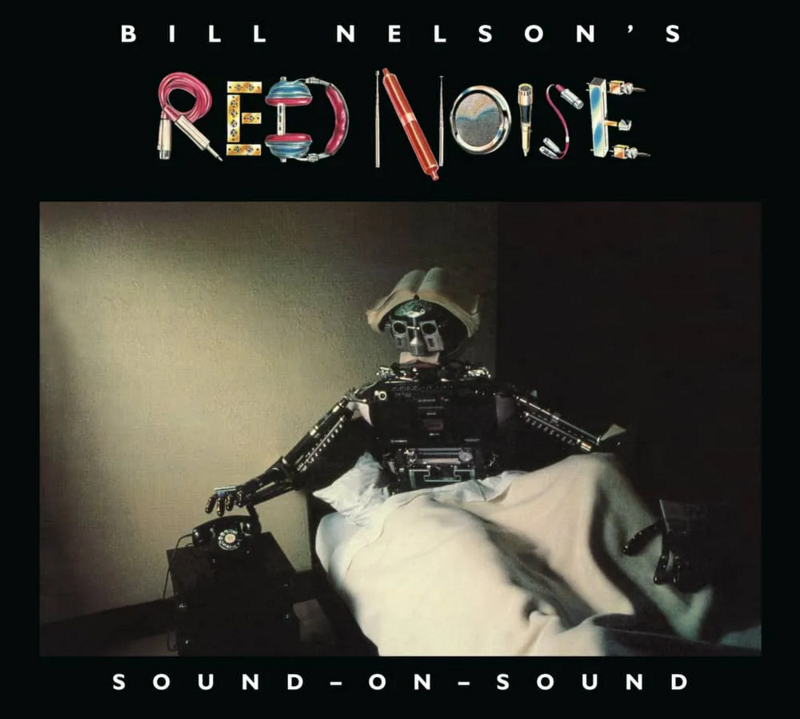
From this perspective, what makes Sound-on-Sound so engrossing is less the way electronics are utilised as an ‘other’ element alongside those of a conventional acoustic band (as with P-Model’s In a Model Room), but in the way they now seem to permeate, invigorate and colour the entire aesthetic, both musically and lyrically. If there’s one word that could apply to the entirety of Sound-on-Sound, it’s ‘electric’ – this is an electrified album, in terms of subject matter, style and content.
It’s no surprise, then, that the opening track is titled ‘Don’t Touch Me (I’m Electric)’. It hits the ground running, and in a way not dissimilar from some of P-Model’s songs, pitch feels almost irrelevant, aside from the bassline. There’s more harmonic clarity in the middle 8, but elsewhere Nelson’s vocals are sprechstimme-esque, abstract, angular vocal shapes and stabs. One of the effects of the ‘electrification’ i spoke of is the extent to which, apart from the prominent drum kit, almost nothing sounds conventional. The bass is low-key, more implied than actively present; guitars spurt out tiny riffs and brief arching shapes from the sides; synths and electronic drums barely project. The whole thing entirely lives up to its title, arcing and convulsing spasmodically.
Electronic encroachment is a guiding concept behind the album itself. On numerous occasions Nelson alludes to the fact that it’s a liminal time, though it’s neither a dystopian vision nor a warning of what’s to come. To call it tongue-in-cheek would be to overstate what comes across most as a highly-charged response to both the state of the world and the state of the art, embracing both a cutting seriousness and devil-may-care frivolity. There’s an emphasis on youth as a vital part of handling, making sense and ultimately embracing the future.
In ‘For Young Moderns’ Nelson describes how “The old world is burning … The empire is falling … The times are alarming”, yet it’s also “a brave new world … a nouveau a-go-go gone wild … a never ending search for romance … It’s got everything, you don’t have to wait”, while noting, at the very end, like a sting in the tail, “It’s a killer if you try to resist”. Guided by a strong, stable, pounding pulse, synths sing out over the brief choruses and laser notes burn through the lengthy coda, while a honky tonk gets going apropos of nothing. There’s something irresistible about the line, “Your kiss is a mirage / It fills me with sand” – Sound-on-Sound is many things, and it often travels into beautifully surreal imagery.
This is reinforced later in ‘Stay Young’, driven by an archetypal, upright, twitchy new wave beat, focusing on the importance of being young at heart. Not, Nelson stresses, wearing “youth like a mask” but something more genuine, because “We must be bolder … The styles are changing / It’s so exciting / It’s so inviting”. The continually convulsing pulse comes to feel like it’s encapsulating nervous excitement. Likewise ‘Stop / Go / Stop’, upright and twitchy again, where there’s a sense of that electricity taking over the running of things, including the self: “Conversion takes a moment / You’ll hardly even bleed / Each painless installation / Is fully guaranteed”. The beats have a machine-like propulsion, and Nelson embodies it in the middle 8, his voice becoming vocoded, triggering a triumphal upward synth whoosh. There’s an unsettling undertone to the song, the robotic allusion used here to take shots at mental health treatment, and the way it will “make you fit to serve / We’ll sever your connections / And seal off every nerve”.
Perhaps the after-effect of such treatment, or simply a consequence of losing that all-important youth, is found in ‘Out of Touch’, where jagged synths spew and gurgle over everything. “But there’s nothing to be said / ‘Cos my nervous system’s dead / and I’m out of touch”, sings Nelson, his apparent resignation at odds with the breathless energy coursing through the song, channelled into a long, substantial instrumental section. Yet it collapses at the end, as if suddenly (but elegantly) stalling. The opposite is expressed in ‘Radar in My Heart’, a track that taps into the same energy and attitude as ‘Don’t Touch Me (I’m Electric)’; muscular verses, coated with electronic flourishes and fireworks, don’t so much unfold as progress in irregular lurches, clicking into gear in the fast-flowing choruses, before – even more suddenly than ‘Out of Touch’ – abruptly halting.
That allusion to robots takes on a different connotation in ‘Furniture Music’, a slower song but where the beats feel heavier, conveying a profound sense of detachment. There’s a kind of dazed interiority articulated here – “It never rains inside my room / My carpet is the colour green…” – a flatness of expression in response to banality. There’s more than a trace of post-punk alienation coming out here, and the reference to Satie’s musique d’ameublement, and by implication the concept of a music that doesn’t seek to engage, echoes that same sensitivity. While the electronics bibble optimistically they can’t shift the impression of a circling music, trapped and disillusioned.
Sound-on-Sound comes into its own, and attains something magnificent, in its closing five tracks. ‘A Better Home in the Phantom Zone’ suggests a Tarkovsky-tinged idea of a region that’s ‘other’. Whether it’s truly better or worse than the everyday world is a judgement call; electronics throw radiance on the chorus, suggesting the “phantom zone” is shiningly inviting, and hurl acid-like spills over references to daily news reporting. Furthermore, the way Nelson describes hollow-minded people is cuttingly direct: “Your relatives are white and all your children have record players / They listen to Tom Robinson, the Beatles and the Byrds and Leo Sayer / You take them to the zoo to watch the animals walk circles in their cages / Your politics are fashionable, you got them from the yellow pages”. The invitation, by contrast, is to “Turn on the sound, tune in the static”, embracing the ambiguity and uncertainty of noise in favour of something more familiar and organised.
Something of the same ambiguity is heard, more personally expressed, in ‘The Atom Age’. Again the twitching new wave pulse, though here taking on an air of regularity under strain. Its outlook is conflicted: “I stand proud as the flags displayed / Citizen of the atom age”, yet “I hang with the angels from the gallows of science / It’s a neon future and it tears me apart / ‘Cos it’s the state of the nation / The state of the art”. ‘Substitute Flesh’ is similarly anxious; here too, synths present a cheerfulness that contrasts sharply with the song’s musical and lyrical hard edge. Nelson is again emphasising the divide between the real and the simulated, stressing the fact that danger is inherent to all genuinely intimate encounters: “Wounded like roses / Lovers are razors / Substitute flesh / The sharp edge of kisses leave our lips bleeding”.
i said Sound-on-Sound was no dystopian warning, though there are allusions to them. Penultimate track ‘Art / Empire / Industry’ – arguably the highlight of the album – electrifies the music to a whole new level while declaring “Speed and machines are the art of our empire … Our great engineers are the priests of the age … Colour is disruption / Uniforms are grey … Ecstasy is treachery / Passion is a crime”. Implications of Metropolis and 1984, perhaps, though the overwhelming exuberance of the song bares not even the slightest trace of concern or irony. This friction – collision, even – is swept away as we’re carried along, borne on a wave of ambivalent joy, even as these disquieting slogans ring out. The climax is the album’s most electric sequence of all, Nelson’s vocoded voice chanting “Art / Empire / Industry” in a rising expanding chord, clearly invoking Kraftwerk (who, it’s worth remembering, when they did this were poised to set off at similarly fast speeds), in a delirious closing gallop.
1984 also gets a passing name-check in closing track ‘Revolt Into Style’, reflecting on past and future: “Why try to keep the past alive / And though I know the time is almost 1984 / It feels like 1965”. Here, too, any prospect of disillusion or worry is nowhere to be found amid the rollicking tempo and playfully burbling electronics. Nelson gives “revolt” a double meaning, suggesting both disgust as well as rebellion. It’s a closing act of light, nimble, but emphatically pumped-up defiance that propels Sound-on-Sound to a synth-infused finale, pointing to a future that’s as inevitable as it is unknowable.
Nelson’s playful consideration of past, present and future – its excitements and trivialities, fears and hopes – is one of the crowning achievements of the 1970s, coming precisely at what was arguably the most liminal period within this already highly unstable and experimental time, with the 1980s approaching fast. An electronic presence is everywhere, in both the electric character of the songs – in the process distorting verse-chorus structures or sometimes doing away with them altogether, and filling them with seemingly endless quantities of energy – as well as the literal presence of synths, drum machines and vocoders, blended here into a homogeneous soundworld that itself embodies past, present and future.
Articulated with a sense of chaotic, even anarchic looseness, yet at the same time intricately organised and executed (a combination redolent of Zappa), Sound-on-Sound is an utmost ebullient last look back at what’s gone before, practically itching with anticipation – tinged with both positive and negative charges – even more traces of that electricity – for what’s to come.
Due to their vintage, the availability of the albums i’m exploring in this Lent Series varies widely. Sound-on-Sound – entirely appropriately – is one of the lucky ones. Not only has it been remastered, in a 2CD set featuring a new stereo mix and an assortment of bonus tracks, but it’s also available in a lavish 6-disc box set (one of the treasures of my own collection), Art / Empire / Industry – The Complete Red Noise, comprising the 2CD set plus two other CDs, featuring a live performance of Sound-on-Sound from the group’s 1979 tour, as well as all of Nelson’s demos for the album, created in 1978. The box also contains two DVDs, with the audio in various high-res formats as well as video of Red Noise’s performances on The Old Grey Whistle Test. Both are still available from Cherry Red Records.

