

The encroachment and infiltration of electronics into pop and rock caused, among other things, a whole lot of disquiet, disagreement and division. One of the recurring themes of this most liminal period are band shake-ups and break-ups, in which opinions about the presence, role and importance of electronics were often central. In P-Model‘s case, suspicion about the rise of what would come to be called synth-pop led Susumu Hirasawa to recoil in the opposite direction, steering the group back to a much safer, smaller world filled with simple rock tropes and shouting, in the process shedding both band members and fans. Bill Nelson had always been the captain of what was first Be-Bop Deluxe, and then Red Noise, hiring and firing musicians according to the dictates of his creative requirements. And then there was The Human League.
Two enquiring sonic minds, Ian Marsh and Martyn Ware, formed a duo in 1977 called The Dead Daughters, experimenting hard with early synth technology. They teamed up with another, even more radical mind, Adi Newton, becoming The Future. Newton left (going on to form Clock DVA, testifying to just how radical he was), and the duo tried and failed to recruit Glenn Gregory as vocalist, turning instead to Philip Oakey, in the process renaming again as The Human League. Further disputes, break-ups and reformations were to come – we’ll get to that – but during their two years of stability, following a period of considerable experimentation and refinement, in 1979 the group released their remarkable debut, Reproduction.
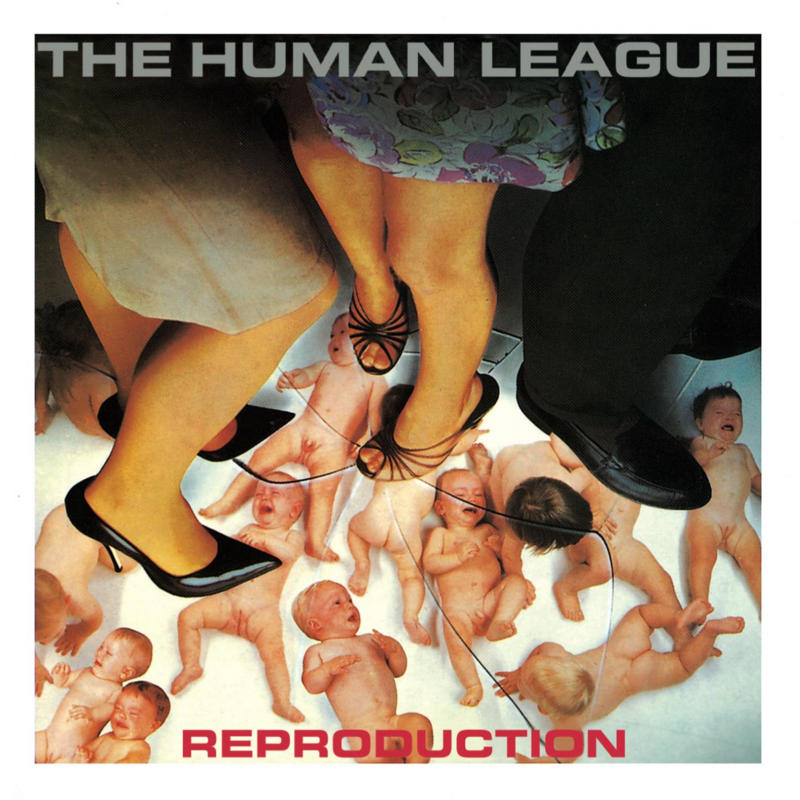
In general, Reproduction is not an album characterised by speed. Ware and Marsh instead use drum machines to create steady pulses that feel reinforced and emphatic, not exactly fixed in place, but inclined more toward stomping and pounding rather than the fleet forms of momentum previously explored in this Lent Series. Starting the album in this way is very arresting, with ‘Almost Medieval’ emerging out of flat, solemn electronic ticks. The hard panning of these ticks – left, right, left, right – is like an implied march, and that’s precisely what ensues. It feels solemn as Oakey intones the opening verse, but after this the sense of relentless forward motion becomes infectious, enhanced by the choruses being extended more than we’d expect. Simply by maintaining steady musical intensity, they manage to increase emotional intensity. By the time the opening lines return, Oakey now singing an octave higher, it’s supercharged, almost overwhelming. And that’s just the first track.
‘Circus of Death’, with pristine synths channelled over a faintly carnivalesque 6/8 metre, sounds like a clear point of origin for Chris Corner’s IAMX, particularly when the vocals let rip. Oakey’s voice is a fascinating combination of prose and poetry, capable of unsettlingly direct dryness, and stunningly forceful strength when he goes big and high. ‘Empire State Human’ is an obvious sibling to this, ramped up to have a proto-Soft Cell, post-disco momentum. Obviously, there’s not one, single track where synth-pop was born, but this is undoubtedly one of its earliest manifestations. Here its fast 6/8 metre is aligned with more stomping pulses which, combined with an anthemic, chant-like chorus, makes it one of the standout tracks on Reproduction.
‘The Path of Least Resistance’ is one of several songs that are contrastingly low-key, caught in a semi-static environment where the bass buzzes, the drums are utterly dry and Oakey seems to be by turns dazed and desperate (similar to the vocal shift in ‘Almost Medieval’), on a funereal trajectory. ‘The Word Before Last’ is more ruminative, caught between a fizzing rhythmic loop and delicate synth strands. It’s like an electronic heartbeat, tinged with a melancholy emanating from tragedy described in the lyrics. The opening gambit of ‘Blind Future’ pours scorn on the empty, defeatist cliches of punk: “No future they say / But must it be that way?” It expands, becoming powerful, into a rallying cry to “blind youth” (echoes of Red Noise’s ‘For Young Moderns’ and ‘Stay Young’), its arching, reinforced melody matched by a bassline so present it seems to act like a counterpoint.
The most incredible sequence on Reproduction begins with ‘Morale’, where the music recedes into an ambient-like delicacy. From this, Ware and Marsh set up an atmosphere of hypnotic synth arpeggios that accompany Oakey’s low, intimate vocals. Stylistically it’s light years from Suicide, but in due course there’s something of the same polarisation, the vocals passionate, externalised and free, while the electronics are subdued, internalised and regular. Rather than ending, the song tips into an unsettling texture that takes over, becoming a surreal, dream-like segue into, of all things, a radical reworking of The Righteous Brothers’ ‘You’ve Lost That Lovin’ Feeling’. The whole thing – again echoing aspects of Suicide’s soundworld – is like a weird human-robotic mix, Oakey’s warmth surrounded by ice-cold, dripping synth notes, made yet more strange by its slow but just as relentless pace.
What follows is another bifurcated track. ‘Austerity’ sets up a steady gallop, and appears to play out as a conventional song, robust and direct. Yet it turns around what appears to be a middle 8; everything gets pulled back, the pulse switches metrics from duple to triple (back to 6/8 again) with the effect that it now slips and trips along more fluidly. It gives real impetus to the song, and the rising chord sequences that appear later crank up the tension, hinting at what would come in a few years later in Ware and Marsh’s outstanding Heaven 17 track ‘Temptation’.
Closing track ‘Zero As A Limit’ takes Reproduction back to where it began, though instead of clicks it’s a nicely ambiguous pulse, like a cross between finger clicks, hand claps and marching feet. Relaxed and unrelaxed simultaneously. Weird, undefined clouds of pitch muddy the clarity from behind, possibly triggering what follows: a long, drawn-out acceleration, such that, by the end, the song both encompasses and exceeds the tempos used throughout the rest of the album.
Reproduction is a remarkable achievement as early as 1979, all the more so as the group stays true to their experimental origins; far from attempting to meld electronics into the structures (and strictures) of conventional band setups and sonics, they embrace them entirely. The fact that they also already have such a strong, individual language, seeking to create thoughtful, considered, meaningful songs makes Reproduction all the more significant and seminal. It paints a picture of a pop future that’s wholeheartedly, unashamedly electronic.
The Human League continued together for a couple of years before the familiar disputes about direction returned, and the group broke up. This particular tale feels as old as time, doesn’t it? Let’s keep it brief.
Oakey convinces Marsh to get rid of Ware; Marsh has a change of heart at the very moment of break-up, and the result is that Oakey goes one way, Ware and Marsh another. Oakey, somehow managing to wangle the Human League name for himself, in an act of desperation goes to the nearest nightclub, finds too likely-looking – but, it would turn out, tone deaf – girls to act as sidekicks, and forms v.2 of the band. Succumbing to that uniquely Faustian combination of audience expectation and commercial aspiration, the band ejects all traces of experimentation, produces one modestly interesting album, Dare (1981), and promptly runs out of ideas. Everything turns bland (Hysteria (1984), then creatively compromised (the aptly-named Crash, 1986) and finally piss-poor (the not aptly-named Romantic?, 1990). It wasn’t until Octopus, released in 1996 – 14 years after Oakey had boldly decided to go where pretty much everyone was going already – that The Human League v.2 finally began to figure out how to make something actually worth hearing.
Marsh and Ware, meanwhile, return to Glenn Gregory, this time successfully recruiting him, and emerge, chrysalis-like, as Heaven 17. They continue experimenting and refining in Penthouse and Pavement (1981), before creating one of the truly great pop albums of the decade, 1983’s The Luxury Gap. There’s little doubt where the real talent lay.

