

Many of the albums i’m featuring in this year’s Lent Series feel as if they came out of nowhere, less part of a process of evolution than a sudden, out-of-the-blue flash of something fully-formed and entirely new. That’s very much the case with The Bridge, a remarkable one-off creation resulting from the collaboration of two Scottish experimentalists, Thomas Leer and Robert Rental. Prior to this, Leer and Rental had separately put out self-produced singles, Leer’s ‘Private Plane / International’, and Rental’s ‘Paralysis / A.C.C.’, both released in limited quantities in 1978. Where Leer’s music was emphatically song-oriented, Rental’s was much more ambiguous, beats and harmonies mingling with strange, wavering shapes and traces of voice in a psychedelic manner. Those distinctions between Rental and Leer are important across The Bridge.
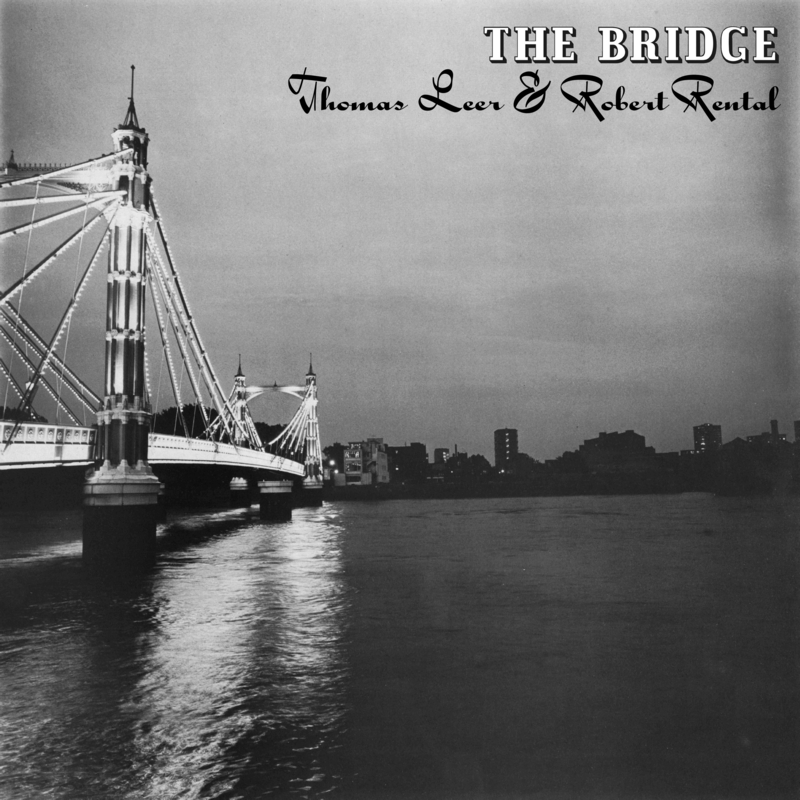
The Bridge is an album that hits the ground running, doing so with some similarities to what Marsh and Ware had been exploring with The Human League (particularly their 1979 single ‘The Dignity of Labour’) at this early stage. ‘Attack Decay’ is filled, everywhere, with pulsing synth patterns, a display of total, indefatigable energy and momentum. The vocals (performed throughout by both Leer and Rental), are low in the mix, part of the rapid, fast-flowing texture, and while it seems as if there are no beats at all, occasional noise pulses serve this function, and over time the synth patterns themselves take on an edginess that makes them percussive. The frenetic intensity is astonishing, mesmerising, and attains real power at points where the vocal line soars high through the surface of the churning texture to resound beyond.
Several of the earlier tracks on the album have a clear connection to pop tropes and structures. ‘Monochrome Days’ puts emphasis on guitars, their riffs aligned to a drum machine, in a punchy, vaguely new wave number that feels tight and focused, tilting on its axis, ramping up for the choruses. ‘Day Breaks, Night Heals’ is more Kraftwerk-aligned, another example (of the so, so many at this time) of chugging momentum, and like ‘Attack Decay’, here too the beats are integrated into, inseparable from, the bassline. Harmonically static, garnished by light electronic decoration, and with circular lyrics (as elsewhere), the track touches on the soundworld of Suicide, only shifting slightly during bridge passages. That’s even more the case in ‘Fade Away’, where the tone is unequivocal. Brisk, firm beats – a timbral mash-up of guitar, noise, pitch and pulse – assume the character of a march. It manages to be both heavyweight and churning, feeling increasingly daunting as its relentlessness becomes apparent. Two minutes in and the vocals (again echoing ‘Attack Decay’) project higher with more power, while synth pulses start firing through the texture and a guitar strikes up a merry tune. What makes it all so hypnotic is the way such total regularity is combined with a complete sense of flux: the nature of the beats, the synths, the voices, is never the same, continually shifting, yet the whole has an implacable changelessness, an inevitability. Is the title ironic? The only thing that seems to have faded is light, air and the ability to move free from these mesmeric strictures.
‘Connotations’ is the first indication of something very different indeed. Buzzy electronic drones, a gentle 4-note bass pattern, the vocals softer than ever within the mix. By now it’s as if the voice isn’t so much a medium for lyrics as a textural or timbral element, suggestive rather than communicative. The music is dense, somehow compacted, with no beats or otherwise dry sounds to break things up, punctuate or define them. Instead, we’re locked into a vague sense of regularity from the semi-indistinct bass. Dream-like and cloudy, the low-key dramatic atmosphere of ‘Connotation’ (a much more refined example of something Marsh and Ware attempted in their pre-Human League days as The Future) is closer to what we would think of today – and which had only been defined as such earlier the same year – as an ambient sensibility.
‘Six A.M.’, the album’s most inscrutable track, occupies similar territory. A short, single phrase repeats again and again, never quite the same, while a bare trace of rhythmic chug doesn’t so much underpin it as act like a hovering palpitation. Periodically worried by a recurring splinter-fragment of something metallic, it becomes like an extended series of breaths, not remotely calm but poised, watchful, tense, haunted. Ambient noir.
‘Interferon’ pushes into the electroacoustic realm. A busy clatter-texture expands to fill our ears, like the sound of a thousand drummers, light traces of synths at its surface, something more sustained moving through the middle, becoming stronger; a strange, perhaps voice-related noise can be heard somewhere within. Nothing definite; all elusive. Until, that is, a slow thudding starts, the clatter recedes and the track evolves from being abstract, noisy and granular to a pitch-based network of bright, shimmering tones. We’re caught in the midst of this web, static but pulsing, with more pitches winking into existence as it continues. Eventually a third state takes over, fading into fast rippling notes and a sense that we’ve somehow gone from stasis to rapid flying. The music sounds more and more weightless, by the end just a dense pitch core with trace notes audible, as if moving at great speed. It all feels light years from the songs with which The Bridge began; perhaps that’s the point: crossing from a place of familiarity and certainty to somewhere new and strange.
‘The Hard Way In and the Easy Way Out’ extends this further, again harnessing sound forms that continually evolve. Starting from another repeating pitch idea, burbling away, even before a minute has passed it’s becoming more sustained, pulsing within a more stable soundworld. Glimpses of indistinct voices, buzzes occasionally scalding the surface, all continuing to shape-shift, drawing the ear to each new instance of change. It’s done with such smooth elegance that the result is enthralling, bringing to mind the extended electronic abstractions from the world of kosmische musik, though here expressed in a more intimate way. Considering the context within Leer and Rental were operating, such exquisite control, and such a soundworld as this, is staggering.
All of which makes the closing track ‘Perpetual’ seem, in hindsight, inevitable. Ambient finally takes over, and we enter a warm, gentle environment where soft voices hang suspended while synth tones calmly slide around. The tension of ‘Six A.M.’ is gone, far behind; arriving at the other side of The Bridge has brought us to a place of peace. Again, nothing is truly static, everything is undergoing change – a landscape of shift, pulsation, crossfade – culminating, in its closing minute, in a glorious, understated expansion, voice and electronics fused.
i said above that perhaps part of the point of The Bridge is its journey from familiarity to strangeness, but it also seems like something of a journey between the creative instincts of Rental and Leer. Leer the song-oriented popster, whose trajectory would tend ever more synth-pop-wise, through his subsequent albums Letter From America (1982) and Scale of Ten (1985). Rental the sculptor of experimental soundscapes, whose Mental Detentions, also created in 1979, demonstrates a radical sonic sensibility. As well as a being a fascinating collaboration, The Bridge is also therefore something of a journey between the differing fundamental instincts of their two personalities.
Above all, though, The Bridge is an incredible, pioneering demonstration of the ways in which electronics and avant-garde compositional thinking were radically reshaping and redefining what pop and rock – and other genres – could be, and would become in the 1980s. One can only wish that they had done more together; as it is, this was Thomas Leer and Robert Rental’s only album collaboration, released in December 1979 on Throbbing Gristle’s label Industrial Records. Unlike many masterpieces from this time, it remains readily available on vinyl, CD and download.

