

For the next album in the Lent Series – and this won’t be the only time – the chronology becomes more fluid. Cabaret Voltaire, comprising Richard Kirk, Stephen Mallinder and Chris Watson, formed in Sheffield in 1973, but it would be five more years before their music would start to be released, on the then fledgling label Rough Trade. However, the trio diligently kept recordings of a large amount of their earliest work, and while there’s plenty to be impressed by in their later, more consolidated output, i’ve always found myself most enthralled by what they created during this nascent phase of their existence.
We’re fortunate to have access to a large amount of that early material. Listen Up with Cabaret Voltaire (1990) compiles a variety of tracks dating from the late ’70s and early ’80s, both officially-released and previously unheard music. And then there’s the motherlode: Methodology ’74 / ’78. Attic Tapes; (2003), a triple album of mind-altering wonderment, a veritable fever dream of sonic shenanigans from the days when the trio was still lurking in Chris Watson’s attic, figuring out what got them musically excited. i call it the motherlode, but for all its fascinating interest it’s also scattershot and qualitatively variable. These were the earliest of the early days, after all.
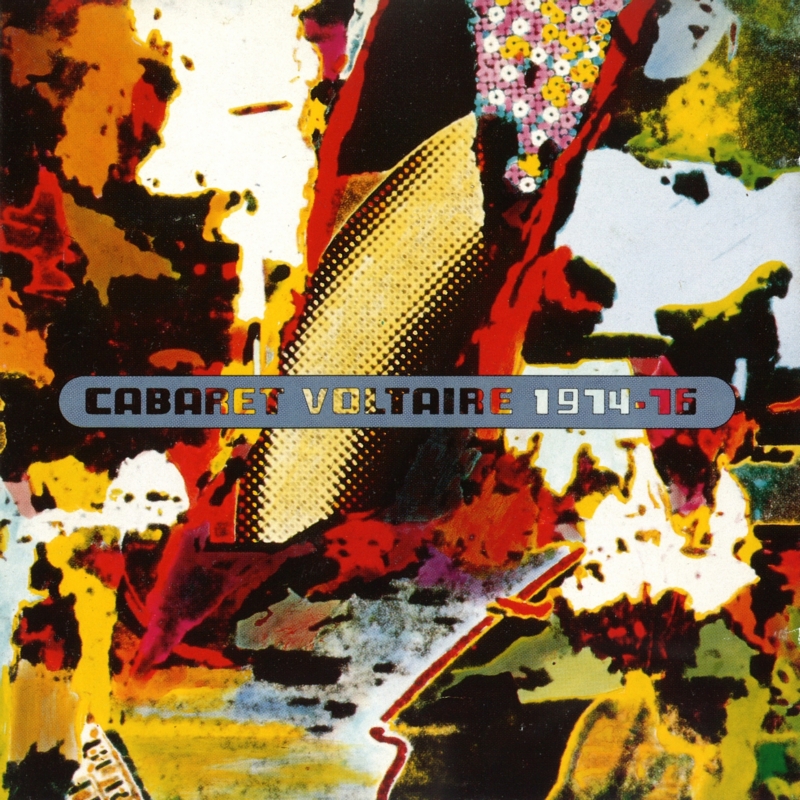
More successful in presenting a coherent immersion into the Cabs’ first half-decade of creative exploration is 1974–76, released way back in 1980. Where the Methodology box set acts as a historical archive, concerned primarily with preserving, 1974–76 operates on a level that states, more plainly and boldly, that what Cabaret Voltaire were creating, even in this earliest phase of their career, was significant, worthy, and a lot more than just experiment.
All the same, there’s often the distinct sense that we’re witnessing an investigation taking place in real time. ‘The Dada Man’, which begins the album, is a mess of regular and irregular pulses running at variable speeds. It has a sense of near chaos, constantly teetering between control of the sounds and them running amok. Bursting and volatile, bombs and fireworks go off, countered by purrs, ripples, fibrillations. Pitch elements purport to introduce stability to the soundworld, alongside traces of rhythm, but the explosions and tilting speeds persist. It takes on an organic quality, like exotic lifeforms moving in swamps. This is collage music, a mix of layering and juxtaposition in which what’s being ostensibly focused upon isn’t necessarily what’s most significant, or even most interesting. Details lurk in blur and shadow, firing the imagination.
More overt evocations of life come in ‘Venusian Animals’, where a crunchy, palpitating pulse is the backdrop for a variety of calls and songs, the primary melody emerging from Richard Kirk’s clarinet. Low, atmospheric, brooding, reinforced by languid drum machine beats – we’re deep in a world inhabited by fauna synthetica, made all the more strange in its closing minute when something almost tangibly voice-like appears, immediately lost in clatter and wind.
Another investigatory aspect is how the three protagonists interact. In ‘Ooraseal’ it feels like discrete layers playing out independently from one another (unlike ‘The Dada Man’). In its latter stages, a harsh rhythmic element becomes more regular, and thereby assumes a frame of reference for everything else, something that would subsequently become fundamentally important in Cabaret Voltaire’s work. Parallel layers also appear in ‘A Sunday Night in Biot’: a distant chord presence, soft plunking percussion, alarm-like noises, distorted speech, noisy cloud formations. Yet here, while they all move independently, they nonetheless form a cohesive whole. The voice becomes extremely harsh at times, in the process highlighting a sense that everything sounds confined within the same small space.
The trio’s instinct for mischief and provocation – the early history of Cabaret Voltaire featured performances and punch-ups in immediate proximity – comes through in several of these early works. ‘Do the Snake’ sets up a suitably hissing environment in which a slow pulse and bassline emerge. Our imagination runs wild imagining an audience responding to the recurring instruction to “do the snake”. Playfully tongue in cheek, the beats hold things in check while mayhem continues above. It must have been wonderful to hear this performed live in the mid-’70s (as long as one could avoid the subsequent fists flying). Something similar takes place in ‘Doubled Delivery’, where, to the accompaniment of not so much a pulse as a sequence of rhythmic splats, the trio strew stuff around. It’s a kind of avant-kosmische, establishing an underlying sense of order enabling flights of fancy of pretty much any kind to happen.
Sometimes a notion of order is dispensed with altogether. ‘Fade Crisis’ does include a rhythm presence but it’s faint, frangible; thus the soft pitches that move about in the midst of far-off voices float and bob with absolute freedom. It’s a curious tension: nothing is tethered, yet the whole is held in a kind of stasis. It’s weirdly, wonderfully beautiful, like watching blobs of chemicals fizz and mingle in a liquid solution. Taking this further is ‘In Quest of the Unusual’ a title that could sum up the Cabs’ entire mission. Again the parallel elements: unsettling undulating tones, vague enclosing clatter, chirping pitches, a half-whispered voice, these and other sounds continuously intersect and morph into each other in a fantastical display of sonic evolution. Another recurring aspect of their music can be heard here, everything sounding controlled yet bristling with levels of energy that feel extreme, continually threatening to rip everything apart.
1974–76 saves the most telling examples of their early work for last. ‘The Outer Limits’ – another worthy description of Cabaret Voltaire’s output – is a lengthy exploration of another form of stasis. High, shimmering pulses, violently beating against each other, are both the starting point and, it seems, the reference point (it’s as if those coordinating rhythms from elsewhere were here sped up until their frequencies become pitches). Below, looping fragments appear, over time seeming to fall out of phase with themselves; a pair of oscillating pitches repeats like a forlorn bird call; in the middle distance, a soft drum machine can be heard. Again the float, again the evolution and morphing of elements, again the sense of careful control – though in this context the level of energy is more measured, everything seemingly suspended between gentle relaxation and tense electrification. That’s only complicated further by a more rapid drum machine that materialises later. Almost all of the tracks on 1974–76 feel frustratingly short, and while at nearly nine minutes, ‘The Outer Limits’ is the longest of them, it’s a soundworld just itching to be extended a whole lot longer.
The album ends with what is, for me, one of Cabaret Voltaire’s most unique, unusual and stunning creations. The title, ‘She Loved You’, is an oblique reference to the Beatles song ‘She Loves You‘, and that subtle change of tense turns out to be utterly transformational. What context there is takes the form of buzzy tones that periodically pulse and fall; a muffled, rather dead beat, like wood striking wood; far-off vestiges of backward speech and song; and juddering reverberant notes like electronic gongs. It’s a black, bleak, blasted landscape, a numb place of daze, where inchoate remnants of the lyrics are articulated in whispers: reverence, secrecy, memory, pain. It’s an adjacent world to that of Suicide’s ‘Frankie Teardrop‘, not so much immersive as all-enveloping and claustrophobic, not so much articulating as implying enormous quantities of emotion from a place of unwavering rigidity. (Tori Amos inhabits a comparable place in her similarly radical reworking of 10cc’s ‘I’m Not in Love’ on her 2001 album Strange Little Girls.)
It must have been literally incredible to be in Sheffield in the late 1970s and hear music like this emanating from an unlikely collection of electronic boxes and tape machines, wielded by an equally unlikely trio of performers. Cabaret Voltaire would go on to refine their sound in ways that would, in a similar way to ‘She Loved You’, undermine, dismantle and complicate meaning through pressurised states of repetition and groove. But 1974–76 is where it all began, raw and amorphous, fearlessly radical and inventive, astonishingly and unforgettably immediate.

