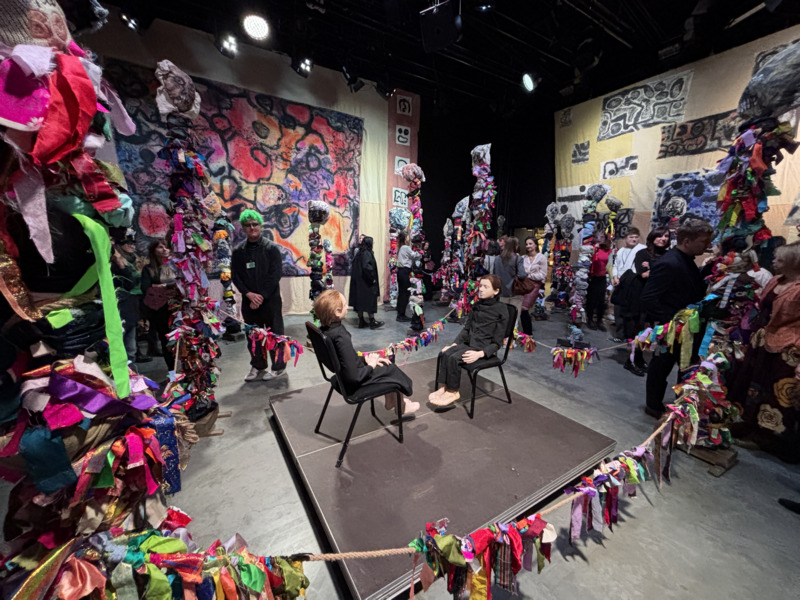
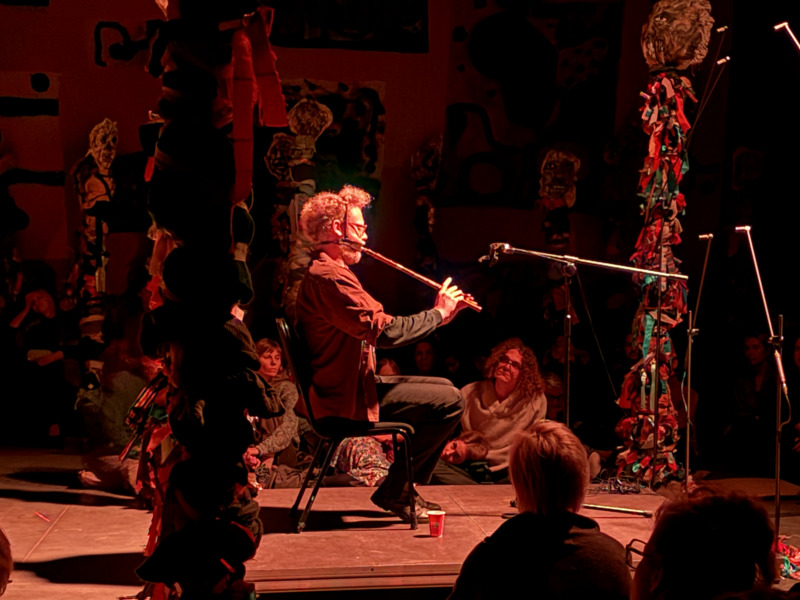
What makes the ordinary extraordinary? What makes a space special? i was instantly struck by this thought, walking into the main space of the Cricoteka cultural centre. The last time i was there, 12 months before, it had been a regular concert hall. Now it was transformed into ‘Up in the gods’, an exhibition by artist duo Jakub Julian Ziółkowski and Si On. Large paintings adorning all four walls, and throughout, tall columns like bizarre totem poles, seemingly fashioned out of rags and scraps of textile with grotesque faces perching on top, simultaneously playful and grotesque. No longer an ordinary space; it had been primed, switched on. Once ‘profanum’, now ‘sacrum’.
SACRUM
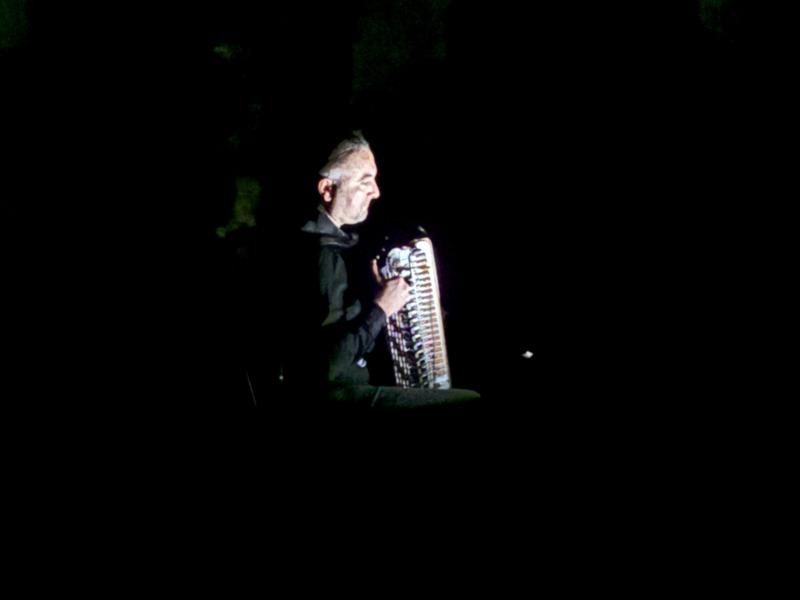
Back in the space the following evening, for Sacrum Profanum’s opening event, Ritual I. The world première of Artur Zagajewski‘s reassuringly-titled Please, sit comfortably or lie down. Close your eyes and switch off. You can fall asleep, everything will be fine. Total darkness, except for a pale light barely indicating the presence of accordionist Eneasz Kubit. He begins, emitting low, complex, microtonal clusterchords. Swell, sustain, decay. The chords speak as low-key monoliths, or something massively slowed down, or elementary pulses at the heart of every pitch. Black on black. But as my eyes start to become dark-adapted, so do my ears. Details now: higher frequencies slowly appear within the clusters, clashing against each other causing different beat tempi, like softly vibrating cilia. Having barely emerged from darkness, Kubit recedes again, descending into the depths, back to black.
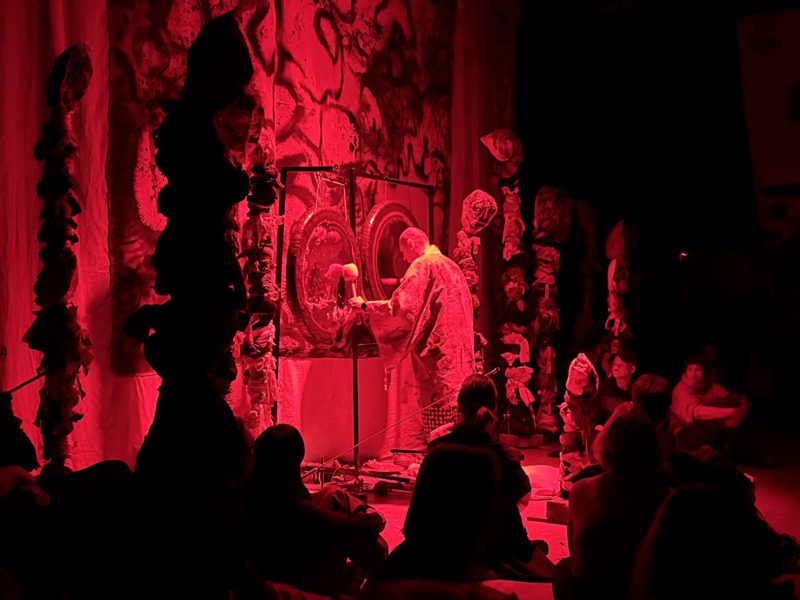
The space turns red, focus shifts to Jakub Ziółkowski’s ‘ritual intervention’. The title is intriguing: a continuation of what Kubit began? a disruption of it? a redirection? It is like some form of arcane, indigenous rite, rhythmic gong patterns answered by growling vocal chant. What makes the ordinary extraordinary? What gives an action meaning, and with it, makes a sound meaningful? Whether Ziółkowski’s intervention was improvised or carefully choreographed seemed irrelevant; it was meant.
More light, and with it more clarity, visual and aural. As Lukas de Clerck performs his The Telescopic Aulos of Atlas, the twin auloi function less as active lines than passive receptors. Roughly a perfect fifth apart, like a mid-register carrier signal, modulated by and thereby revealing tiny invisible fluctuations in the space. De Clerck’s instrument gains autonomy, speaks of its own accord, becomes emphatically melodic. Listen closely, though, and – echoing Kubit’s chords – other pitches become apparent too, juddering together like ghost notes riding the tune’s waves. The evening is a ritual in the true sense: channelling the inner, the invisible, the inaudible, rendering them tangible. Sacrum.
PROFANUM
Thoughts about what makes a space special, an action meaningful, turn unfathomably dark the next day. Shootings in Kraków’s central market square, multiple murders and many more injuries, four days of mourning declared. And with them, the dying of a festival. But before it expires we’re back in Cricoteka, for Ritual II. Taking place behind closed doors – officially cancelled, invited guests only – gives the occasion increased weight, the space now something beyond merely special. Unlike yesterday – a complete contrast to everything about this day and its black events – Cricoteka is filled with light, and with it blazing colour from the walls and columns.
The bagpipe and brass duo WCIAS, brothers Karol and Filip Majerowski, start the ritual as it means to go on: an eternal drone, with a playful line dancing and lurching over it. As if spluttering into life, it grows in confidence, the duo enthusiastically uniting in a unison tune, Filip’s trumpet rough at the edges, Karol’s pipes sagging at the end of phrases. i realise that, in light of what’s taken place today, in the wake of atrocity, it’s impossible to concentrate. This occasion, this music, seems both so trivial, so pointless – and yet utterly important, vital. Whether it’s any good or not feels irrelevant; it’s not what they’re playing that matters but the fact that they are playing. It turns more personal, the duo sing, unaccompanied, folk-like, words and melody cycling round, and while i have no idea of its meaning the immediacy of its humanity feels overwhelming. Karol’s pipes resume, ending in an improbable duet with Filip’s tuba.
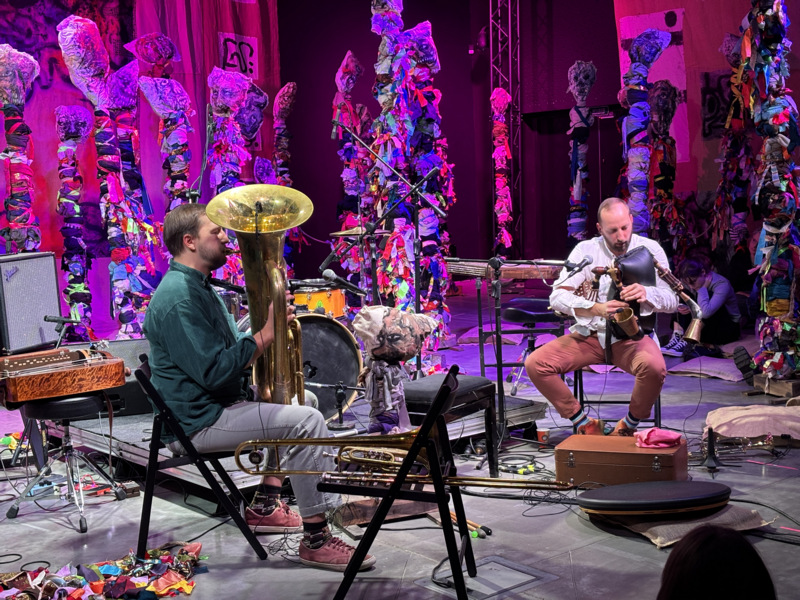
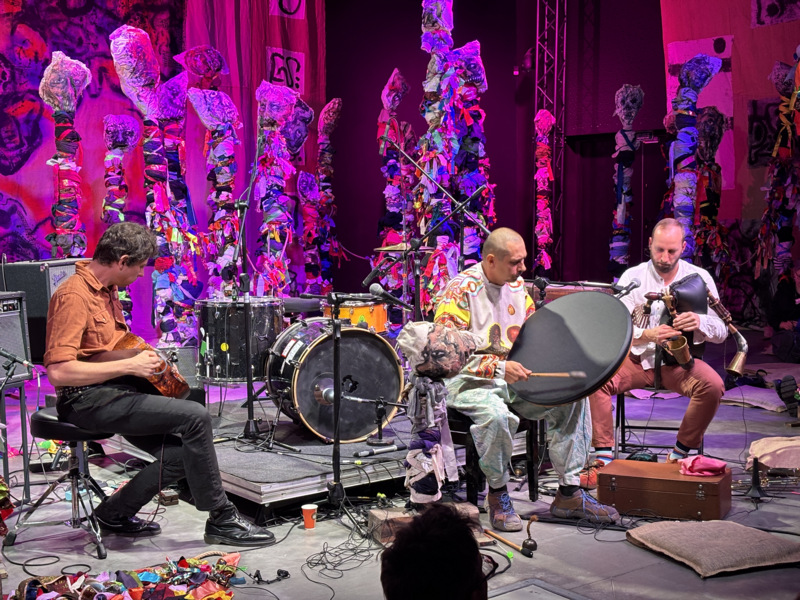
Jakub Ziółkowski returns for a second ritual intervention, wielding a hand drum alongside Karol’s bagpipes and Pancerz on hurdy-gurdy. The drone expands, explodes in fact, while Ziółkowski uses a bright green superball mallet across the drum membrane in the most beautifully strange solo, now texture, now noise, now deep tones, which transmogrify into soft drum beats, miraculously in tune with the instruments on either side. It continues like an extended dance on one note, drums and pipes breaking up in rhythmic and melodic embellishment while the hurdy drone remains a hypnotic constant, neither background nor foreground, but everywhere.
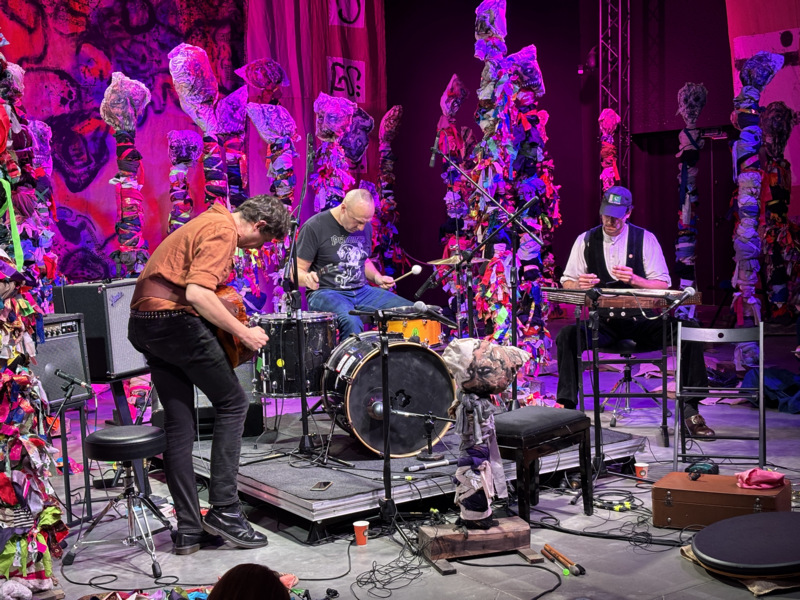
The line-up shifts again, becoming Kromleh, a trio comprising Pancerz, drummer Maciek and Sylwester Sudnik playing santur. Can drones reach zeniths? It seems they can. Like a slowed-down memory of krautrock, the trio becomes ever more focused, intensifying around that unceasing pitch. Initially part of the percussion, aligned with Maciek, once Sudnik brings the santur into play everything changes. That sense that it’s not what’s played but the act of playing that matters takes over everything. In the wake of, and in spite of, the horror of the day, their performance proves massively life-affirming. Aftermath as ritual, ritual as drone, drone as purpose, its persistence an undying act of resistance, defiance, protest.
The ritual ends, and with it Sacrum Profanum 2026. Municipal events in Kraków are cancelled, and the festival is forced to comply. Devastation reigns, yet community prevails; no-one wants to leave, because when tragedy strikes this is what we do: meet, gather, commiserate, celebrate, share, talk and make music.
The next morning, an unexpected epilogue. In the old town, walking a complete circuit of the market square, down all the roads leading to it, each one sealed with police tape. As i complete the square, from a high window comes the sound of a bugle. Steady, measured arpeggios. The Hejnał mariacki, played every hour in Kraków since time immemorial but, following the shootings, shockingly silenced for 12 hours. In this strange, surreal, early morning atmosphere, everyone around quiet and subdued, it’s like a sibling to the Last Post, calling out remembrance in all directions. Another space becomes primed, switched on. As tradition dictates, the music abruptly halts. Silence. i walk away from the centre, but as the square grows more distant the bugle strikes up again. i know it’s my imagination but it sounds new, faster, more energetic. Reveille?