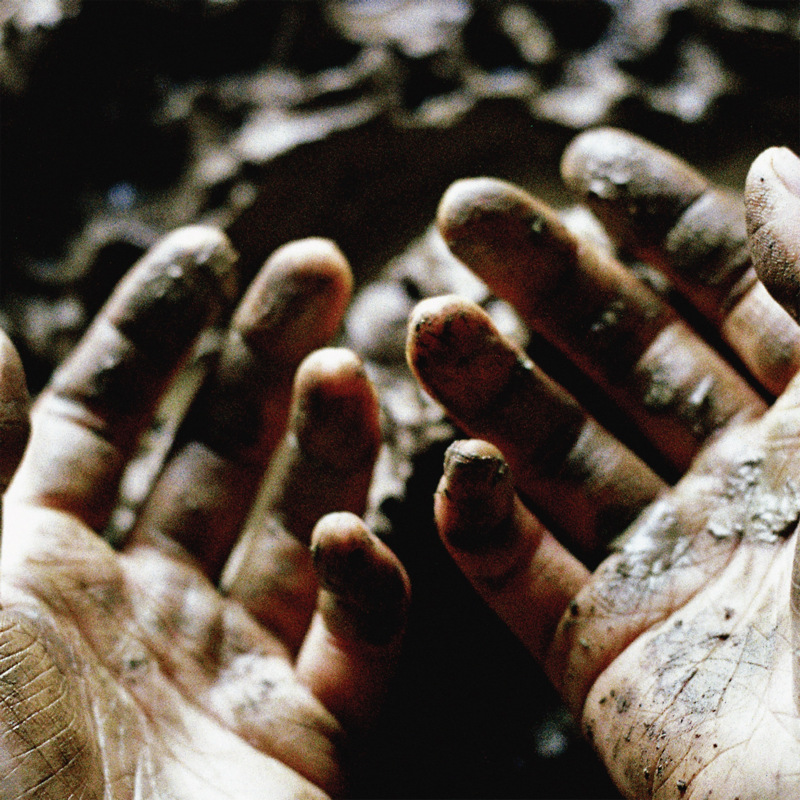
Looking at the artwork of What to Make of These Mortal Hands, the new album from Felicia Chen’s nom de guerre Dis Fig, it suggests the hands of a survivor of something catastrophic. Dust and dirt cling to the fingers, and beyond, blurred, are what appear to be the jagged forms of rocks and stone. All of which could hardly be a more apt metaphor for the soundworld permeating this extraordinary album, where human vulnerability is subjected to overwhelming sonic straits.
Are we enclosed? Is this the catastrophe? Opening track ‘Arrival’ suggests it might be, tense metallic tappings answered by close proximity impacts and repeated dull blows. They’re sporadic yet also give the uncanny sense of a nascent drum pattern. An oscillating guitar drone begins, there are snatches of something vocal, and suddenly we’re not so much in the midst of as buried beneath a massive, crushing pulse. It seems astonishing, under such unfathomable weight, that any kind of continuity is even remotely possible. Yet this is just track 1.
This kind of movement, from something stable, familiar and manageable to its polar opposite, is a characteristic of several of the tracks. One of the most breathtaking is ‘Psaltery’, opening in a place of complete silence. That in itself is something of a shock, coming in the wake of ‘The Account’, a measured but nonetheless punchy piece where the words (performed by the wind between, aka Eldon Somers) are surrounded by beats that bounce against and around them. Chen’s voice materialises afterwards, fragments and syllables, deformed, aspirated, fluttering, settling into a super-intense concluding vocal. So the opening silence of ‘Psaltery’ is a momentary breather after the devastation that preceded it, leading into a gentle, delicate, intimate song, pulseless vocals over plucked notes. But noise is there from the outset, like isolated strands of bacteria slowly but surely multiplying. It encroaches more and more, bass throbs, beats bruise, and Chen becomes essentially lost in the almighty overload that ensues. Lost – or assimilated? Is she screaming, her notes clipped beyond recognition, or simply pulverised by everything above her?
Likewise ‘Vorago’, the title of which is an archaic term for an abyss or chasm. Blank ambiance, strange noises, friction pitches – heard both forward and reversed – a hypnotic music held in place, pulsing, plunking, throbbing, whispering, sighing. It’s a surreal kind of non-place, but a beautiful one, and a liminal one, in terms of the tangibility of what we’re hearing. Halfway through, though, and it’s lashing out, compressed screams and percussion, complex and pungent, not wild exactly but with a fucked-up elegance. Again the punches fly, the weight descends, pounding with industrial relentlessness, from something human to absolute mechanisation.
There are more than temporary respites from these barrages of aural enormity. ‘Ginko’s Way’ lowers the ante, surrounding Chen’s harmonised melody with calling rooks, the song taking on the sense of a meditation. Indistinct noise and subterranean piano notes fill ‘Mystic One’, which demonstrates the most convincing sense of stability on the album. Yet a sense of the bigger context never goes away, such that these fragile, gem-like songs speak less as interludes than dream states, points where the music focuses not on the scale of what’s outer but on the potency of what’s inner. ‘A Hundred Hands’ is perhaps the most telling, a morose repeating guitar progression, steady, plodding, blank, the passacaglia to Chen’s barely enunciated poem of vulnerability and endurance. There are echoes of Nine Inch Nails’ Still here in its dazed numbness, given an exquisite twist toward the end when the guitar falls out of sync with itself.
Even in these short asides, there’s a distinct sense of simmering – nothing feels remotely cold anywhere on What to Make of These Mortal Hands. And it’s the manifestation of that heat, in the form of slow burns and incandescent climaxes, that doesn’t just typify the album but is arguably its point. In ‘The Snake You Built’ there’s a Chelsea Wolfe vibe as its rock undertones ferment. Overlapping, non-complementary tones arbitrarily streak the space, a drum kit somewhere in the middle distance, some close-up half-audible rumination. The eruption that ensues carries familiar hallmarks: pushing ahead while compressed from above, building to a fully clipped overload chorus. (It feels totally appropriate that Chen hasn’t shared the lyrics for all of the songs, including this one, as their semi-indecipherability is surely an important part of their essential nature and mode of expression.)
Apropos: not just the mode but also the range of expression, which is hugely impressive. ‘The Stone Awakens’, featuring LUηG (aka Cameron Tanaka) takes a different approach, not a slow burn but a sparking into life, glitching and glittering and ominous. A razor edge, rippling at different speeds, Tanaka’s vocals a heightened personification of desperation, while the beatbass returns to mechanistic malevolence, though now pulsing rather than pounding. The track seems to transcend expression as an artistic act, becoming something more pure, more raw, Tanaka grunt-cry-screaming beneath a deluge of crunch distortion, everything juddering due to both external and internal weight. It neither ends, nor subsides, nor burns out, but concludes in a minute’s worth of glowing heat.
For me, the high point is ‘I’ll See You In The Burning Sun’, the longest track on the album. It’s a true slow burn, a reverby accordion repeating a three-chord phrase, as the surrounding texture gradually becomes richer and more harmonically varied. Its soft edges harden, sharpen; bass joins in, a pulled punch pulse; Chen joins in, half yelling, half screaming. Of all the tracks on What to Make of These Mortal Hands, it’s the most polarised: Chen, a barely-controlled, white hot focal point, borderline manic, within a dense, slowly processing apocalyptic suspension, all controlled motion, practically majestic.
A similar attitude comes in the last track, ‘Komorebi For Ele’. Now an organ drives the chord sequence, in a doleful closing procession. As Chen sings – saving her most purely lyrical outpouring for the end – the bass consolidates, and immensely slow beats don’t merely punctuate but punch through the music, each one a giant gash, coated in acid by crashing cymbals, and as Chen falls silent the processional continues as the crushing weight crunches its details to a point of total obliteration. Looking down at my own hands as the music fades, i almost expect them to look like those on the cover.
Released last month on Thrill Jockey, What to Make of These Mortal Hands is available on CD, vinyl and download from Dis Fig’s Bandcamp.