
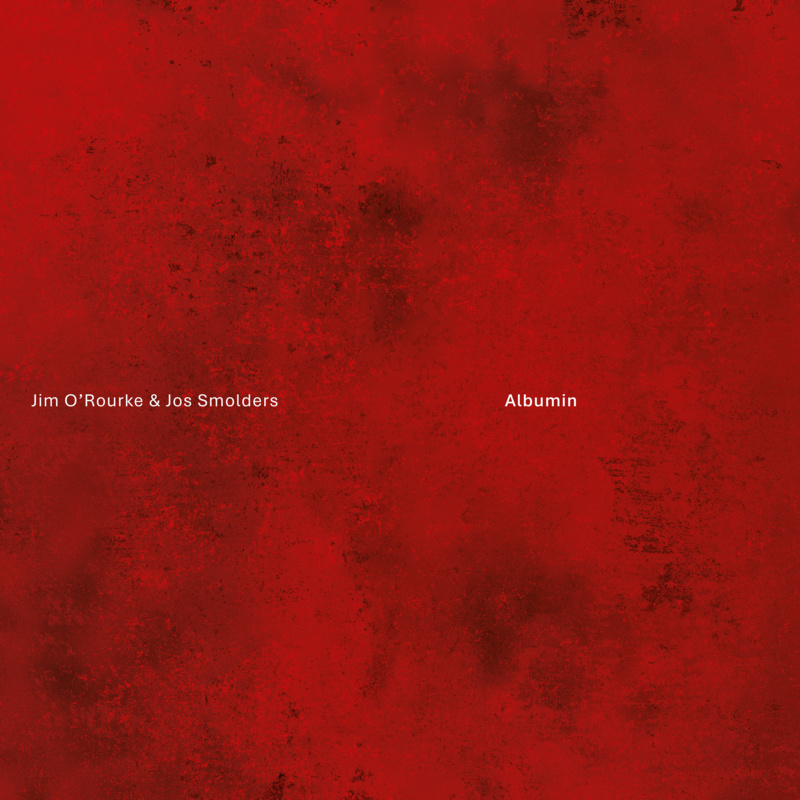
An album i’ve kept returning to in recent weeks is Albumin, the latest collaboration from Jim O’Rourke and Jos Smolders. There are various reasons for that, but perhaps the primary one is its gripping spontaneity. The cover artwork is a telling analogue: a large red environment (clearly evoking the title), within which arbitrary agglomerations can be found, lightening and darkening the patina. Seemingly randomly distributed, they appear as both isolated incidents and grouped into clusters and constellations. Likewise Albumin, its two 18-minute tracks operating in a similar way, projecting something of a prevailing palette, while the surface details are less about clear progression than more elusive progress. Things happen, some connect (or appear to), others transform, a few materialise from nothing and vanish into nowhere.
The first few minutes of part 1, ‘(HP)-(HP)’, are instructive. An intense throbbing, twitching, juddering opening salvo, pitted with small rhythmic sputterings, continual swells, and the sense that, in almost no time at all, we’ve become completely overwhelmed. Yet apropos of nothing, this imposing abstract world is cancelled out, replaced with music far more identifiable and navigable. Plunky percussion, like a complex clockwork mechanism. This juxtaposition of the immediate and the alien, space and saturation, is a trait of Albumin as a whole, manifesting with unpredictable invention. The percussion elongates into synthetic strands that fizz with tracery, a new mechanism emerges but morphs into a network of chimes. And all the while Smolders and O’Rourke push hard from beneath, causing the contour to contort and bulge in ways that feel both increasingly familiar yet surprisingly fresh and potent, in no small part due to the way they undermine whatever grip we currently believe we have on what’s happening.
But it’s not chaos that reigns, it’s caprice, and of an impressively sensitive and nuanced kind. ‘(HP)-(HP)’ recedes as much as it protrudes, subsiding through soft-edge rumble into soft enigma; falling away to light metallic accents, and a new chimescape bereft of impacts – an impossible mechanism with no straight edges – to a vista of sustained pitches, strong but gentle, contrasting the density and the detonations that sporadically occur. It’s no criticism – no negative one, anyway – to say that this is not a balance of tension that O’Rourke and Smolders maintain; antagonism and friction aren’t prominent here, irrelevant in this soundworld that manages to find homogeneity despite its erratic inventive flow. And beauty too – so much of what transpires through ‘(HP)-(HP)’ is just marvellously lovely, a fact the duo perhaps tacitly acknowledges in the unhurried way they allow ideas to speak and evolve.
Despite its overt abstraction, one realises in hindsight that ‘(HP)-(HP)’ has come to feel unexpectedly tangible, even tactile. That’s continued in Part 2, ‘r(OP-OP)’ in a striking introduction where electronic tones reverberate with what seems a new kind of alien remoteness, yet its cool, rippling sheen is intersected by long notes, possible fragments from some distant, drawn-out melody. That sense causes a frisson through what follows, becoming a focal point – almost a mid-register drone – through assorted skitter and jitter. Again the sensitivity, everything subsiding through delicate bass pulses into soft, glinting effervescence – like refracted bell resonance – and, later, vague drifting tones. If anything, these glades of sonic sanctuary seem more and more foundational, the stable bedrock above which shifting tectonics fracture. As below, so above: halfway through ‘r(OP-OP)’, we find ourselves in an atmosphere of delicate pitch fragrance worried by tremors in the air. There’s almost the sense of a tune somewhere, some hauntological artefact half-congealing in the floating viscous notes.
It’s a mesmerising passage, all the more so as, in due course, it becomes lost – though seemingly because the music tries to turn more directly toward this possible memory. Yet in the process everything becomes more ambiguous, and there’s another surge – what will turn out to be the last – that leads to a final transformation. The texture is dense but detailed, it’s hard to know where, and on what, to focus attention, yet it’s not remotely frustrating as everything is interesting, and somehow every small detail seems to pull us back, and out, to the whole. Noise bands become clarified, start to shine (echoing that earlier focal point), and Albumin ends with them continuing to glimmer through a cloud of electronic smoke.
Released last month by Moving Furniture Records, Albumin is available on vinyl and download.

