
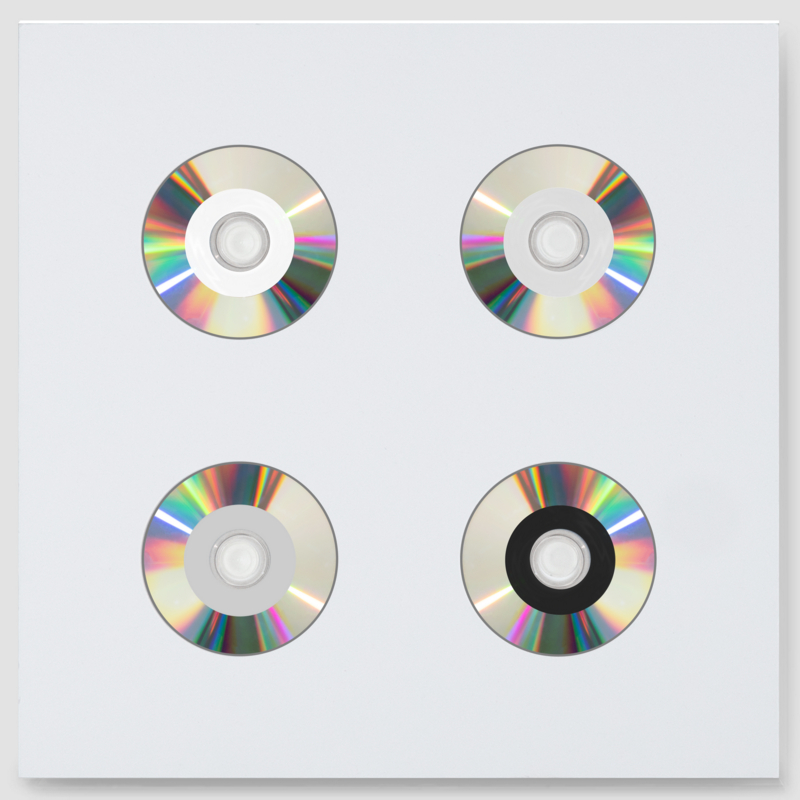
It seems entirely appropriate that my relationship with ITERAE. the latest album from collaborators Joseph Branciforte and Jozef Dumoulin, is one that i’ve circled around and repeated numerous times. My first contact resulted in quizzical curiosity, with subsequent listens proving ever more beguiling. Furthermore, ITERAE provides both a complete 8-track album (on CD and download), and, on the flipside of its elaborate physical release, four 2-track EPs (on mini CDs), suggesting new ways for its structure to be approached. So as an integral part of these multiple re-listens, i’ve experienced it in multiple permutations, physical and digital, large and small, as one 8-track whole and multiple 2-track modules. And every single listen has yielded more, revealed extra details and elements within, to the extent that i am now thoroughly, unequivocally entranced.
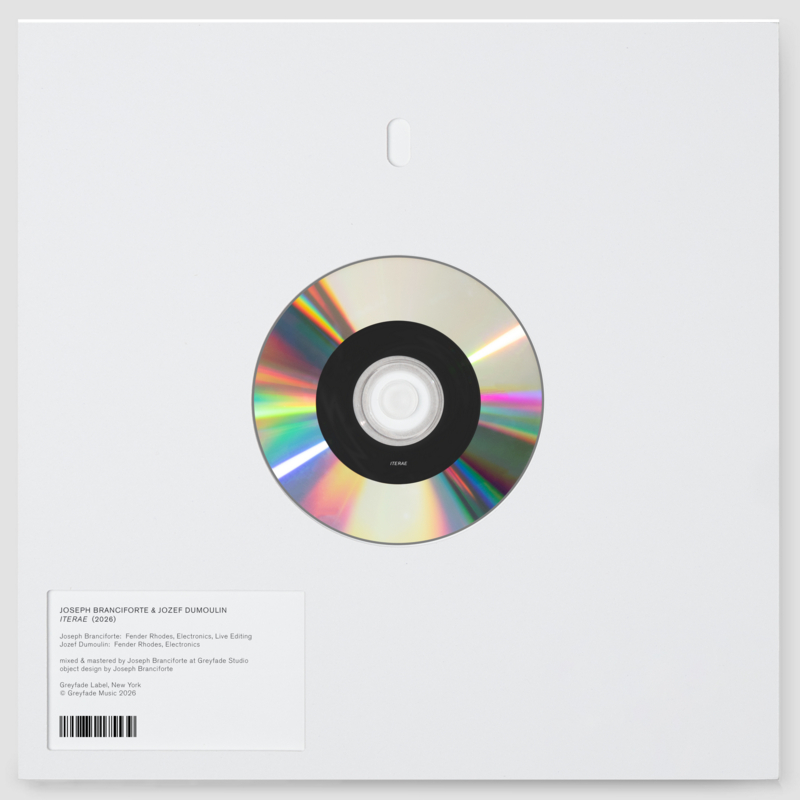
The raw material for ITERAE was created by the duo during a two-day period. Branciforte & Dumoulin both wielded Rhodes pianos and electronics simultaneously, live performance and live processing combining to create a complex sonic dialogue. The edited results of those improvisations are presented on ITERAE in what, from one perspective, is a sequence of two-part sections, the only track titles being symbols: ⊏ followed by ⊐, oscillating back and forth, cycling round and round: start, end, open, close.
Those binary titles suggest various connotations, but among other things in this context they indicate what can be thought of as complementary opposites. This is felt in the most fundamental aspect of ITERAE, multiple tensions that give rise to and permeate everything that we hear. The most significant and prevalent of these tensions can be heard in the work’s conception of movement, continually caught between stasis and progress. The former manifests in the repetitions and loops that are the music’s building blocks, like tessera assembled into sonic mosaics; the latter emerges in the shifting ways these are juxtaposed and transformed over time, together with our own precarious perception of both.
The opening of the second ‘⊏’ (i.e. track 3) is formed from icy slivers of glitch, their light, chuntering repetitions suffused with warmth emanating from a sustained (though implicitly looping) cloud of pitches. This immediately demonstrates some of ITERAE‘s other tensions, between cold and warm, and between pitched and non-pitched (glitched) elements. For several minutes assorted layers rotate on their (possibly shared) axis, while lower down, within the texture, something enigmatic, Rhodes material not directly complying with strict repetition, almost percussive, indicating a streak of freedom within the otherwise intricately controlled sound mechanism. This is another aspect of that primary stasis-progress tension, heard in rather gleeful glimpses of free-wheeling material that seem increasingly whimsical amidst this panoply of loops, cycles and grooves. And there’s yet another, around halfway through, roughly five minutes in: the music is pared back to a spasming chordal idea, delicately coloured by more of an implication of pitch than anything tangible. But it’s enough to soften things, such that, as it continues, the ear is pulled between perceiving things as active and busy, or relaxed and laid-back. It’s a fast-slow confusion that reaches it zenith a couple of minutes later, as soft notes materialise in the middleground, a layer of sonic bliss at the heart of various concentric bands of rhythmic jitter. This is one of several episodes on ITERAE where everything seems to become suspended, held in check, while continuing to burble along in an unpredictable, quasi-Brownian fashion. Progress or stasis; both and neither, the spell finally broken in the closing minute as more delicious moments of keyboard caprice emerge through the final loops.
That track’s counterpart, the second ‘⊐’ (track 4), tilts into a strange place where glitch becomes distant gunfire and pitch some kind of ominous deep shifting bedrock. It takes time, and passing through passages where things seem vague and confused, before we arrive at greater clarity. Whereafter, the pitch-glitch tension is expanded further, chord loops irregularly chug and pulse, behind strong, reverberant notes projecting shining melodic shapes. Despite the endemic sonic dirt (which almost seems a by-product of abrasion caused by all the hard-edged repetitions), the music continues to shine, dirt, pitch, glitch and noise all occupying the same space, repeating, progressing, cycling, evolving: circular and linear simultaneously.
Despite the iterative aspect of the work – from which its title clearly comes – and its permutational possibilities, to speak of one track, or one pair of tracks, is not to speak of all tracks or pairs of tracks. They operate with impressive uniqueness, despite their obvious similarities of palette, idea and method. In the first ⊏ ⊐ pair (tracks 1 and 2), it’s particularly striking the way, halfway through ‘⊏’, the texture is reduced, as if the music had become utterly transfixed, almost a state of rapture. It’s a tone that persists into the ensuing ‘⊐’, where it leads to a ravishingly lovely extended episode of shimmering suspension, answered by periodic bass tones. This, in turn, is followed by the most miniature of ideas, a high falling tone that seems locked in, ever to fall – only to invert, ultimately defying the prevailing equilibrium.
In the last ⊏ ⊐ pair (tracks 7 and 8) the complexity of the soundworld is pushed hard. Another tension is heard first, ‘⊏’ teetering between the gentleness of the Rhodes and the sharp edge of glitch, whereupon the question of forward and stalled motion becomes immersive. As if to prevent those improvising melodic shapes from progressing, the sonic surroundings seem to close in, density increasing, blurring things into a surreal environment. Everything is askew, and as the Rhodes continues (or does it?), glitch coats the music more significantly, deeply etching its surface, and the texture explodes in a stunning paradox where nothing feels static, yet everything is constructed from a myriad tiny repetitions, cycles and loops. Bewildering and beautiful. ‘⊐’ eases off, leaning more into the possibility of freedom, though its melodic ideas recede into the background like so many half-forgotten memories, as glitch dances above. Things become defocused, turning like a mobile, all elements circling mesmerically while a soft motor seems to purr at the mechanism’s core. Yet another tension, between ostensibly passive and active sonic actions.
Extremes comes to the fore in the third ⊏ ⊐ pair (tracks 5 and 6), in such a way that they almost threaten to undo the liminal tensions pervading the album. Repetition is so often obfuscated, complicated and masked throughout ITERAE, but in this ‘⊏’, those perpetual iterations that construct almost everything we hear are boldly placed front and centre. A raw glitch loop, periodically challenged by a fragment of organ chord, is succeeded by others, a procession of starkly looping episodes that emphasise the extent to which nothing here has permanence. It’s quietly moving, the ephemerality of everything, fashioned into such exquisite forms of persistence. It might seem obsessive, but if anything it feels loving, an almost sensual desire to assemble these vestiges, off-cuts and remnants and linger on them, contemplate what momentary reality they had. It might seem grotesque – like the scientist making dead flesh twitch with electricity – but it’s the opposite: playful, balletic, elegant. And, at its close, surprisingly poignant as Rhodes chords ping and glance across the ongoing spasmodic texture, like a distorted recollection of song.
Its ‘⊐’ turns this inscrutable – maybe happy; maybe melancholic – and in so doing demonstrates another tension, between tangible ideas and mere scraps of potential, the Rhodes now becoming less substantial, submerging into the texture, embodying oblivion. Elsewhere things were surreal; here they’re a dream state, bobbing (trapped) in viscosity, the music’s hypnotic quality an unsettling parallel of its spell-like capture. Everything moves, nothing moves; details everywhere, details nowhere – after the most overtly looping track on the album we find ourselves in the opposite, the most completely nebulous. It seems half-imagined, half-real when traces of tones start to poke through. Softly clanging notes, a slowly-descending scale, intermittent bass throbs; from abject obscurity to this place of simple, gorgeous clarity, ending – as no other track on ITERAE does – with a period of necessary silence.
Released in April on Branciforte’s Greyfade label, ITERAE is available in a lavish, limited physical edition – music literally as a work of art – comprising the full-size CD and four mini-CDs mounted on a display board, as well as download.

