A few years ago i floated the idea among various friends and colleagues of bringing back the noble act of booing at concerts. i was surprised at the level of shock and alarm the suggestion provoked, and while i’m not going to get into the ins and outs of the various debates that took place, the end result was that i felt begrudgingly resigned to accept that the only suitable response was simply not to clap. i know, i know: so bold, so courageously honest and authentic, so … polite. Anyway, i was reflecting on this during the opening weekend at this year’s Huddersfield Contemporary Music Festival. i’ve been writing about HCMF every year since 2012, and i’ve never spent so much time at the festival not clapping. That being said, there was plenty to think about, and even, occasionally, to enjoy.
Notions of lament permeated the festival’s opening concert given by Ensemble Proton and Schola Heidelberg. In James Dillon’s case, though it was writ large in the work’s title – Lamentations: – and in his typically extensive programme note, it proved to be largely theoretical. The opening of the piece was certainly arresting, the voices embedded within, inseparable from, the ensemble texture. In the second section this was developed such that the voices seemed to be the source of the instrumental material. Perhaps their chords, gestures and filigree were saying what the voices weren’t (or couldn’t): elaborating, interpreting, contextualising.
Yet nagging doubts even from the opening section about the music’s neutrality, and its prevailing sense of stasis, grew and grew. Would i even be thinking about lament without that title telling me to? Perhaps the third section would have tipped me off: bass-heavy, slow, dark, unclear, internal(ised). Its immediacy felt palpable, yet as the music receded to expose the singers, the fact that everything they did throughout the work came across as merely a collection of vowels and consonants devoid of obvious meaning, felt overwhelmingly problematic. Dillon had opted (in typical fashion) to assemble a collection of texts and then shuffle through them – “dissevered, mixed and folded into each other” as he put it. Fair enough, all very contemporary and on brand, but while words have meaning, they’re not magic; this wasn’t a spell or a charm or an incantation or a prayer (all empty actions in any case). The mere fact that a fragmentary syllable or a phoneme originates in something emotionally-charged doesn’t bestow on it anything at all from that point of origin. What does a single tessera say about the whole mosaic? Maybe Dillon believes otherwise, and was aiming for some kind of mystical “homeopathic music”, the lost essence impossibly permeating the whole. But homeopathy is nonsense, and likewise, literally, in Dillon’s case: the singers opened and closed their mouths, made sounds, fell silent – they could have been singing anything, it made no difference. By the end i realised the same could be said for the ensemble’s music, by now flat, formless, flaccid – did any of it mean anything? Nothing sounded compelling, unequivocal, necessary, urgent – all the qualities that one would normally expect to find in Dillon’s music in abundance.
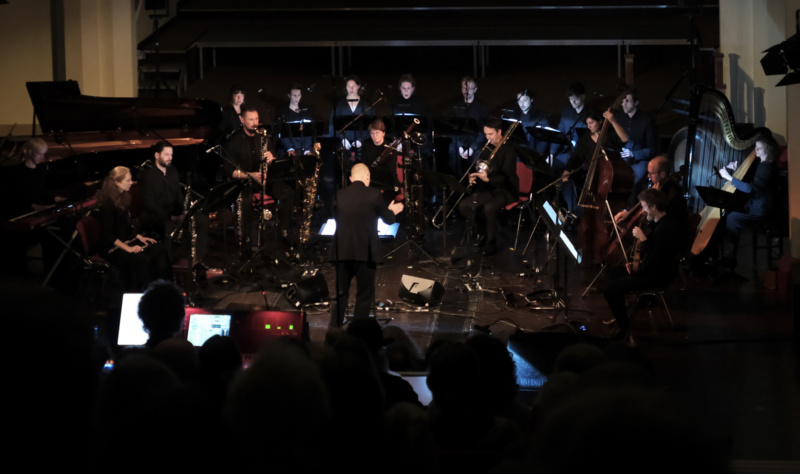
broken place, opening, by Naomi Pinnock, was in many ways the opposite. Her music often has an abstract quality; not exactly dispassionate, but a combination of austerity and composure that avoids overt emotional charge. So i was powerfully struck by the bleakness of broken place, opening, which felt anything but abstract. In contrast to Dillon, here was a distinct, individual and above all real mode of lament, where sounds sagged, sometimes passively falling, elsewhere seeming to be actively pulled, and where notes sat adjacent without a convincing sense of connection. The formation of chords was an interesting counterpoint, the ensemble instantly grouping into strange, dense, trudging formations. The chords turned icy, their pitches negatively charged particles, and in due course resembled a slow rocking, as if the ensemble were trying to console themselves, or Pinnock, or us. And on further still, moving beyond, below, a dislocated music, progressions out of joint, out of sync, out of time. All of which made the work’s coda, higher and faster, continuing to sag, feel unreal and dream-like, like a doomed aspiration.
At the first performance of Gregor Kulla’s whatevergirl (at this year’s Estonian Music Days), i don’t remember a drum being involved. However, on this occasion, in Quatuor Bozzini’s Saturday lunchtime concert, Kulla himself occasionally played soft rolls and strikes on a tenor drum, which felt intrusive and distracting. Whereas previously the work had sounded white-hot, like sound being (re)formed in real time before our ears, now the drum took on the impression of an outside influence demarcating the hitherto fluid structure, and acting as a fixed focal point to which the quartet’s transformations now seemed both in relation and in response. It hardly turned whatevergirl into a bad piece, but the change was unhelpful and unnecessary, and in all important respects diminished the raw power it had demonstrated at its première.
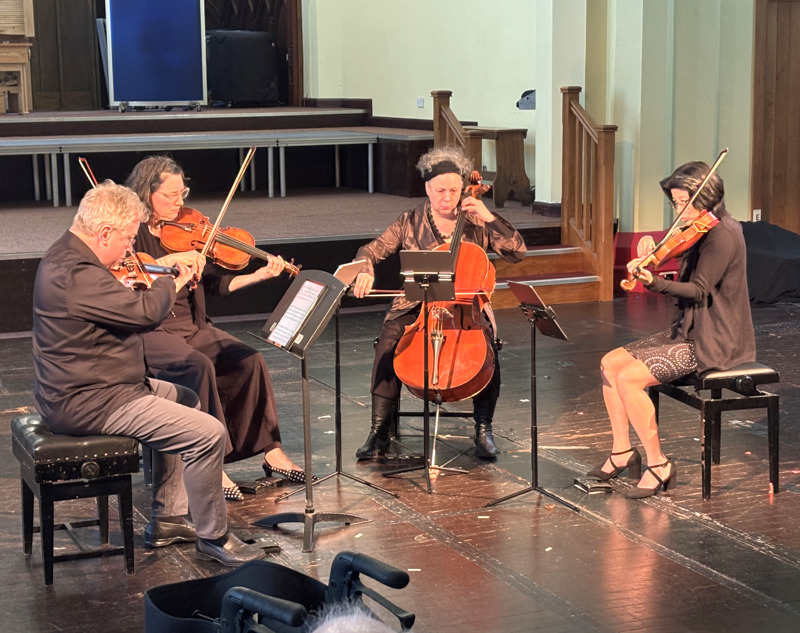
The only other work of interest in the Bozzini’s concert came in Lithuanian Egidija Medekšaitė‘s Megh Malhar. A simple, lovely exercise in understatement, it unfolded as soft, ambient, diaphanous, diatonic sustained tones, like listening to the imagined sound of filtered light, dappled, calm, occasionally rippling, trilling, and finally trembling, triggering an unexpectedly edgy final swell.
More challenging music came in a concert given by two duos, Electric Circus (Freya Goldmark, Sarah Watts and Xenia Pestova Bennett) and Juno 3 (Han-Earl Park, Lara Jones and Pat Thomas), focusing on Irish composers. The concept (gimmick?) was on a mash-up of notated and improvised elements, which in Peter O’Doherty‘s Cartographies of Resistance VI (Gloss) had a strikingly sinuous, circular quality. It was highly immersive, mesmerising even, pulling us in in a way that felt like they were the charmer and we the snake. Rob Casey‘s Waylines nicely disrupted perceptions of cohesion between the players. To the left, Electric Circus, sounding a bit like Messiaen’s ‘Danse de la fureur’; to the right, Juno 3, popping like electronic fireworks and short circuits. But in no time everyone diversified, becoming closer to a sextet of individuals all playing in parallel. Yet it didn’t feel remotely disorienting being constantly pulled between the voices, becoming even more fascinating as Electric Circus reunited to start anew, then tilting the other way in a lengthy electronic-only coda.
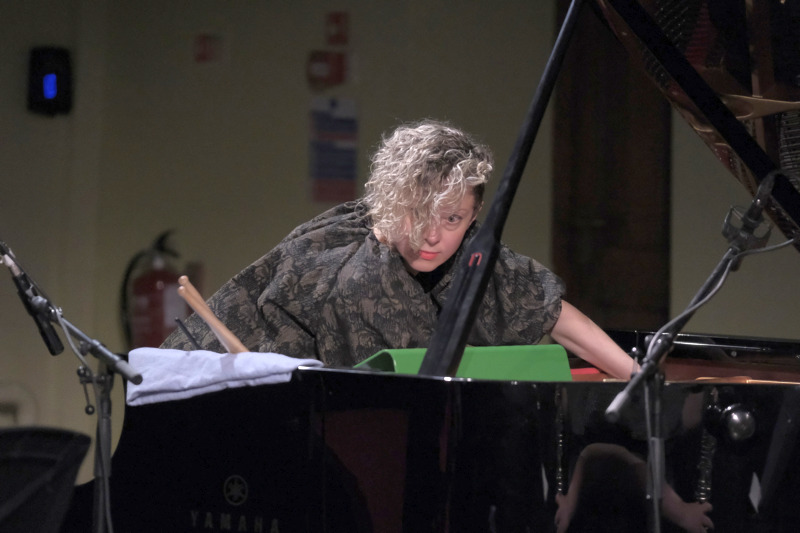
The most successful of the three Irish works was ±6° by Ailís Ní Ríain. Now the relationship between the players felt more like a battle of the bands, intense and forceful, hugely volatile. Yet many elements seemed unifying, almost like navigational aids – a pattern, a sustained pitch, a timbre – receding into the texture or transforming once we had locked onto it. Ní Ríain also played extensively with group cohesion, creating a palpable tension between 1×6, 2×3 and 6×1, at the same time moving fluidly between density and relief, acoustic and electronic. Utterly gripping, irresistible stuff.
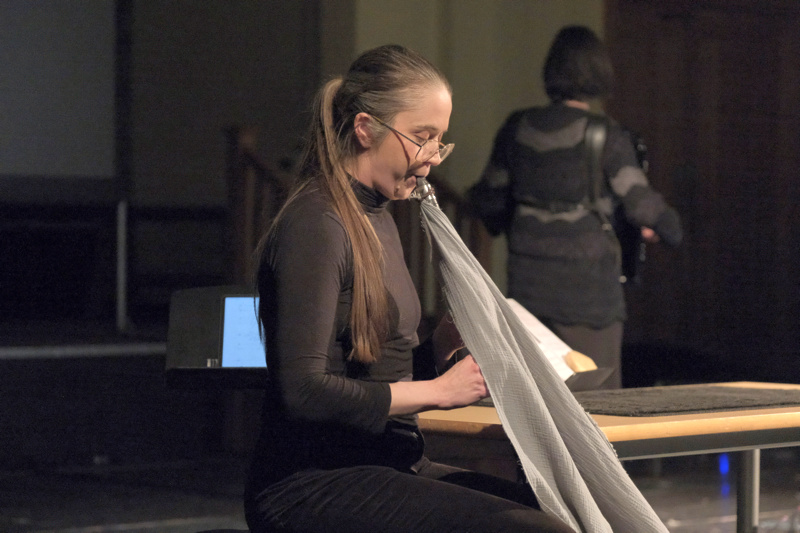
My relationship with Finnish composer Lauri Supponen’s music feels like my relationship with a cryptic crossword puzzle; i can read the clues, but can’t easily parse them, and i certainly can’t solve them. This feels all the more beguiling as the materials in his work often have a disarming simplicity, as they did here, in the first performance of east by the Zöllner-Roche Duo. His work is never remotely boring – quite the opposite! – and east had a mysterious, semi-theatrical opening, the duo both draped in fabric, from which they seemed to need to get free. Yet for now at least, i dismally have to admit defeat; either i’m trying too hard, or not hard enough.
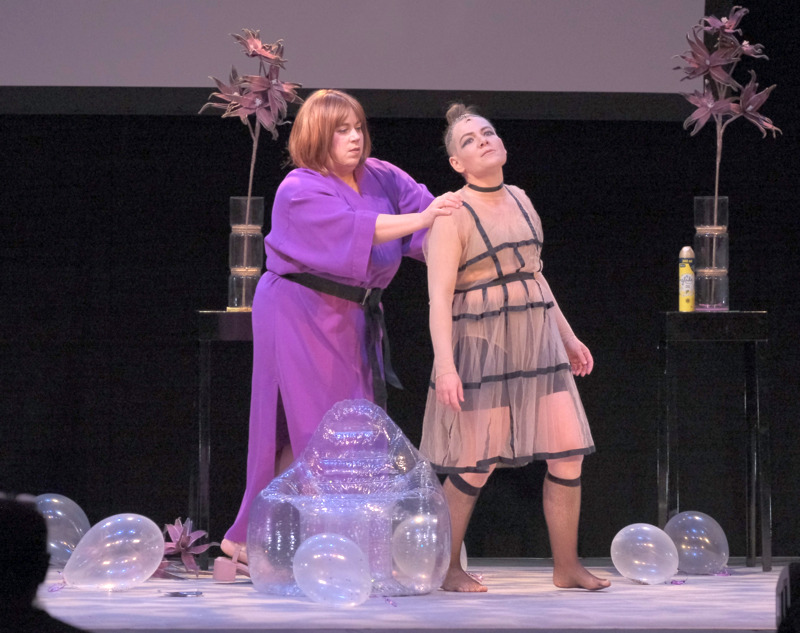
Also from Finland, and altogether more direct, was Heinz-Juhani Hofmann‘s electroacoustic opera Myself/Myself/Myself. Hofmann’s focus for many years has been on the most challenging aspects of life and relationships, and that was overwhelmingly the case here. An electrified psychodrama exploring the psychology of a young woman trying to find her place and identity in the modern world, it was stunningly embodied by Annika Fuhrmann as Didi, caught between a desire to embrace and reject the love of her mother (played with real sensitivity by Pauliina Palo). Fuhrmann flitted between sprechstimme, speech and song, articulating a musical language that felt all the more authentic for being so fractured and unstable – indeed, often entirely absent. In the same way, the electronics reinforced her with real weight, and as such often felt less like a distinct element than something emanating from and modulated by her voice, which only heightened the intensity. The work’s occasional moments of clarity – particularly an unexpected aria half way through, Hofmann hinting at a Bach-like accompaniment figure – had enormous power, both in the way they brought lyricality to Didi’s immense emotional turmoil, but more in the way they offered brief, focused respites from the scattershot viciousness and violence that was her primary mode of expression. This was the first part of a trilogy, and while i’m keen to experience where it goes next, Myself/Myself/Myself suggests Didi’s future could be bleak.
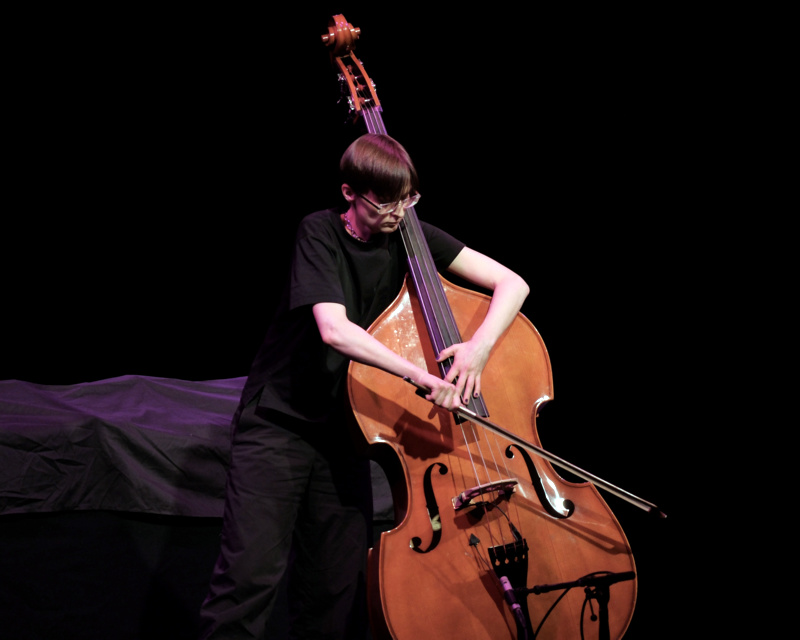
There was a mesmerising solo performance from Kris Kuldkepp, who gave the first performance of her Morphology for Loving Ears. At first she seemed small within the large space of Bates Mill Blending Shed, but she filled it entirely. From semi-focused drone work, the soundworld Kuldkepp created soon became precarious. Deep tones often dropped out, leaving the music thin, her double bass’s material (which had never stopped) barely emerging from the noise floor, implied more than present. She took us into a deep, reverberant place, where pitches floated and rebounded off its invisible sides, reducing the intensity until everything was polarised, dark depth with a high overtone like a fixed star shining far above. Whereupon Kuldkepp moved from delicacy to ferocity. The former: soft fragments, glissando sighs, jagged shapes sounding oddly lyrical, stabilised with gentle noise and hints of bass. And then the latter: emphatic ricochets like drums, answered by bow swishes like a flapping flock of birds, roaring into a wall of rumble, seemingly modulated by Kuldkepp’s bow, sawing and sliding hypnotically, the enormity of the music suggesting Bates Mill might actually split open. Yet she made everything solid evaporate, navigating into a gaseous atmosphere, purring and chirping sounds behind and to the sides, dancing arpeggios in front. Slowly we were grounded again in the reality of drones, high, low, grinding and granular. Spectacular. (And Kuldkepp has just released the work as a download on her Bandcamp.)
For me, the highlight of the HCMF opening weekend came on Saturday night in the Town Hall, at a concert given by Collegium Novum Zürich. In Zara Ali‘s Isolation Forest the relationship between the music on stage and what was coming from the speakers was curious: were they rivals? alternates? Another strange aspect was that it felt difficult to grasp whether the music was volatile or highly controlled. Ravishing textures of multifaceted colour and timbre were punctuated by slab-like monoliths of bell-bass resonance, and the work took on an ambiguous character, simultaneously playful yet focused. It became increasingly clear that Ali wasn’t concerned with mere gloss or surface excitement, but that there was a deeper trajectory determining things. Not without surprises, though; there were some wonderfully unpredictable moments along the way, the most dramatic being a final plunge into literal total darkness, to be surrounded by birdsong and electronics.
The most exhilarating music of all came in Michael Wertmüller’s aptly named The Exaggeration. From the outset, an engrossing interplay of extensive, irregular, punchy rhythmic sequences – the actual pitches often seeming arbitrary, but who cares? These were regularly broken up by numerous soloistic asides and intricate contrapuntal episodes, mixing highly metric and free-wheeling materials, both united and quasi-chaotic. It meant what it was, end of – and it was marvellous to be in the thick of it. Was it too long? Maybe it was – or maybe that’s an exaggeration. Unlike most of the rest of the music we were subjected to during this opening weekend (from Cassandra Miller and Gerald Barry and Julie Zhu and Martin Rane Bauck and Arturas Bumšteinas, none of which is worth talking about, let alone listening to in the first place), The Exaggeration was not a puzzle or a game or an abstraction, or portentous or simplistic or polite or timid. Raw and tumultuous, absolute and alive – pure music. What a complete and utter thrill.