
There’s a deep, tragic irony in the title of Breton musician Emilie Quinquis’ latest album. Eor means ‘anchor’, suggesting not just water and depths, but security and immovability. Yet its eight tracks are a dark sequence continually articulating wistfulness, uncertainty and loss. Its initial sounds, in opening track ‘Inkanuko’ (desire) hint at what’s to come: electronics and breath, cold and warmth; slow beats, somewhat heavy, yet accompanying lyrics that speak of stars and a blaze. The Breton lyrics mingle with Zulu at its centre (duetting with Desire Maria), making for a heady admixture. Heartfelt but low-key, and despite all the positive buzzwords – sparks, joy, heart, upstream, new lease of life, spring, hope – it’s curiously equivocal, even downcast; desire from a distance, love from the past.
Whereafter the album progresses through a series of reminiscences that bring ever greater clarity to just how un-anchored the narrator has become. ‘The tumbling point’ plunges into poignancy, recalling outdoor intimacy, walking cliffs together, described in a way that’s constantly precarious and paradoxical, where tumbling and falling are adjacent to “Leaning on the air” and flying. Meanwhile, in a sign of not just things to come but the ultimate destination of Eor, “the seas” seems to exert an uncanny gravitational pull. Appropriately, lightness and heaviness move together in this song, gentle vocals alongside arpeggios (which characterise most of the songs on this album) and beats that have an ever-so-slightly disquieting punchiness.
The sea makes its presence felt more in ‘Blaz an holen’ (the taste of salt), the music pared back, now breathy and beatless, the pulse more about passively keeping time than actively propelling it. A happier song, with a lighter touch, it takes us into the album’s first half coda, ‘Distro’ (come back), where things start to unravel fast. Slow arpeggios underpin achingly tactile words that memorialise close physical intimacy, with, ominously, “The sea twinkling”. The middle 8’s simple synth elaboration is melancholic, and the harmonies can do nothing but tilt side to side, as Quinquis laments how “softness” and “warmth” are now gone, at the same time continuing to search for truth as the song sags into low register weight: “Tell me, where were we going / When you were disappearing”.
There’s a dual shock from second half opener ‘Dec’h’ (yesterday), which paints a stark portrait of then and now. First, there’s a power, confidence and above all drive in the music hitherto absent. Second, is the way the music thereby glories in the happy past tense before unexpectedly slamming into the final verse’s present day buffers: “Leave me in peace … Stay away from me / I won’t go dancing … Go away”. In this middle 8, the synths are redolent of an electric guitar solo, seeming like so much keening, and Quinquis’ delivery is as if through gritted teeth, with even a hint of malevolence.
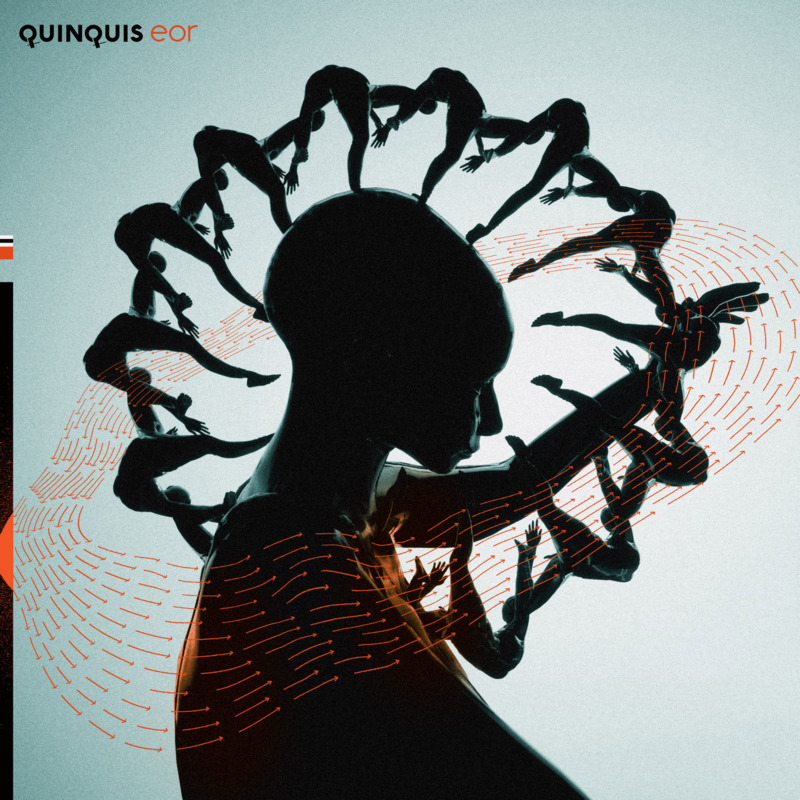
The final three tracks form their own continuity within the album’s overall interconnected narrative. In ‘Morwreg’ (mermaid) the narrator feels herself to be doubly separated from the object of her desire – sea versus land, creature versus human – and her breathy delivery is riddled with uncertainties, “Do you want me still? / Do you love me?” The track summons up something of the upbeat strength from ‘Dec’h’, but here it comes to feel like a red herring, going round and round in circles (echoing part of the cover artwork) rather than actually moving forward. Quinquis’ vocals are reduced, become fluttering, and by now the underlying beats have a distinct air of desperation. This aquatic allusion turns more literal in penultimate track ‘Peñseidi’ (shipwrecked people). At this stage it feels like she’s getting stuck in an emotional and musical rut: arpeggios stronger than ever, breathy vocals, tilting harmony. It’s an almost literal treading water, climaxing in total breakdown, “our kisses … disintegrating in the water.” That innocuous word, “our”, is interesting; ‘Peñseidi’ uses it extensively (in the English translation almost every line begins with it), extending the sense of loss from the other also to the self: “Our anchor is unhooked / Our compass is broken / We’re sent out of the harbour / Towards the open sea / We’re shipwrecked people”.
In this way, ‘Peñseidi’ doesn’t just look back, but also ahead, foreshadowing the final loss that brings Eor to an end. Despite bracketing the two of them together, their respective disappearing acts could not be more utterly separate. Hers is a reaction to his. The anchor may be unhooked, yet closing track ‘Aet on’ (I’ve gone) sounds as if in an immobile daze. Shorn of beats and melodies, all those hitherto acrobatic arpeggios now fixed as an uncomfortably oppressive buzzing drone, the song is driven by memories rather than music. It’s a litany of broken fragments of recollection, wishing the past into the present, yet now, for the first time on the album, projecting on into the future, ending with a bald, broken statement of intent: “I’ve gone / After him / And I’ll never / Come back”. It’s a heartbreaking testament to the extent to which desire and memory can be maddening, destructive forces. Yet, just as Eor opened with a kind of fatalistic take on hope, so it also ends. But hope is still hope, impelled here by an indefatigable, immovable love.
Released by Mute, Eor is available on CD, vinyl and download.

