

Something i haven’t drawn attention to in this Lent Series is the fact that almost every album i’ve explored has been a debut. It’s the case with Suicide, Sakamoto, P-Model, Human League, Leer & Rental, Der Plan and Fad Gadget. John Foxx and Bill Nelson’s Red Noise clearly pick up on musical threads from earlier groups (Ultravox and Be-Bop Deluxe respectively), but in both cases they’re a wholesale sonic and aesthetic overhaul. And while Cabaret Voltaire’s 1974–76 wasn’t their debut, the material it contains predates the few albums they had released by that point, so it functions in essentially the same way. This isn’t insignificant. It highlights the degree to which a first album has extensive freedom, can act as a genuine blank page, a testing ground, a place where experiments can be carried out, prototypes made, imagination running riot without restriction. That’s true even at the most stable of times, but during this particularly liminal period i’ve been exploring, 1977–81, when electronics were causing a fundamental shift in how musicians conceived and executed their ideas, it caused debut work to become all the more radically inventive. Apropos.
At the start of this Lent Series, i said that it didn’t take long to realise which album should come first. Likewise last. Liaisons Dangereuses was a band comprised of instrumentalists Chrislo Haas (of both DAF and Der Plan) and Beate Bartel (of Einstürzende Neubauten), with vocalist Krishna Goineau. Haas and Bartel were both German, while Goineau was born in Sri Lanka to German and French parents, living in France and Spain before settling in Germany. This is directly relevant to what was not only the group’s self-titled debut album, but the only album they ever released. In choosing the name Liaisons Dangereuses, they immediately tapped into connotations of decadence, manipulation, strategy, power games, and emotional cruelty. These themes certainly populate Liaisons Dangereuses, articulated primarily in French, and once in Spanish. The choice of language (one of Goineau’s mother tongues, of course) is interesting from the perspective of distancing their work from the German dominance of Kraftwerk, and the otherwise prevalence of English. In one sense, it’s a pose (appropriately French), yet it’s also part of positioning themselves obliquely adjacent to what was happening at the time.
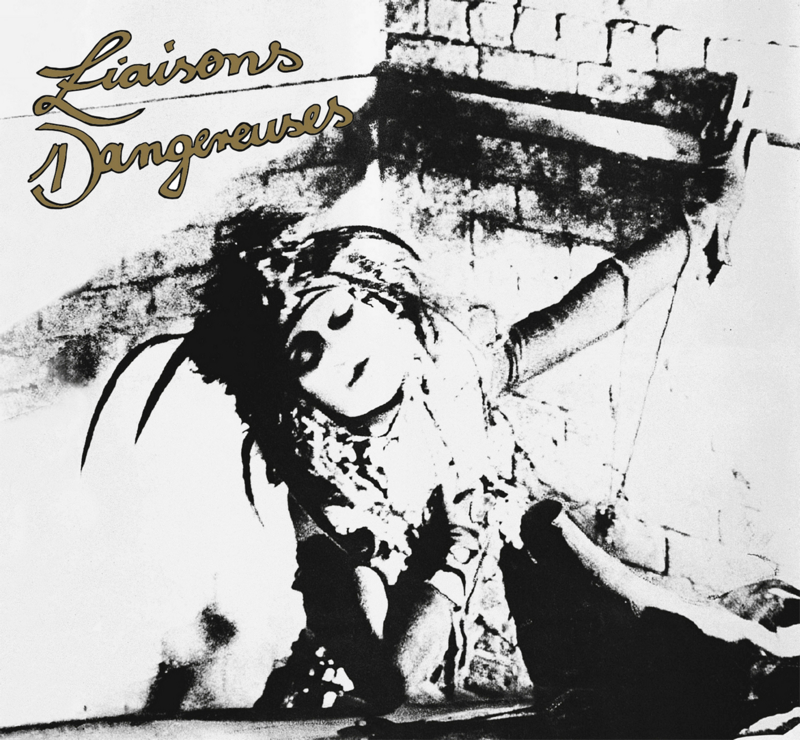
In many ways, Liaisons Dangereuses takes us back to a new iteration of the sonic place where this Lent Series began. Suicide’s self-titled debut is defined by its stripped-back limitations – beats, bass, vocals – working together to form a transcendent form of repetitive focus, with the intensity of a laser. Liaisons Dangereuses demonstrates a very similar aesthetic, though working to somewhat different ends and expanding the sonic range ever so slightly, to equally powerful effect.
The paradigm is established in opening track ‘Mystère Dans Le Brouillard’ [mystery in the fog]: steady, unwavering beats; a basic bassline that occasionally tilts; halting, somewhat breathless vocals (here and elsewhere, Goineau is periodically joined by his sister Joanna) articulating repeated phrases. All very stark, all very Suicide. Embellishment, like everything else, is minimal, electronic motes glitter over everything – “Ce n’est peut-être que la lueur d’un feu follet” [it may just be the glow of a will-o’-the-wisp] – but bursts of noise start to take over. This is more than just repetition, there’s a dramatic shift taking place, and while the music continues seemingly unaffected or indifferent, by the end everything has been swallowed up and obliterated in noise.
Several of the songs on Liaisons Dangereuses emphasise radical restriction. One of their best-known tracks, ‘Los Niños Del Parque’ [the children of the park] – a one-off excursion into Spanish – forms a sharp polarisation between the relentlessness of the beats and bass, aligned with Goineau’s rhythmic, dead-pan exploration of children’s ostensible innocence, and Joanna’s wildly playful shouts and squeals. Strict regularity versus boisterous unpredictability, entirely appropriate considering the subject matter.
‘Kess kill fé show’ (say it out loud: Qu’est-ce qu’il fait chaud [it’s so hot]) is similarly polarised; though the pulse is moderate, it’s a clear opposite to Goineau’s heightened, fraught vocals: “Comme dans une jungle / Ont est perdus / C’est vraiment terrible” [like in a jungle / we are lost / it’s really terrible]. An ominous bass motif cycles round, having the effect of increasing the intensity, like a wall closing in. The track is like a window into something bigger and more terrible, suggested by increased ferocity and noise toward the end. Most pared back of all is ‘El macho y la nena’, begun with a burst of laughter that perhaps tells us everything we need to know. Four minutes of mesmerising rapidity ensue, with snarling, fixated, hard-to-parse lyrics – seemingly a bizarre back-and-forth between the titular man and woman – caught in an endless loop.
Liaisons Dangereuses is especially celebrated for the innovative, pounding electronica that forms the foundation of many of its songs. In ‘Etre Assis Ou Danser’ [sitting or dancing] it’s gloriously in keeping with the narrative, recounting “l’histoire d’un garçon / Qui ne pouvait pas arrêter de danser” [the story of a boy / who couldn’t stop dancing]. Driving, highly charged beats and bass (always inseparable) are the endless momentum for the tale, with Joanna’s usual counterpoint role here taken by an incensed saxophone part that similarly squeals and waxes in response. Just when we think the “story” is never actually going to get going – Goineau just announcing it again and again – it nonchalantly leaps to the end: “Il finit par crever” [he finally kicked the bucket], whereupon the sax really lets rip. We’re left to wonder whether there’s a connection between dancing and death, and whether this has all been a danse macabre.
Though it’s something of a vignette, the propulsion of ‘Etre Assis Ou Danser’, as with Suicide, serves also as an indicator of the importance of the story. It may be succinct, simple, spare, but that’s no reason not to take it seriously. The same can be said of ‘Peut Être … Pas’ [maybe … not] which, though it eases off slightly in pace, increases the punch factor. The beats are upright and pointed, a drone twanging in the middle, while the circling lyrics are concerned with the improbability of “Apercevoir de nouvelles couleurs
/ Avoir de nouvelles chances / Etre dur, avoir de nouveaux amants” [seeing new colours / having new opportunities / being tough, having new lovers]. The upbeat stance is in stark opposition to the dark isolation in the lyrics, contact reduced to “Parler avec son miroir” [talking with your mirror]. Some articulation of that comes in the points of deviation, one of which is occasional outbursts from the hitherto inconspicuous bass. But the primary outpouring comes from Joanna’s total opposite to Goineau, soaring above his matter-of-fact speech in an ever-increasing, soaring line. Her voice is superbly inscrutable: keening, elated, scared, frivolous, or perhaps just as remote as Goineau.
Liaisons Dangereuses are at their most radical where they take this fundamental blueprint of focused, locked-in repetition and manipulate it more radically to achieve emotionally-charged ends. ‘Apéritif De La Mort’ [aperitif of death] is one of the best examples of this. The beats are modulated to become akin to a racing heartbeat, surrounded by electronic pulses, noise elements, hovering pitches, scraping metal, adjacent clatter. It’s an astonishing, mesmerising soundworld, repetition neutralised here to form a dark, destabilised stasis. It’s the perfect context for Goineau’s voice, his lyrics narrative but paratactic, emerging like disjunct moments from the same long dissociative spiral being recollected at random. They amount to a loss of control in terms of movement (“Je vis dans une montagne russe” [I live on a roller coaster]), integrity (“Je suis un glaçon qui fond” [I am an ice cube melting away]), freedom (“Un boulet de prisonnier au pied” [a prisoner’s ball and chain on my feet]), solidity (“Une valise à double fond à la main” [a suitcase with a false bottom in my hand]), stability (“Un ascenseur qui monte et descend” [an elevator goes up and down]) and orientation (“Perdu dans un labyrinthe” [lost in a labyrinth]), while a Sword of Damocles hangs overhead (“Jouer à la roulette russe / Je bois l’apéritif de la mort” [playing Russian roulette / I drink the aperitif of death]). It’s noirish and claustrophobic, churning, terrifying, unchanging and inescapable, a closed loop, a sonic and lyric trap.
Occupying a different region of the same queasy soundworld is ‘Avant-après Mars’. Polarisation has here become stratification. The bass and beats are more powerfully punchy than ever; a weird, hovering razor buzz – a cross between a chainsaw, an aeroplane and the world’s largest wasp – flies continuously around; electronics periodically unleash bright bursts of blip-chatter; Goineau speaks, his vocals delivered in rapid-fire gabblings. Different layers, seemingly in parallel rather than interconnected. Yet their combined effect is just as destabilising as ‘Apéritif De La Mort’. As Goineau repeats lines from Nostradamus – words describing “a great king of terror” coming down from the sky in 1999 – as if he’s transfixed in a prophetic trance, we’re caught between that (at the time, futuristic) apocalypse, the beats-bassline combination urging us to dance, the ominous threat from the approaching saw blade, and the cheerfully meaningless output from the computer. We bounce between them all, upbeat and downbeat, uplifted and dragged down, but once again, totally unable to escape.
In a way not dissimilar to Units, words become like mantras or slogans on Liaisons Dangereuses, emotions, sentiments and observations reduced to a terse, concentrated essence. It’s perhaps surprising, then, that (again like Units), the album features an instrumental track. ‘Dupont’ takes the disorientation we’ve been experiencing and maximises it. A strange electronic world of sparse beats, repeating elements and erratic pitch intrusions, some of which click into the underlying pulse (such as it is) while others fizz, judder and sprawl off-grid. There’s an impression of sounds cycling though here the emphasis on repetition is reduced, the scope is larger, the elements more diverse, less predictable. Only the pulse and vestige of bassline are consistent, clear markers of regularity; everything else is as mysterious and exotic as its title – the French equivalent of the English surname Smith – is not. It brings to mind some of the surreal, lopsided music of Der Plan (particularly ‘Persisches Cowboy Golf’) but avoids their child-like handling of sounds as toys. This is adult, serious, sounding more like half-melted, malfunctioning Autechre than anything else.
The album ends with the title track, 102 off-kilter seconds that manage to sound quasi-stable yet somehow chaotic, perhaps resulting from Goineau’s curt commands: “Essaie de t’amuser / Ferme les yeux / Pense à quelque chose” [try to have fun / close your eyes / think of something]. There’s vague triumph in his delivery, each line its own flourish, both buoyed up and made stranger by the spasmodic pulse behind him. As if, at the final moment, to counter any concerns that might be brewing, he announces, “Pense à ta vie / Pense à ta mort / Liaisons dangereuses / N’essaie pas de me comprendre” [think about your life / think about your death / dangerous liaisons / don’t try to understand me] – and, having barely got going, the music crumbles and cuts.
Like Suicide, also like DAF (though, ironically, after Chrislo Haas had left the group), Liaisons Dangereuses gets its enormous charge from the precarious balance between neutrality and emotion, metric certainty and free-wheeling spontaneity. In some ways that encapsulates the essence of the challenge thrown down by electronics as they inveigled their way into the hitherto acoustic-only domain of rock and pop. Virtuosity, skill, rawness, warmth, heart, soul: all of these musical aspects and qualities were fundamentally challenged and irrevocably changed during this remarkable period, 1977–81. So many new voices were unheard, misunderstood, misrepresented, mocked, suspected and side-lined at this time. But change is always painful, traditions are stubborn things, and even the most ostensibly receptive minds can turn out to be staggeringly, stupidly closed.
In this Lent Series i’ve explored a dozen voices who, to differing degrees, managed to make themselves heard. All unique, all breathtakingly original, all making deeply significant contributions to a music that would not, and could not, ever be the same again.

