
It’s usually the case that my life-long love of dance music sits at not just a distance but a complete remove from pretty much everything i explore here on 5:4. So it’s been great to spend time with Hypatia, the latest album from Agnes Hvizdalek and Jakob Schneidewind. It’s been over a decade since the duo’s last release, Zakeri, in 2015. Back then they called themselves Demi Broxa, but for this new album they’ve become Pnø. That change is significant.
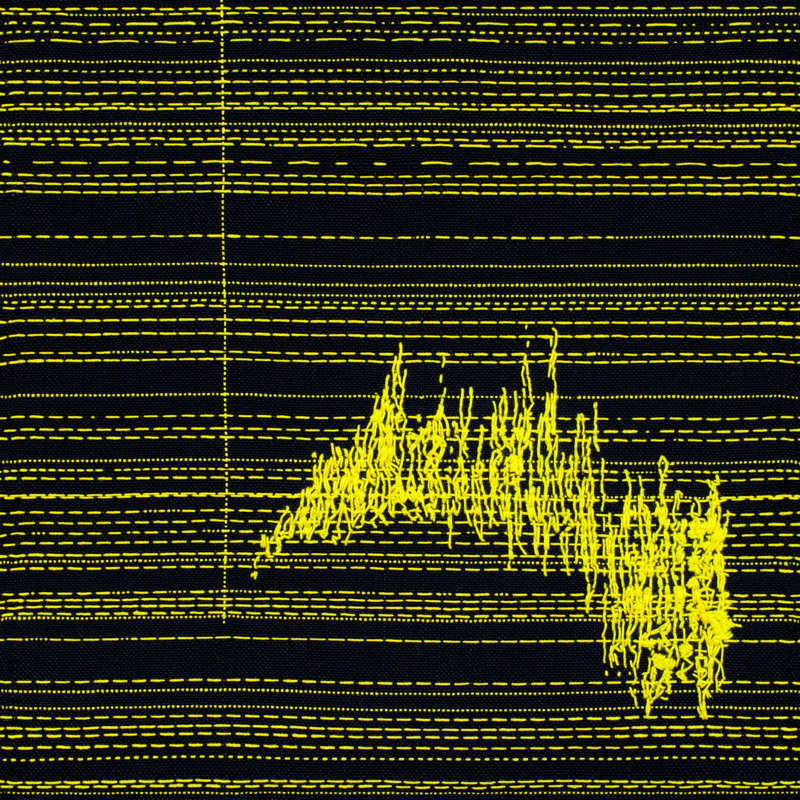
Hypatia is not an album with the same kind of exploratory spirit or experimental breadth as Zakeri. There, as Demi Broxa, things materialised and coalesced, they came into being spontaneously, often over extended periods of time. Within a generally atomised soundworld, the duo assembled granular elements into slowly-evolving, at times convoluted forms, shapes and textures. Hvizdalek was often indistinguishable from Schneidewind; voice and electronics both revelling in their equal abstraction. But this is Pnø, and this is not what Hypatia aspires to. More is taken for granted: the influence of dance music – more of an undercurrent than the driving force of Zakeri – is now the overt, highly tangible, primary aspect of the music, acting as both foil and complement to Hvizdalek’s again transcendently abstract vocal palette.
This polarisation plays directly into the duo’s respective preoccupations. Hvizdalek’s approach has always been that of a meta-vocalist, roaming the uncharted hinterlands beyond the limits of conventional singing. Both her solo and collaborative work – in this context, Backstage, Casa das Caldeiras and Strictly Akustik especially come to mind – repeatedly demonstrate how she becomes timbrally remote, simultaneously electronic and / or acoustic: human, animal, alien, machine. Not so much a singer as a signal generator. Whereas a focus on dance tropes has become a key feature in Schneidewind’s more recent work, in particular his 2021 solo EP, Beta, as well as his work with the live techno group Elektro Guzzi.
Yet despite the considerable shift in the duo’s creative mode, atomisation remains a crucial part of Pnø’s methodology, with much of the music concerned with and constructed from fragments that shape, fill and define textures, their grains and tessera flexing more than before in the process. The closest points of contact, and to an extent continuity, with Zakeri come when the beats are absent. Album opener ‘Due’ melds Hvizdalek’s close-miced voice into buzzing electronics. It’s a statement of intent, an archetype, a prototype, warm, strong and potent, ending in jittering pulses. In both ‘Reflex’ and ‘Nano’ voice and electronics become a seamless network of clicks, like exotic animal or insect calls. Though ostensibly relaxed, as it continues ‘Reflex’ increasingly feels taut and precise, given low-key intensity through a discreet, sporadic beat-bass presence. ‘Nano’ occupies the same habitat, though the bass now pummels periodically, like a mostly stable heartbeat, while sustained sung notes drift through the space around the creature-calls. ‘Row’ ramps up the rapidity of click language such that it forms pitches, the electronics mirroring this, giving the impression that the two are trying to come into focus or alignment. Hvizdalek asserts more, Schneidewind less, while powerful bass from below makes everything tense, electrified and radiant.
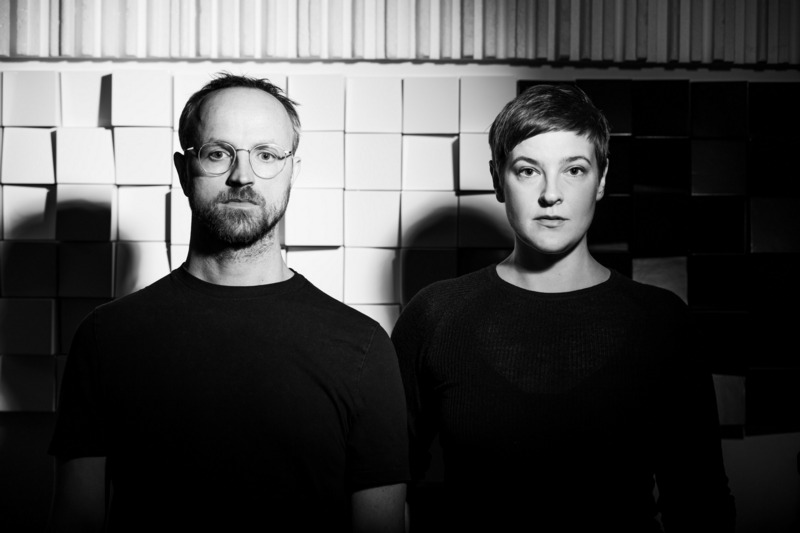
But these tracks arguably aren’t the point of Hypatia, they’re places of stasis and repose, interludes betwixt the main thrust of the album. Schneidewind’s beats define the landscape, pulsing grid structures channelling elements of dancefloor narrative. But this is no uplifting trance: Hvizdalek is by turns mouthpiece and passenger, less articulating than emitting streams of pulses, breaths, clicks and whispers, so microscopic they’re not merely sub-syllabic but sub-phonemic. There’s a lovely uncertainty in the way voice and electronics are balanced (if that’s the right word): from one perspective the beats’ fluency and flow seem in stark contrast to the vocals being apparently stuck in place, strangled by the attempt at utterance. Yet that’s based on a no doubt false assumption that there are implied words behind Hvizdalek’s output, and i’m not remotely convinced that’s true. A meta-vocalist will obviously speak a meta-language. From this perspective she becomes a playful, even frivolous addition to Schneidewind’s electronics. Dance music by aliens.
Several tracks sit in something of a middle ground between repose and propulsion. In ‘Aire’ the bass becomes akin to a didgeridoo, while the vocals contort above. Beats start up but everything is semi-static, dronal and fixed. ‘Rouge’ is similar, Hvizdalek’s meta-language now at the heart of more granular abstraction. When the beats get going they’re languid and leisurely, forming a cohesive parallel strand. In tracks like these the beats can feel, if not irrelevant, then certainly secondary, tactile but ephemeral, a kind of matter-of-fact opposite to the free-wheeling, pulseless vocalisations. Likewise ‘Tang’, where light, quasi-irregular rhythms chug almost absent-mindedly while Hvizdalek continues to ‘speak’, and the most (for want of a better word) melodious track ‘Last’, softly sung pitches hanging in the midst of a myriad grains, motes and droplets, over a solid but laid-back pulse.
But again, that’s not the point, not the main point anyway. ‘Muskat’ ramps up the techno, Hvizdalek’s presence moving between stretched out, in the process losing timbral focus, and full-on shape-shifting, going high and strange. This only fuels an early sense of euphoria – the dancefloor quintessence – though Schneidewind keeps it in check, and the vocals reform into gabbling distorted fragments as everything reduces. And nowhere on Hypatia is the intensity greater than in ‘Blender’, where the beats pound with firm solidity while also conveying a real sense of moving at speed. The voice, carried along by them, now becomes abstracted into a pitched percussive element embellishing the floor-stomping, at the same time sounding as if the sheer power of the beats has caused whatever pseudo-intelligible words Hvizdalek might be enunciating to be ripped apart into shards and shreds.
Released in June on Palazzo Recordings, Hypatia is available on vinyl and download.

