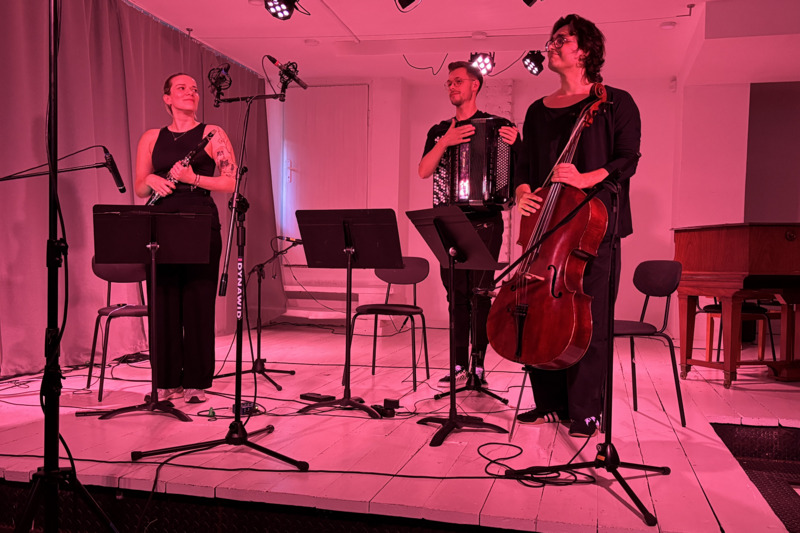
There was impressive music to be heard in some of Warsaw Autumn’s less prominent events. The Polish Composers’ Union hosted a small-scale concert in Warsaw’s Hashtag Lab showcasing the three winners of this year’s Zygmunt Mycielski Composition Competition. Performed by Trio/Duo/Unum (who might have made up their name for the occasion, but they should definitely stick with it), comprising clarinet, accordion and cello, the prize winners used these instruments in different permutations. Katarzyna Chlebek‘s Sharp objects, for clarinet, accordion, cello and tape (2nd prize), was a work characterised by drone from the tape and rapid gestural activity from the players, with a voice talking about the titular objects (“sharp objects are sharp by definition…”). It all felt behaviourally static, stuck even, until a point later when pitch disappeared completely, leaving just the noise of hands and keys. In Nikodem Kluczyński‘s cello solo Mad Dog or Cello music (3rd prize), we heard what seemed like an intense, almost hyperlyrical stream of consciousness, more and more insistent (or should that be dogged?). A few moments of reflection were allowed, before the work pushed off again, if anything even more relentless than before, in music limited in terms of material but not in terms of propulsion.
First prize went to Aperture, a work for clarinet, accordion, cello and electronics by Dominik Radoń, and the jury had clearly got it right. At first: everything in close proximity, high sustained tones, soft, slow. A simple start but the music felt unusual as it continued, growing in momentum, becoming frantic, but in a way that sounded demonstrably abstract, not emotionally charged. It seemed all about shape, juxtaposition, repetition and the like rather than some underlying ‘drama’, which actually made it more compelling. Radoń eased this later (widened the ‘aperture’?), the instruments becoming conversational, sharing and swapping ideas before unexpectedly polarising to registral extremes.
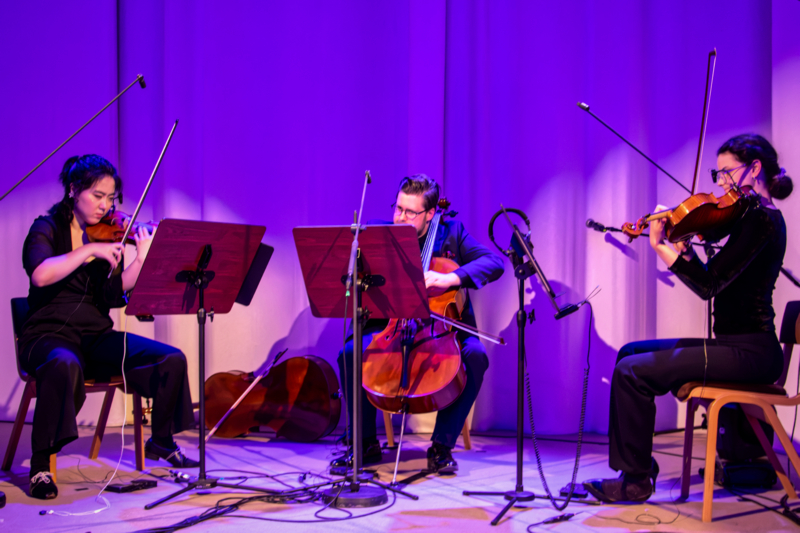
Monday afternoon brought the final concert of an initiative called Collectif4Composers, mentored by Agata Zubel and writing for the Fibonacci String Trio. While the majority of the premièred works lacked strongly memorable ideas, a couple had more going for them. Po Hang Yuen‘s Dàn_III. was built upon ricochets, a constantly moving foundation over which short gestures played out. What made it compelling was the way it toyed with (un)certainty, the cello gradually emerging from textural emphasis, seeming to be driving toward something tangible. But it wasn’t a simple progression from A to B, and by the end things remained playfully open.
Best by far was Tomasz Podubiński‘s my liver bones and you (ii), a piece worthy of being featured in the main Warsaw Autumn programme. This was honestly one of the most riveting works i heard during my weekend at the festival, and proved once again how often the most outstanding music is to be found in fringe events. The music was just wonderfully strange: pitch, timbre, register, phrasing, all seemingly turned fluid, occasionally embellished with soft whispered words from the players. The result sounded at once beautiful and unfathomable – almost as if speech had been converted into music – becoming one of those pieces where i found it was impossible (too distracting) to watch the performers, but had to just listen. It became the most sonically complex amalgam of three distinct elements – violin, viola, cello – somehow forming a cohesive yet disorienting composite music. At times it was like a rudimentary conversation, the trio taking it in turns to suggest sounds in the ongoing fabric. It was never less than absolutely engrossing, everything in flux all the time, with even the nature of the vocal sounds unpredictable and never clean. Scordatura came to the fore at the end, in a mesmerising sequence of open string notes like deep growls. A piece i simply cannot wait to hear again, and which, considering that tantalising “(ii)” in the title, left me super-keen to hear the previous instalment.
The outstanding event of the opening weekend came at the Nowy Teatr on Saturday evening, in a concert given by Hashtag Ensemble conducted by Lilianna Krych. The five works they performed were sonically connected in part due to the way they explored different forms of slow-moving material. Oskar Tomala‘s everything can be seen through the prism of was the one disappointment. Resurrecting the soundworld of Jóhann Jóhannsson, while it began like stepping into a dream – warm triadic invocations suggesting traces of something lingering – it squandered its promise by simply shifting in and out of focus again and again. The result was simply boring and overlong; Tomala clearly had way too much faith in how interesting this material actually was. Stefan Prins‘ I’m your body, as its title suggests, conveyed an intense sense of physicality through its assortment of pushing, rubbing, blowing and stroking actions. Its wonderfully involving, complex textures often seemed disarmingly simple, the strangeness of the timbres, juxtapositions and techniques making them appear more difficult to parse than they really were. They became increasingly defined, concrete, the ensemble working (or trying to work) together to create … what? – something nascent but urgent, a flailing, ferocious act of raw expression. It was hard to know whether the electronics were dominant, an outside force taking over, bringing order, or disrupting it or redefining it. Fascinating music from start to finish.
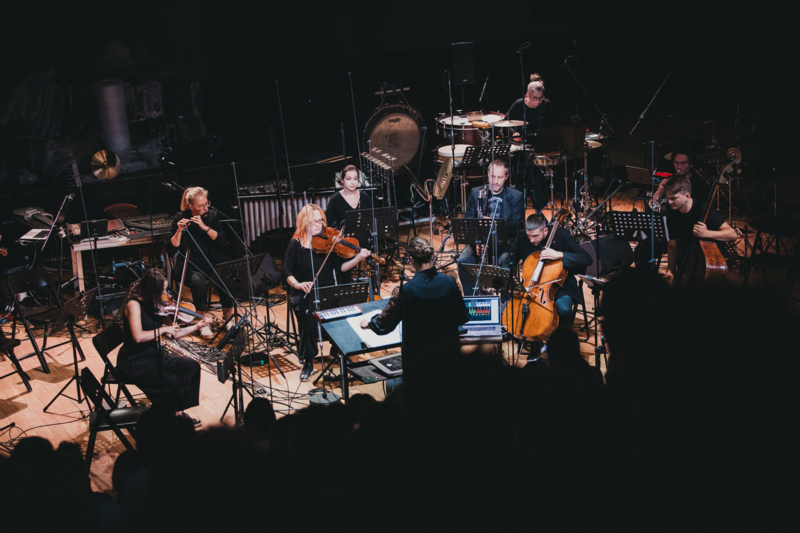
In Ask the Frozen Lark Belarussian composer Andrew Evdokimov set up an energetic granular texture within which more elements were added. And then rhythm coursed through it too, creating a powerful tension with the ongoing noise. The continual fluctuations resulting from this were the basis of the music, passing through periods of uncertainty, reducing to skittering sounds, surging to a tutti frenzy (more entertaining than thrilling) that ostentatiously sagged after, somehow ending up in soft radiance. Sara Glojnarić‘s Pure Bliss seemed to immediately topple into something extant but in a confused or complicated state. The music more and more appeared to be like something deconstructed – or should that be reconstructed? or recreated? There were suggestions of laid-back, languid tropes, balmy and whoozy, yet digitalised, as if the titular bliss were made from data: synthetic? virtual?. Yet the instruments kept (or made) it real, becoming a glorious blur, momentarily focused but skidding sideways into unfocus, now a rather beautiful, sustained harmonic mess, two or three steps removed from any notion of clarity.
Most potent of all was Presence for zither, string quintet and electronics by Aleksandra Słyż. Unlike Tomala, its slowly-shifting sustained texture was not allusive, not reaching to the past and relying on tropes of memory, comfort and emotion. Instead it was a language of cool abstraction – evoking not invoking, stating not quoting – and, remarkably, over time it stopped sounding like a sonic presence within the Nowy Teatr, and seemed to become a space itself. With resonances spontaneously emerging and arising all around, it was like a force field manifesting as frequency bands, defining its own form via an architecture of energy remnants, reverberating and ringing like the overtones of half-forgotten bells. Perhaps that makes it sound too ethereal – it was earthy too, rooted, grounded, although in practice had the physicality of gossamer, beyond notions of earth and sky. Its conclusion was semi-scrutable magic, its chord pausing and restarting like a drawn-out “end”, suggesting an oblique connection to something that once, long ago, had been tangible.
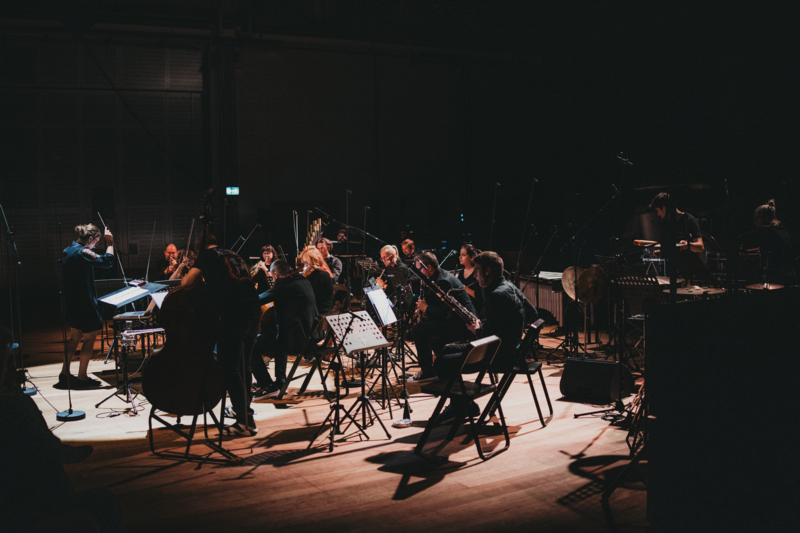
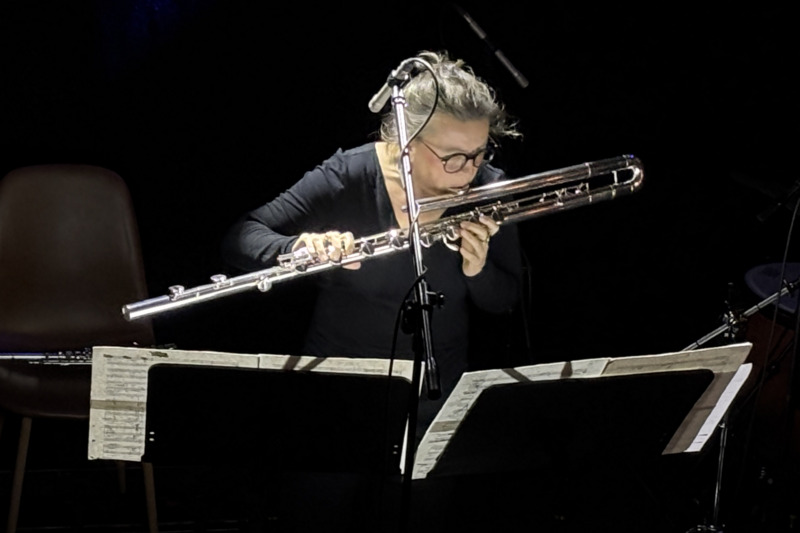
A more low-key event, but a personal highlight of Warsaw Autumn 2026, came late on Saturday evening, in the bar space of Pardon, To Tu. It was here that flautist Beatrix Wagner performed three works, opening with Bruno Maderna‘s 1958 Musica su due dimensioni for flute and tape. The piece felt more than usually tantalising, the flute as the main lyrical voice, and the tape: echo? alternate? antagonist? Over time the tape seemed to be going its own way, at first suggesting two parts in parallel, but then beginning to splinter and proliferate. i was struck in a new way by the extent to which Maderna’s tape part really does turn “other dimensional”, far from the flute’s tone, transforming into strange and abstract forms and timbres. The basic question remained: were the flute and tape connected? A musical multiverse?
Having been so overwhelmingly wowed by Gerald Eckert‘s latest album – by Best Album of 2025 – the prospect of hearing two of his works live was mouth-watering. The first, Verschränkung – ins Offene established a fantastical soundworld – like next-generation Maderna – a bass flute now inhabiting the other dimension. Slow, elusive, timbrally fugitive, Wagner’s acoustic sounds melded with Eckert’s electronics into a rich, truly electroacoustic whole. Until, via whistles and rumbles, the electronics evaporated, leaving the flute alone in reverberant space, a soft presence of something that barely constituted an atmosphere, yet the flute’s song continued. This was followed by an absolute contrast, Klangräume II, Wagner switching to piccolo to unleash a rapid, breathless stream, peppered with marvellously ear-splitting accents. The tape part was its equal in terms of busy noise, but later stratified into pitch bands, akin to wind voices whirling around Wagner. It was exhilarating, its intensity building even more, reaching an apex of piercing high notes – like birdsong in extremis – until all noise abruptly dissipated. My ears were left tired – but extremely happy.