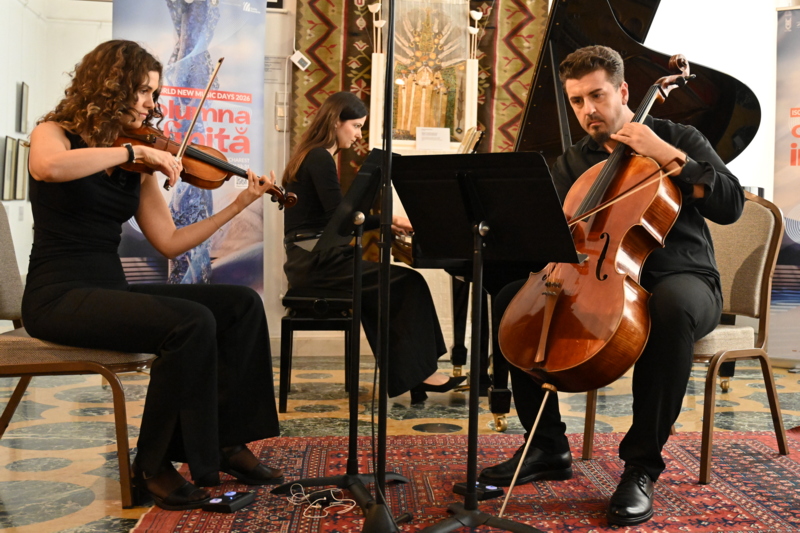
An in previous years – and perhaps inevitably, for reasons of practicality – the majority of the concerts at this year’s World New Music Days were focused on chamber music.

Aside from the official ISCM allocations, there was the usual quota of the derivative and the dire. Romanian Livia Teodorescu–Ciocănea‘s Au Café Momus was another work initiated by music from the past. More of a diversion than anything else, it was weirdly rooted in Puccini (who knows why) and way too long for its meagre ideas. Cristian Morales Ossio (Chile) gave us the predictable contrabass clarinet piece in Draft for Extinct Birds, laden with all the standard low growls and high squeals. It’s wearying to hear how many composers continually seek to do nothing more with this hugely versatile instrument than just polarise it to these contorted extremes. Reaching for the stars by Australian Michael Hannan was pure post-impressionistic pianism, with lashings of sustain pedal; noodling but earnest, it gave the distinct impression that, although exceptionally light, it actually aspired to be perceived as deep. The USA fell short again in Mark Micchelli‘s quartet A Difference of Sixty-Eight Days, due to a fundamental failure of imagination, suggesting that laid-back repetitions constituted “unpredictable chaos” (when they just sounded like business as usual), and that slow sliding glissandi were an analogue for despair. Despite its reliance on tropes, cliches and received notions, it was still better than what his compatriot Will Rowe served up in his solo violin piece Rituals: six minutes of fast, generic ‘stuff’, filled with endless arpeggios.
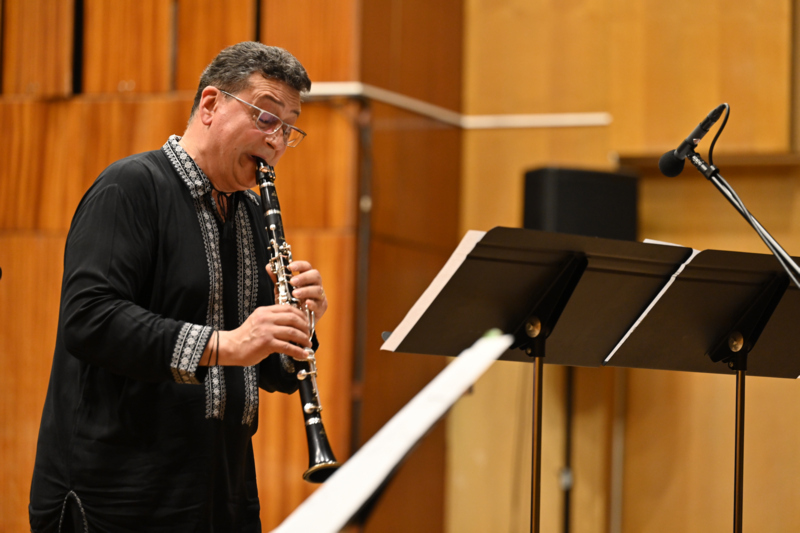
Thankfully, most of the featured chamber works demonstrated altogether more personal and effective musical languages. Canadian Heather Hindman‘s Seule for alto flute was nicely elusive. Initially clear in terms of trajectory, regressing from fast flowing lightness to more forced, insistent repetitions, beyond this it became vague, faint and quavering, leaving one reappraising the apparent certainty heard at first. Matic Romih‘s (Slovenia) three-minute solo clarinet piece Transcendence worked by simply being a genuinely cute little trifle (one of several during this year’s WNMD). Likewise Romanian Cristian Bence-Muk‘s Head or tail for cimbalom, performed by Cătălin Răducanu, a jaunty work with moments of repose (it would be pushing it to call it reflection), literally playful since its progress was partly determined by coin tosses.
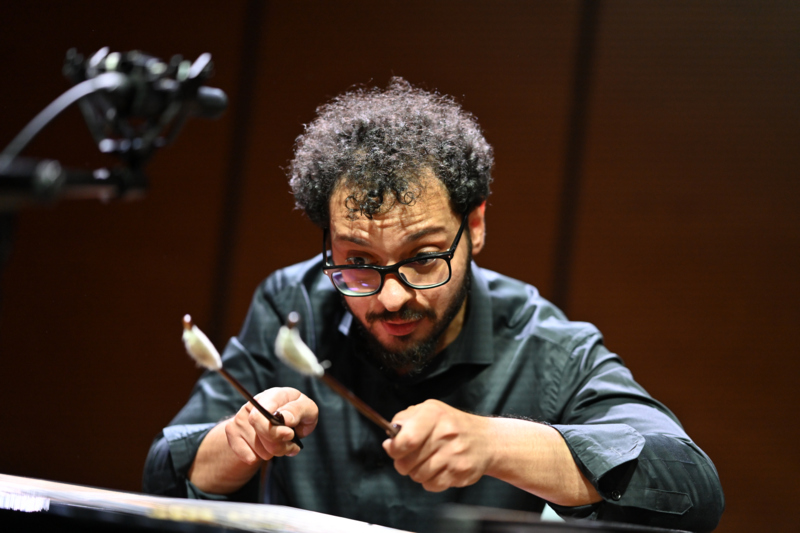
The highlight of Răducanu’s concert was Curta–metragem nº 2 (Brumas de outono) by Daniel Moreira (Portugal). This was music of pronounced focused intensity, weighty, contemplative, unhurried. Its language was obliquely lyrical, like a melody from a half-forgotten dream, its connections and contours erratic and speculative. Later, it moved amidst scale clusters, enclosed by resonance as if closed off from the real world. It arrived in a yet more fantastical place, where memories of melody were replaced by more tangible tremolandos, only to end up in a quiet, rather solemn statement of something maybe remembered, maybe imagined.
There were many other first-rate solo works performed during WNMD 2026. Myrtó Nizami‘s (Greece) Gone in No Time for solo cello, performed by Mircea Marian, was rooted in a mode of driving, rather grinding repetition, as if obsessed by the attempt to attain something. The attempts slipped sideways: now a collection of fast, small bowings; now delightfully out-of-tune diatonics over a low drone. There was a telling discomfort at its foundation, finally sliding up and down the fingerboard while pitch content became slowly erased. Crescendo by Romanian Mihai Măniceanu initially guided Diana Moș’ violin through a series of swelling upbow strokes. They served as introduction to a breakneck blur of material: melodic, rhythmic, flowing, faltering – but not stopping. Until, that is, the violin entered a mysterious pulseless zone, one moment calm, the next scraping. More upbows and the pace was reignited, stalling shortly after but nonetheless managing to reach full throttle, ending up like a folk fiddler on speed.
Flautist Ion Bogdan Ștefănescu’s recital, given in the Tapestry Room of the magnificent Mogoșoaia Palace, featured three dazzling solos, all incorporating verbal elements. Carmen Maria Cârneci (Romania) used a bass flute in her 1991 piece …une main immense. The work displayed twin trains of thought, primarily that of an unstoppable line, buzzing and undulating, never florid exactly but with a clear sense of decoration and embellishment colouring almost everything. The secondary train emerged in spoken syllables occurring randomly throughout, suggesting either an implied subtext glimpsed in these tiny moments, or perhaps, more profoundly, of the primary train briefly transcending music to form proto-words. Croatian Tomislav Oliver‘s Mixordia IV “transmitting” for flute also featured verbal fragments, though as a more volatile presence. It was the opposite of Cârneci, as if the capacity of words was insufficient, the subtext transcending the human voice to form flute music. And what a transcendence! – Ştefănescu was by turns angry and plaintive, turbulent and sobbing, unleashing the most supercharged outbursts, becoming increasingly unstoppable, though continuing to be sensitive to, and shaped by, softer details.
Stunning in an adjacent way was Solomonarul for alto flute by Diana Rotaru (ISCM Romania’s Artistic Coordinator). Starting like something ritualistic – a kind of spellcasting – the music became an absolute torrent, pouring out of Ştefănescu’s instrument in the most extraordinary way. Words emerged here as part of the magicry, and it was as if the music were overloaded, pitch compressed out of it, into a peculiar buzzy melody – now incantation – eventually becoming a high line broken by slow timbral trill key clicks, sounding like, of all things, a form of drum accompanying the tune.
Despite many being played, only one of the submitted works for string quartet made a strong impression. That was Faux Flora by Madli Marje Gildemann (Estonia), receiving its world première by the Arcadia Quartet (Gildemann won the 2023 ISCM Young Composer Award). i explored Gildemann’s work in some depth a few weeks ago, and Faux Flora was a continuation of her preoccupation with organic forms and functions, demonstrating again her fondness for tremulous, allusive soundworlds. (In some ways Gildemann’s music could be described as being more ‘about substance’ than actually ‘being substance’.) Thus it was that the three short movements of Faux Flora operated at something of an intangible distance. The first, like a slow awakening, a kind of pre-energy, cool and remote; followed by a fascinating centre – faint noise, faint tones – with group chords that the ear couldn’t resolve. The conclusion was all pulsing momentum with sharp gestures, in this context sounding almost shockingly direct.
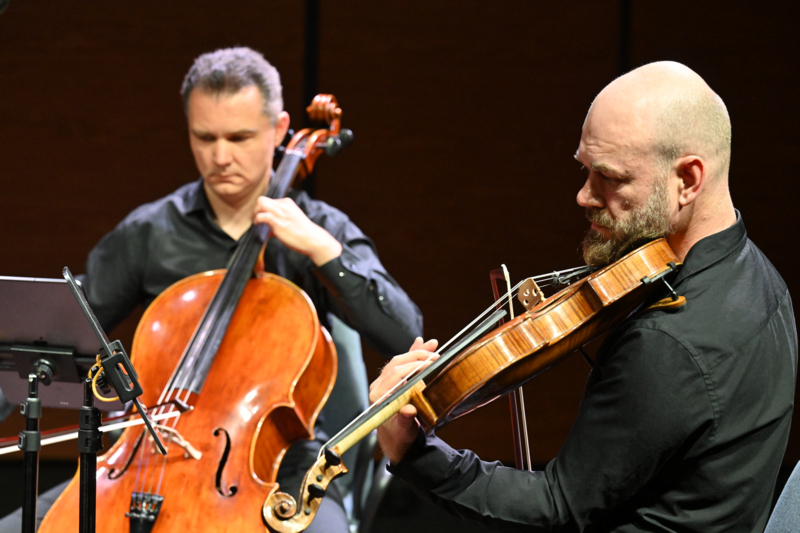
The standout work from the other quartet concert, given by the Gaudeamus Quartet Filarmonica Brasov, came from Núria Giménez Comas, who only need two instruments, violin and cello, for her exquisite piece Lluor. Désir d’étoiles. Similar to Anna Pidgorna’s The Stockhausen Menagerie (which we actually heard later the same evening), the duo seemed to be engaged in a courtship display, imitating each other, aligning and coordinating, listening and responding. A dancing dialogue – each move and gesture aimed at the other – they arrived at what seemed a consensus, a hanging major third, only for she (violinist Raluca Irimia) to walk off, he (cellist Mircea Marian) continuing to echo and call from a distance. It was surprisingly touching.
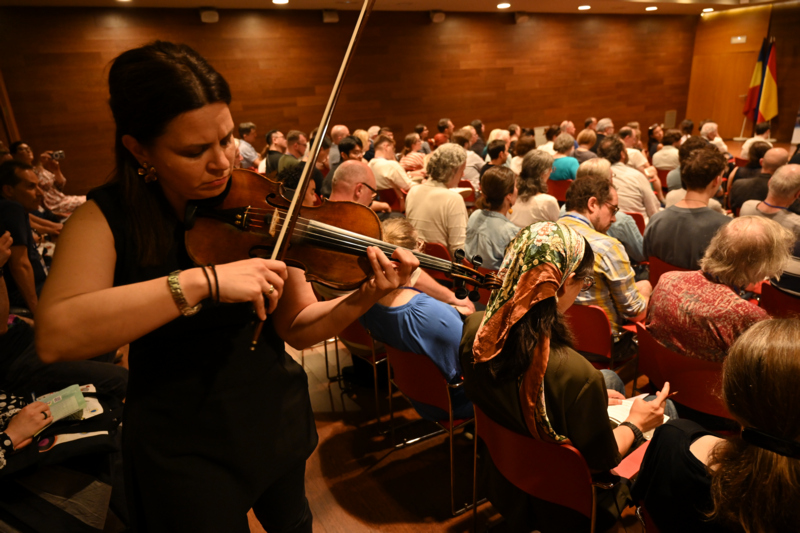
This was just one of seemingly endless ways that the concept of duo was interpreted throughout the festival. For Petra Stump-Linshalm (Austria), the clarinet and piano in Touching Sound were playfully cryptic, as if presenting music in code: a phrase, a noise, muted piano notes, rude repetitions, something low and brooding – all potential outputs of an unknown cypher. Yet this was followed by the opposite, an overflow of transparent, bubbling clarity – decrypted music! – though with elements or echoes of the code embedded within its flow. It ended up somewhere in between, a halfway place, fluid but semi-hidden, the clarinet unstoppable but often barely audible, while the piano roamed around its string innards, concluding in a wonderful veiled epilogue, the clarinet now half in shadow. Sweden’s Lina Järnegard accompanied her clarinet (performed by Emil Vişenescu) with electronics in Inside Voices, a potent piece, slow, un-demonstrative, subtle and restrained. Its lyrical line was strong but unfolded within a broad form of rumination, while the electronics, featuring occasional curious moan-like sounds, formed a kind of sympathetic atmosphere.
A more turbulent atmosphere occupied Hisataka Nishimori‘s (Japan) Souten no Raika (Lightning in Azure), a rapid-fire duet, tumbling along, led by relentless, frantic violin pace though the piano was no less energised, firing out repetitions and quieter, deep register explosions. Yet, more interestingly, Nishimori played with elasticity, pulling at the tempo and violently releasing it, causing notes to bounce and ricochet. Unpredictably pressing on and holding back, they both finally, unequivocally, let rip.
Surely the most successful duo during WNMD 2026 came from Zosha Di Castri (Canada). Her Sprung Testament, also for violin and piano, began polarised: piano lurking in the depths, violin singing high above, seemingly worlds apart – were they even connected? Indeed, the piano practically had a percussive role, like a pulsing low drum, in due course turning highly gestural, with big descending scales. The two finally merged, the piano leaping into the middle register to focus on rhythm while the violin was concerned with line. Increasingly playful, they romped ever faster, Diana Moş’ violin ending up squalling impossibly high while Adriana Maier … struck a vibraslap(!). As if flipping a switch, they were at once subdued, though Moş garnished her material with florid low-key fireworks, and the duo intensified, became dogged, strained – only to push through and attain a curious state of serenity, ending up polarised, as they had begun, and yet nothing like it. (If the piece had ended there, it would have made total sense, though there was actually a fourth section, full of rapidity and flourishes, that felt oddly disconnected from all that had gone before.)
Aside from these marvellous works for one, two and four players, there was also one noteworthy trio. Jongwoo Kim‘s (South Korea) SAMMULNORI for violin, cello and piano (performed by Trio Larson) was characterised by nervous energy, not flowing but moving in bursts and lurches. There was a strong sense of underlying connection: the piano making the effort to ground and propel things, ensuring that that everything cohered. Kim suggested broader potential in the material, and while that seemed thwarted – the nervous energy appearing to resurface – it appeared more a product of breathless enthusiasm than anything else, confirmed in a thrilling conclusion of overwhelming exuberance.