
So it begins. To mark the recent centenary of Hans Werner Henze (born 1 July 1926), Wergo is undertaking a wholesale sweep through their extensive back catalogue of recordings of his music, boxing them up in five substantial volumes, together forming the Hans Werner Henze Edition. As such, this will not only be an entirely appropriate response to one of the 20th century’s most imaginative composers – already, typically, becoming neglected; i’ve not come across a single concert marking or even noting the occasion – but it will form a superb, even more extensive counterpart to Deutsche Grammophon’s already substantial 14-CD Henze Collection, released in 1996 (and slightly expanded a decade-and-a-half later). Wergo’s first volume has recently been released, and as its title – Sinfonia – suggests, they’ve perhaps wisely decided to begin in a highly arresting way, with Henze’s 10 symphonies, all performed by the Berlin Radio Symphony Orchestra conducted by Marek Janowski.
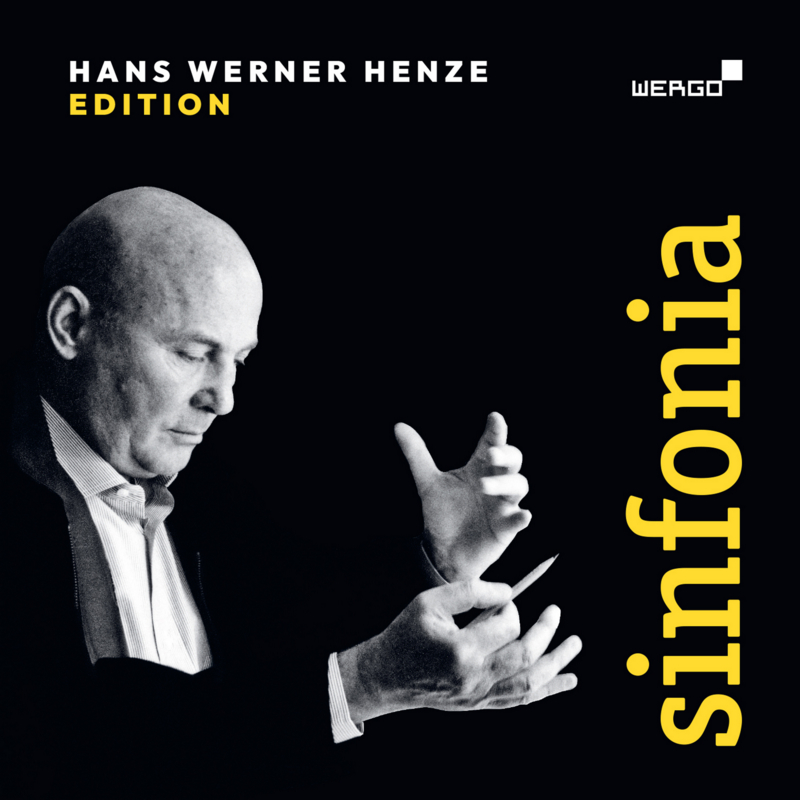
These performances were recorded from 2006 to 2013, originally issued on five CDs. To date, it’s the only complete Henze cycle – Henze himself conducted the first six for DG; assorted conductors have tackled one or two – and it goes a long way to illustrating vividly both the recurring traits and the aesthetic evolution that took place between Symphony No. 1, composed in 1947, and Symphony No. 10, completed over half a century later in 2000.
Symphony No. 1 mingles energy with lyricism, but it’s the latter that quickly becomes established as the dominant tone throughout. Janowski acknowledges this, opting to keep the orchestra restrained, even laid-back at times. This actively enhances the work’s occasional neoclassical touches (Stravinsky lurking in the wings), keeping them light, and brings vivid clarity to a sequence featuring multiple strands of counterpoint. It also serves to generate a strong air of mystery at the close of the first movement, causing it to tilt enigmatically at its end. Though the three movements have similar durations, it’s the central Notturno that feels most substantial. Traces of neoclassical and neoromantic mingle with Henze’s own lyrical angle, which Janowski emphasises, making the melody touching, and its environment meditative. The finale – extending that multi-strand sequence from earlier – is rendered an exciting interplay of instrumental sections, fantastically contrapuntal, the Berlin Radio Symphony Orchestra becoming more soloistic as individual lines are each given weight and attention.
That moment of mystery, and the work’s soloistic character are a noticeable point of continuity in Symphony No. 2, completed in 1949. In his wonderful autobiography Bohemian Fifths, Henze describes the symphony as “music for a winter’s day, utterly grey and gloomy. It is as though the experience of war had begun to demand an answer in my music.”. It’s a work that begins in a slow, solemn place of intimacy and individuality, and Janowski makes the atmosphere feel genuinely magical, yet not grey or gloomy, somehow dark but not dark. It can seem as if he’s trying to smooth over any rough edges (something Henze actively avoided when on the podium), though that doesn’t stop the orchestra in the middle movement from pounding hard. In any case, the music’s fascinating push-pull means its ‘molto vivace’ doesn’t really have a chance, seemingly subject to a constant impulse to reflect and turn inward. That’s greatly extended in the concluding Adagio, Henze’s meandering lyrical lines lovely but inscrutable, weighty but not clearly inclined toward light or dark. An outburst comes out of nowhere, the orchestra not merely unsettled but seemingly fraught in this recording. The result is a true climax, made powerful and punchy – and also sustained, in an exhilarating ending that no-one can have heard coming.
Symphony No. 3 was completed the following year, and operates in a similar way. Henze titles the first movement ‘Invocation of Apollo’, suggesting order, composure, yet its initial smouldering intensity soon yields to swells that Janowski makes very edgy indeed, though these in turn recede to more strains of neoclassical jaunt. They get into a groove, and in due course more and more instruments pile on, until an almighty surge. As if momentarily forgetting itself, things return to how they began. The other two movements aren’t so equivocal, the ensuing ‘Dithyramb’ letting loose a xylophone amid wild brass reports and tattoos. One senses something of a tussle here, the Berlin Radio players tugging hard at Janowski’s leash, though that only makes the tension between its energetic and singing impulses more potent. In particular the climax is enormously imposing, making everything shiver in its wake. Yet it too ends up kind of where it began, and it falls to the closing ‘Conjuring Dance’ to whip up everything into a true frenzy, fanfares leading to a pounding processional. A fantastical episode en route barely detracts from the pile-driving momentum that propels the symphony to its end.
For all their abundant energy, all three of those early symphonies display a fascination with manipulating sonic power and channelling it, challenging it, not simply letting it run amok. Instincts toward melody and mystery seem just as significant to Henze, and that’s overwhelmingly the case in Symphony No. 4 (1955). Cast for the first time in a single movement, the work feels tentative, semi-suspended, even reluctant to move. Over the course of its 22-minute span, there’s a potent oscillation between impulse and inhibition. Whatever pushes forward is always short-lived, falling back, as if the orchestra were caught in an equilibrium from which they can’t escape. Janowski improves on Henze’s own recording by moving briskly, making each successive idea interesting in its own right, while at the same time making the pivoting of the music feel utterly odd and mysterious, the apparent product of completely abstruse or arcane language. Now tender, now tetchy, the work feels emphatically symphonic, working through both its material and its attitude, exploring radiance and intimacy but, as if due to pent-up frustration, ending in a final, dissonant eruption that leaves one dazed.
In Symphony No. 5 (1962 – a work i explored following the composer’s death in 2012), Henze explicitly makes the music pushy and volatile. (In Bohemian Fifths Henze wrote it “evokes the toccata-like animation of a large city like modern Rome, but it could just as well be New York, with its physical energy and dancing, its hectic pace and brutality.”) Though here again, after barely a moment the opening ‘Movimentato’ starts internalising. The orchestra seems to be in fundamental disagreement, the brass aggressively yanking one way, the strings desperately attempting to smooth things, each successive push making the opposite feel more wan and blank. Janowski makes the music feel downright disoriented in the central Adagio, solo strings articulating in darkness, ending in a beautiful, odd hanging chord. In Henze’s own recording the final ‘Moto perpetuo’ is a tough nut to crack, but the Berlin Radio performance has more cohesive continuity. The motion may be perpetual but the ferocity is by now measured, with more emphasis – beautifully clear in this recording – on inner lines moving through the vaguer passages. The forces trying to keep things moving feel positively exhausted as they slam into the symphony’s final accent.
Convolution, fragmentation, disconnection – these qualities typify Symphony No. 6, completed in 1969 and subsequently revised in 1994. He summarised it in Bohemian Fifths as “my difficult, polyphonic tribute to, and expression of solidarity with, the modern Cuba that I love so much”, and Janowski wisely doesn’t try to make things ‘click’, allowing seemingly disjunct ideas to jostle and juxtapose. But when Henze disorients he remains tantalising, a tone of mystery and intrigue remains. And so here, as some strands float while others turn frantic, instruments bristle with nervous energy while others tick along quietly. Henze (as usual) is more extreme in his interpretation of the work, and the Wergo recording is perhaps a case of Janowski holding back a touch too much. Nonetheless, the second movement’s flare-ups are genuinely unsettling, and the way the Berlin Radio orchestra establishes loci of clarity within some of the hyper-energetic sequences proves highly valuable for navigation. The movements almost come across as three discrete attempts to convey the same thing, and the ongoing levels of intensity and confusion only heighten as the symphony continues. It’s bewildering and wonderful.
Completed in 1984, Symphony No. 7 places momentum at the forefront, initially in the form a semi-indistinct ‘Tanz’. Chug turns to jaunt, but almost everything lurks in the depths, and only the strings seem to get what speed and flow are all about. And melody for that matter, but their attempts to assert something lyrical are lost in a growing tension between an urge to let rip and dance and more complicated digressions and disruptions. The second movement is intoxicating in the extent of its mystery, slowly revealing more and more accumulated weight. But it’s the third, ‘Unablässig in Bewegung’ [always moving], that – despite being the shortest movement – dominates the symphony. The orchestra seems to awaken in a new way, pulling the ear all over the place as it does so. The players all seem to know what they’re doing from the get-go, a coherent textural whole with us lost in the midst of its panoply of details. It’s as thrilling as it is literally stunning, attaining Mahlerian intensity as it accumulates and grows to a fanfaric climax. The dark aftermath is temporary, as the final movement blends excitement and lyricism, thick and substantial (even a touch stodgy), but also soft and mellifluous, ultimately channelled into a juddering closing procession.
The remaining symphonies all date from the 1990s. By now, though unpredictable, we kind of know what to expect, and Symphony No. 8 (1993) feels familiarly lyrical and muscular simultaneously. A nice aspect of this recording is the way Janowski keeps it uncertain whether the music is actively conflicted or more passively multifaceted. That reading makes it highly dramatic, now rhythmic pulsing, now rumbling turbulence, now ecstatic singing, now ghostly shivering. This quicksilver performance is truly electrifying, and it makes the central movement feel overwhelmingly defined by contrast, like a weird, playful dance. One moment balletic (due to lyrical outbursts), the next gallumphing along, that notion of conflict resurfaces as more benign competition. The Berlin Radio orchestra is magnificent here, having a blast in the bizarre dance that keeps reforming into ever new shapes. The nimbleness in turn makes the Adagio final movement sound curiously awkward. It’s warm, and texturally light, yet dark in hue and with the distinct impression that, like the equivalent point of Symphony No. 7, it’s congested. Surges die away, and Janowski nicely connects back to earlier in the work’s dancing, ethereal ending.
Ninth symphonies have been known to carry a certain amount of historical baggage, and Henze leaned into the Beethovenian legacy by making his Symphony No. 9 choral. Completed in 1997, it’s Henze’s longest symphony, dedicated “to the heroes and martyrs of German anti-fascism”, using a text drawn from Anna Seghers’ book The Seventh Cross, articulated across seven movements, performed in this recording by the Rundfunkchor Berlin. In addition to historical, it also tapped into personal baggage; in the closing paragraphs of Bohemian Fifths, Henze reflects on further inspiration for the music:
I recall the fears and pain of my childhood and youth – they become landscapes, a land of mists and topsoil, from which I derive the backdrop of sound against which the tremendous stirrings and movements of the persecuted and the persecutors will have to be depicted and in which human nature merges with our environment, an environment to which we are exposed like a hare to a pack of hounds, fatally, tragically entangled, condemned by fate, with no hope of escape.
The symphony doesn’t so much depict the narrative as mirror its sense of urgency and anxiety. That plays well into Henze’s long-established push-pull of tension and release (or in this context, relief), and Janowski emphasises this, the music easing only to be pressed on again, conveying a potent sense of desperation. The choir sings as one – a communal “I” – navigating mystery, pain and collapse, while the orchestra becomes harsh and unstoppable. The voices shift to “We” as the work moves from personal reflection to group destruction, though Henze creates darkness that’s appropriately hard to read. Pain as immeasurable as this cannot be simple to express or grasp.
The orchestra isn’t merely an external pressure; in due course it turns mournful, ruminating on what’s happened. The organ takes over as antagonist in the sixth movement, ‘Die Nacht Im Dom’ [the night in the cathedral], its horrifying immensity making the choir sound smaller than ever, achingly fragile. The voices fracture into gabblechatter and whispers, and it seems the symphony is heading for a brusque, imposing conclusion, bereft of sentiment, ending in abject horror: “my eyes are full of dirt, / my mouth is full of worms, / my face will be eradicated”. Yet it ends with ‘Die Rettung’ [the rescue], a place of numbed neutrality (inscrutable brass), where the choir sings a gorgeous closing reverie. Its beauty is broken; the meandering voices are not merely filled with regret, their words laden with “as if”, but the reality around them seems almost too exquisite to believe. There’s hope in this ending, but it’s grounded in a reality of overwhelming pain, suffering and trauma. The way the voices cling to the final word of the final line, “nur diesen einen Tag” [only this one day] is heartbreaking. Tomorrow is too alien and difficult even to contemplate.
Henze’s Symphony No. 10, his last, was composed from 1997 to 2000. The four movements’ titles suggest a kind of synthesis of all the preceding symphonies, ‘A Storm’, ‘A Hymn’, ‘A Dance’, ‘A Dream’, yet Henze’s response to these invocations is typically nuanced and individual. The first movement seems less depiction than metaphor. Discrete elements feel misaligned, patterns playing out in cross-rhythm, and while there’s enough recurring clatterbang to satisfy the title, Janowski makes it feel like it’s injecting power and focusing momentum rather than disrupting the flow. The second movement is hard to read, flowing but angular, and while it seems personal – emphasis on individual strings – the Berlin Radio orchestra players keep at something of a distance. As a ‘Hymn’ it appears to lack faith. Likewise the ‘Dance’, which feels just a bit too restrained to sound plausible, lacking the exuberance that characterises so much of Henze’s work. Janowski leans into its rollocking end, but again we’re left wondering. The closing ‘Dream’ encapsulates all of this equivocation. The orchestra warms up but there’s a kind of diffidence in their behaviour; rhythms are light but soon tilt into shadow. Here too there’s the sense that the music is kind of self-involved, self-directed, not projecting out toward us. This seems extraordinary at the work’s close: so much happening, yet so soft, so undemonstrative. Is it the piece or is it the performance?
That’s actually the key question, and unlike most of Henze’s later symphonies, there is actually another recording available of Symphony No. 10 that makes for an illuminating comparison. A live recording by the Orchestre National de Montpellier, conducted by Friedemann Layer, it was released in 2005, nine years before the Janowski-Berlin Radio performance, and clearly indicating its limitations and shortcomings. It is, frankly, astonishing: the ‘Storm’ could not be more real, volatile and full-blooded; the ‘Hymn’ has an excellent earnestness, pushing to be lyrical; the ‘Dance’ is a play of extremes, full-on one minute and hovering nothingness the next; while the final ‘Dream’ is a delicious stream of consciousness, the players engaged in a mild-mannered tussle between orchestral sections and pitch registers. In short, it’s a convincing, cohesive and compelling symphony, one of Henze’s best.
Yet despite the fact that this complete cycle of Henze’s symphonies by the Berlin Radio Symphony Orchestra and Marek Janowski has a weak spot, the other nine symphonies are all absolutely superb performances. That’s true both on their own terms, as well as the extent to which they reveal Henze’s long-term symphonic trajectory, and the various predilections and preferences that appear again and again within their details and architecture. Furthermore, it’s a magnificent way to get Wergo’s Hans Werner Henze Edition up and running, serving as a powerful, exhilarating reminder of the importance and ingenuity of his thoroughly unique music.
Released by Wergo, Sinfonia is available as a slim 5-CD box set and download. The second volume of their Hans Werner Henze Edition is coming in mid-October, focusing on Henze’s other orchestral music.

