

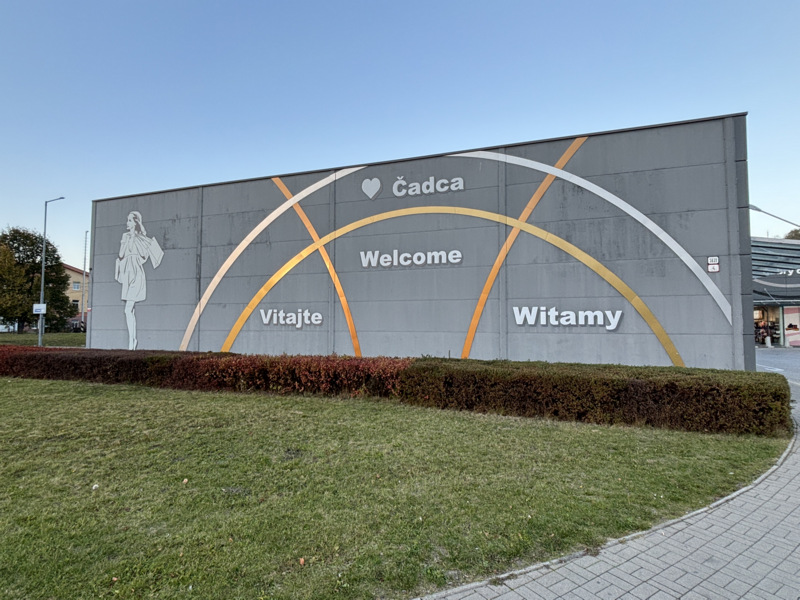
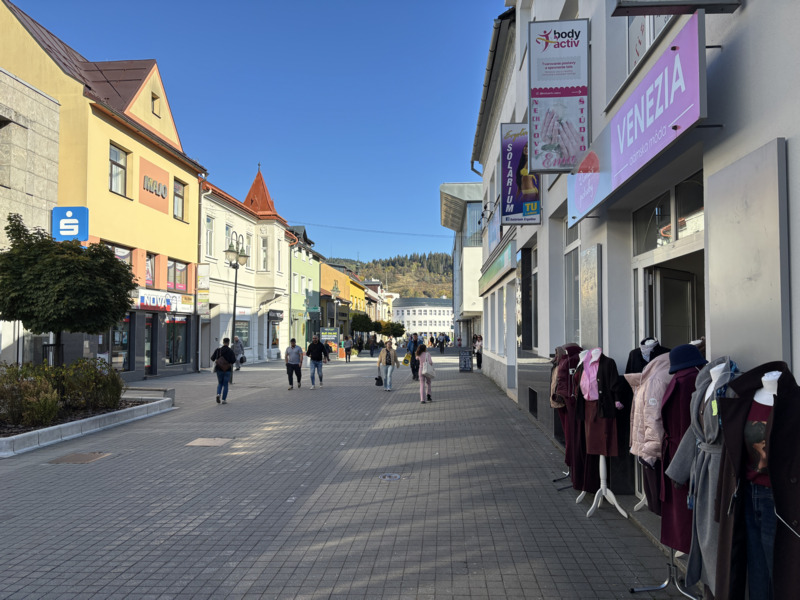
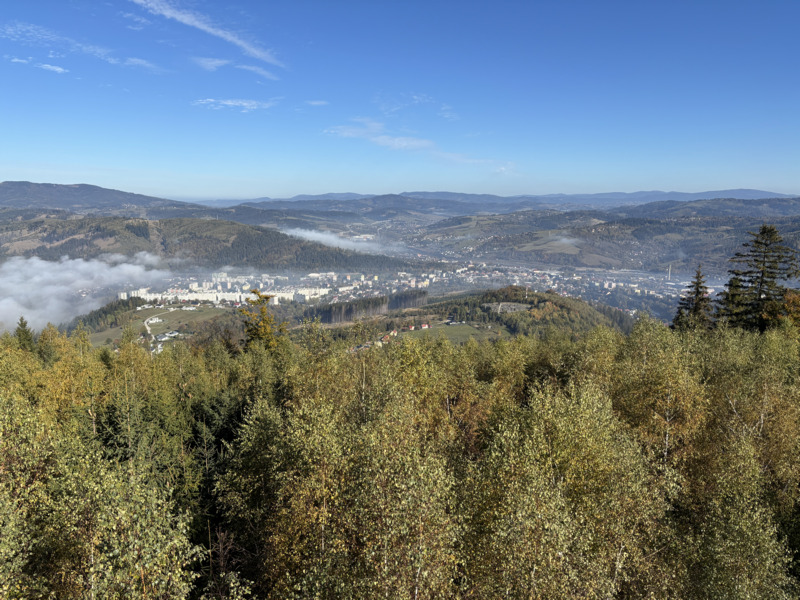
Over the years, the performances i’ve attended that have felt most meaningful, most urgent, are not well-known, long-established festival behemoths, but small-scale, intimate projects conceived by individuals and often realised against the odds. Thus Concentrated Voices, the project of just one man, Slovak guitarist Ondrej Veselý, who over the last few years has cajoled and encouraged an increasing number of composers to consider his instrument and contribute to a slowly growing corpus. The project is centred in Čadca, a small town in northern Slovakia, not far from the Polish border. It’s a curious location for something radical; even on sunny days, Čadca is a grey, uninspiring place, displaying signs of external neglect and internal disinterest. Yet look up, and the contrast is immediate, as Čadca is surrounded by vast landscape, with any number of inviting mountain hikes providing stunning views that make the town seem even more small and isolated. Čadca is Veselý’s home, he grew up and still has family in the town, and it’s there that i made my way, from the UK to Kraków, and thence by car into Slovakia.
In terms of being realised against the odds, Concentrated Voices is in part a response by Veselý to what he perceives as an attitude of, at best, indifference and, at worst, antagonism within Slovakia toward culture in general and artists in particular. This situation has been exacerbated in recent times by controversial governmental attitudes and decisions – summarised by Veselý as “funding cuts, public smears, demagoguery and hostile rhetoric” – aimed at cultural figure and institutions. But Concentrated Voices is also a call to arms, and a wake-up call, on a more local scale. Veselý describes how Upper Kysuce, the northern Slovakian region that includes Čadca, “has long been culturally undernourished. Its public cultural life is dominated by commercialised folklore, button accordions and low-cost entertainment presented as art.”
Concentrated Voices is thus playing out in a challenging climate, and to that end the project’s two inaugural concerts did not take place in Čadca itself, but in two neighbouring locales, chosen by Veselý for distinct reasons. The first was in the village of Oščadnica, within a large manor that for several decades has been an art gallery, Kysucká galéria. Just a short drive from Čadca, Veselý describes the gallery as “one of the very few places here where contemporary art can be presented with care and respect”, and is therefore the ideal location “to create a glimpse of what could be possible: a region that also has room for contemporary, internationally relevant art.” i used the word ‘intimate’ before, and that’s very much how this opening concert felt, located in the attic space of the gallery, with low, sloping ceilings and seating for maybe 30 or 40 people at most. i also used the word ‘small-scale’, and that’s not even remotely true of what ensued, with the first half of the concert extending to around 100 minutes, with the entire event, including interval, running to nearly three hours. This clearly took a lot of people, including i think Veselý himself, by surprise. No complaints from me, though, particularly as the second half proved to be a lot more engaging than the first, making the extended running time increasingly enjoyable.
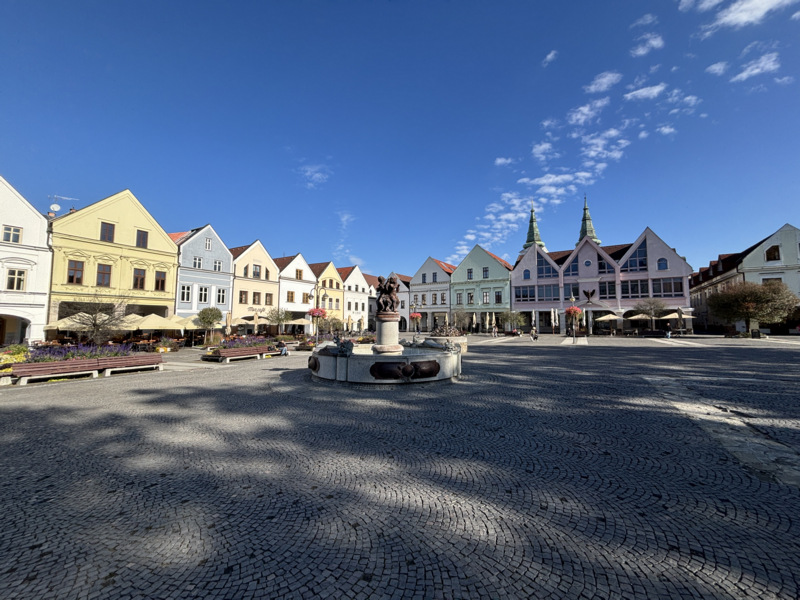
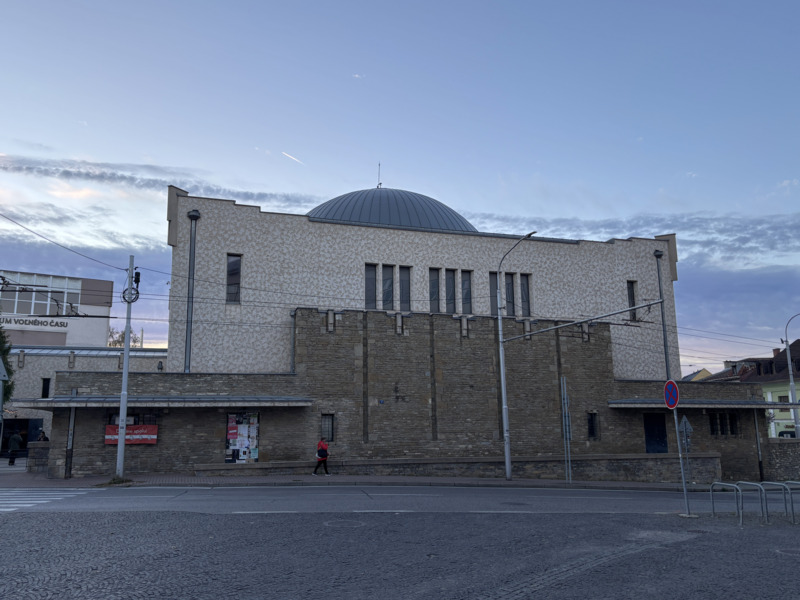
The second concert took place in the city of Žilina, around 20 miles south of Čadca, on the river Váh, with a beautiful old town square, castle and cathedral. It also has a synagogue, Nová Synagóga (designed by none other than Peter Behrens), where Veselý performed. He described how this space “has long championed contemporary art”, yet “has also repeatedly faced attacks from the current Ministry of Culture, whose agenda is openly anti-LGBTI and pro-Russian. … Choosing Nová synagóga was therefore also a way of supporting a place whose work I value.” Here, the atmosphere could not have been more different, surrounded by the vast open-plan spaciousness of the building, in which Veselý and we felt very small indeed. While not identical, there was a lot of overlap between the two concerts, enabling us to hear many of the works twice. i’ve said it numerous times before, but more concerts and festivals should do this, particularly when works are being performed for the first time.
The acoustic guitar is often regarded as a gentle sonic presence, and several of the composers played into that cliché, producing music that was relatively innocuous. The first movement from Marián Budoš‘ Songs From A Magical Garden, ‘Alba’, acted like a palate cleanser, arpeggiated pleasantries rooted in memories of Bach, followed by Viera Janárčeková‘s Siebte Saite, a somewhat hard-to-penetrate work but displaying an interesting mix of playfulness and constriction. Ian Mikyska‘s Along, one of the 13 premières, placed Veselý’s guitar within a context of field-recorded walking. This had an aspect of the uncanny about it, as the strict pace of the footsteps confirmed veracity, while shifting sounds around them suggested not everything was equally real. The most overt moments made the music seem suddenly submerged underwater, an effect that proved ever more illusory. But Never Mistake Our Generosity For Weakness was the title of the new piece from Peter Machajdík; its first performance proffered little more than gentle chords with soft washes from a tape part, while the second brought more sonic clarity – a texture made from bell chimes becoming fuzzy noise – but little in the way of narrative certainty.
Toughest to sit through was False Fruit by Marc Sabat, music reduced to a blank, repetitive rising phrase that immediately became annoying, coming across as little more than a weirdly-tuned, rejected sketch by the vacuous likes of Einaudi or Joep Beving. Even worse – though thankfully extremely brief – was the Sonatina by Marco Baldini. Dry, repetitive, empty, pretentious. No. Alvin Curran‘s Poke Pounce Pummel Postulate Prattle went in the opposite direction in terms of quantity, and initially its mix of elements – flamboyant, thoughtful, gestural, over-the-top, pared back, obsessive; essentially all or nothing – was striking, appearing to deliberately sidestep substance, focusing on the how of performance rather than the what. But the piece soon came to feel not merely random, but an attempt to shock, surprise, weird out or even entertain. It did none of those things, settling into a holding pattern of irritation at the inanity of its actions.
The first highlight came from Serbian composer Snežana Nešić, whose Indigo Maris is the first part in an ongoing series of works under the title Heraldica Transcendentalis. As with so many electroacoustic works, the essence of its fascination was in the relationship between the guitar and electronics. The former: muted notes picking out an angular main idea, possibly a join-the-dots line; the latter: harder to read, soft and abstract with glistening motes. A tangible point of connection came when the electronics featured chiming pitches, seemingly triggering the guitar to a more elaborate melodic mode. Yet the two elements ended up poles apart, the guitar occupied with short, high notes, the electronics low and sustained. The relationship became yet more elusive as Veselý turned more elaborate – for a time unaccompanied – while the electronics presented a kind of metallic sheen behind him. though ever more detailed, such that it rivalled the guitar for attention. It was a fascinating piece, and despite hearing it twice, it wasn’t enough.
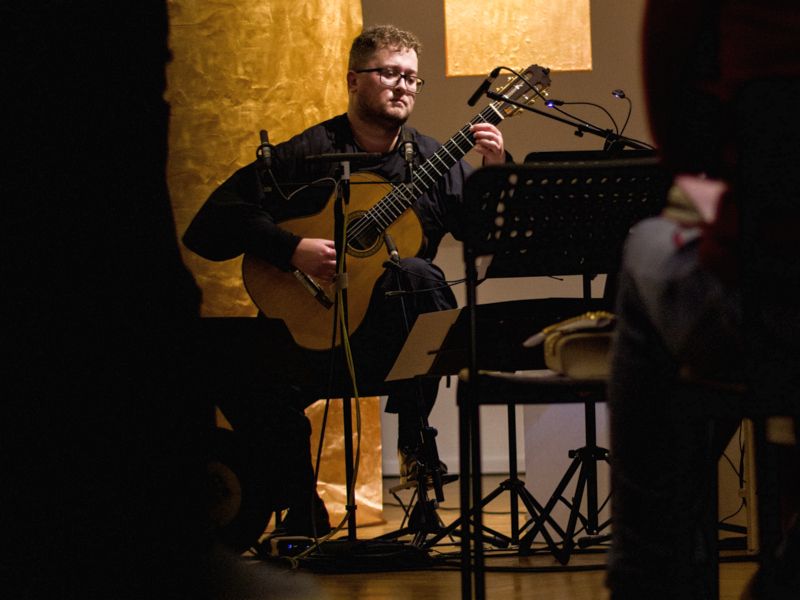
Ondrej Veselý probably doesn’t regard himself as a composer, but one of the most exquisite performances in each concert was his own Towards the Light. An achingly fragile miniature created in memory of a friend from Bratislava, and barely a few moments in duration, it was so ephemeral it sounded like music that was already finished, Veselý manifesting a few vague echoes of its existence. Its delicate, tentative melody spoke less like a small flame than the smoke left after it had been extinguished. Another piece impelled by death came from Iranian Idin Samimi Mofakham, whose I Call Thy Name; I Take My Stand was one of the most experimental works we heard, inasmuch as the guitar was no longer a sounding but a mostly silent body. Inspired by footage of a man searching body bags for his son, named Sepehr, the work acted as a commemoration for both the search and the son. From a small speaker came slightly shimmering sine tones; Veselý said the boy’s name, and began to move the speaker over the body of the instrument, searching it, perhaps cleansing or blessing it. His fingers lightly touched the nut and tuning keys, idly picked out a couple of descending plucked notes, before resuming with the speaker, holding it over the fingerboard as if now it exerted some kind of unseen, possibly miraculous force. The name again, “Sepehr”, uttered with abject neutrality, not a call or an invocation, a statement. Meanwhile the sine tones – always changing but never exactly dissonant – came to feel like the environment, rendered as an alarm, the whole atmosphere buzzing with omnipresent non-silence. It was extraordinarily powerful, fitting music for experiences and feelings that utterly transcend what music can speak of.
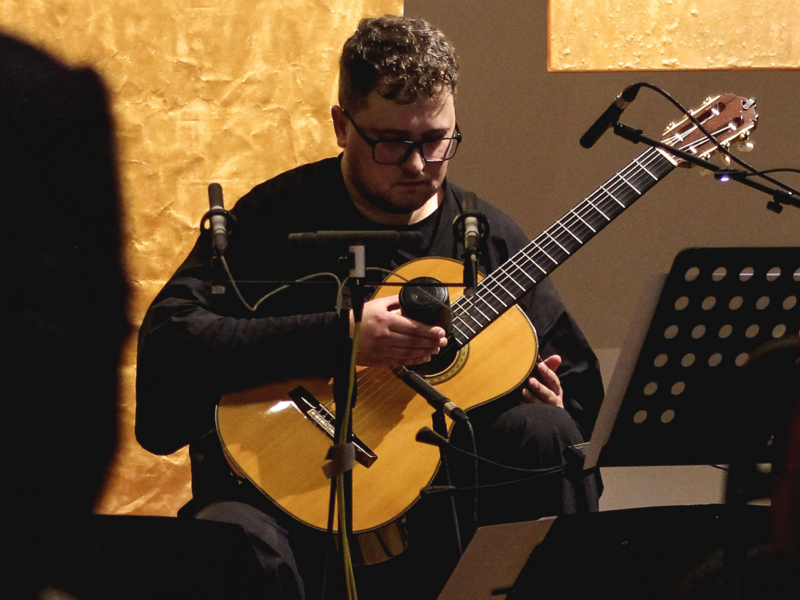
Another experimental work came from Adam Holáš, who put oscillators and assorted small paraphernalia on the strings to create drone #1. The changing quality of the drone, gradually more complicated and dirty, was mildly interesting, but there was little new about it, and when Veselý began introducing a line and some strumming over the top of it, nothing about the combination seemed to gel. More effective was if becomin_D == ‘same’: print(‘bye’) by Pavol Béreš, in which the stability of delicate rising phrases and sustained tones gradually broke down or was subject to interference. The presence of an AI voice at certain points wasn’t helpful, undoing the established abstract focus, though the work’s conclusion worked well, everything becoming filtered, distilled and reduced to just a single tone. Liisa Hirsch also employed the small speaker used by Mofakham, trapping it within an upturned glass bowl in her new piece Sounds Held in Your Darkness. One of the quietest Concentrated Voices pieces, its music was a soft meditation on microtonal harmonics, embellished with light tapped tremolos, while noise from the speaker caused the glass to rattle faintly. The effect was to make the space (even the Nová Synagóga) feel small and special. The melodic shapes of the harmonics were always changing, often angular, sometimes rapid, becoming flurries. Yet because they were harmonics every note felt deliberate, considered, even accented, in music less about flow than the necessity of each new note. Finally, the harmonics subsided to reveal the guitar’s slight detuning, in a hypnotic epilogue where the speaker seemed to reach a high point of agitation, causing Veselý to slowly raise the bowl, while the speaker continued to softly shake.
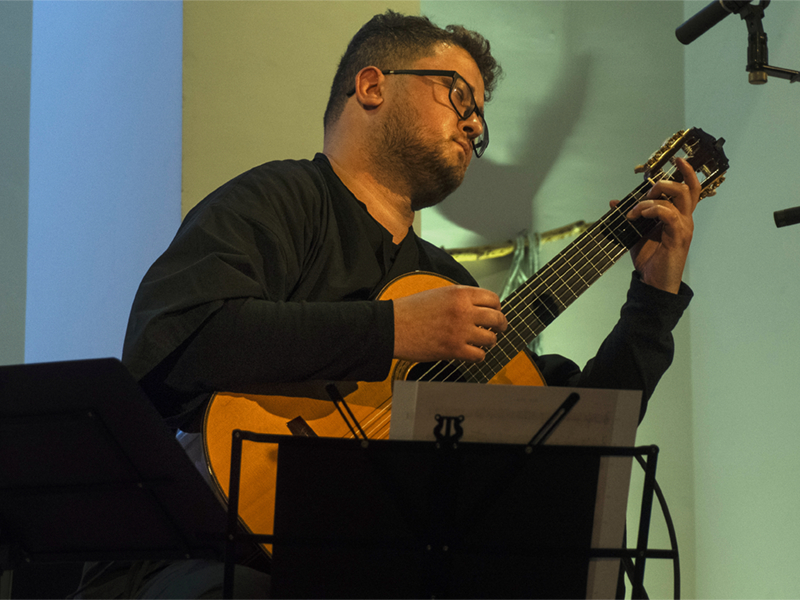
Among the loveliest music in these concerts came from Juraj Gažmerčík, whose Capriccio featured the most beautiful microtonal scordatura. It had a compelling if strange sense of progression, driven by some kind of lyrical impulse, a singing stream of consciousness that felt gesturally familiar but harmonically baffling. Gažmerčík made the ending enigmatic, breaking up the flow and becoming simultaneously thoughtful yet pointed. Considering the name of Veselý’s project, only one of the works he performed could be described as being explicitly ‘concentrated’, James Helgeson‘s Usque ad Noctem. Undemonstrative but engrossing, these were seven meticulous tiny worlds that, both individually and as a group, utterly belied their size in terms of substance. They were easily the most rich music we heard over the two days: dense, diffuse, singing, scurrying, contemplative finally – and over in just a few minutes. i wish there was more i could say about them, as they were so captivating. Fancifully, one felt Helgeson had managed to condense his material down into a potent form of sonic essence, and diluting it would result in an expanding, fractal-like quantity of deliriously detailed music.
The work that had me most mesmerised – and contemplating long after – was Loops for Guitar II by Bernhard Lang. One expects loops to sound as stuttering fragments of something bigger, but Lang’s loops were a lot more than just that. With deliciously complicated tuning, they also conveyed the impression of a small form shifting and evolving with each repetition, and each sequence of repetitions; yet they were also like the effect of a process deciding the best way forward on the fly. Its continually experimental (though not remotely tentative) continuity made it feel like moving between little soundworlds, all quite different from each other, with shifting forms of momentum. Another perception emerged later, the loops sounding now as continuity, not a disruption of it, less about multiple attempts to articulate than the desire to re-articulate in the same or subtly different ways. One of the most fascinating examinations of repetition and permutation i’ve ever heard, revealing just how complex the notion of ‘loop’ really is.
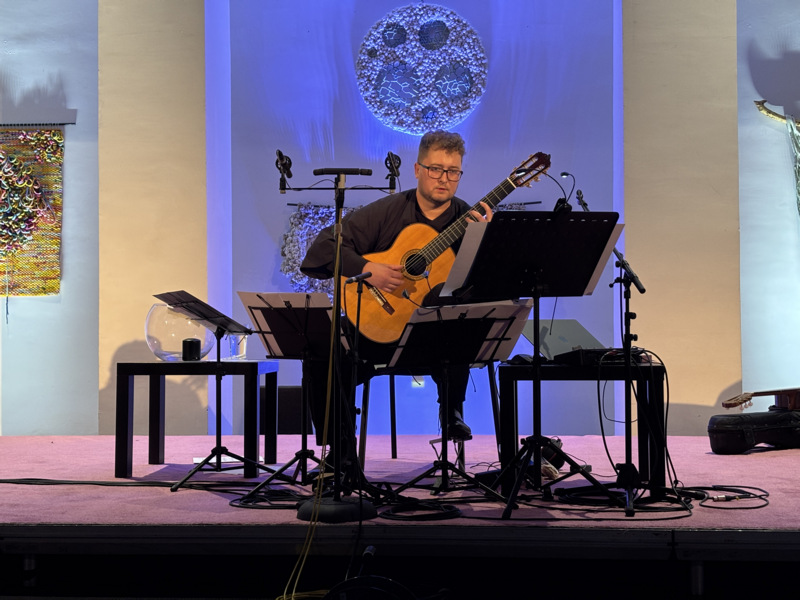
Concentrated Voices fully lived up to its name: it was an intense two days, with a huge amount to take in, both in terms of the quantity of music we heard and the many in-depth conversations about perception, place and politics that fed into one’s understanding of what Ondrej Veselý is trying to do. Personally, quite apart from how musically rewarding it was, i found it deeply inspiring. As an opening salvo, it felt impactful and necessary. It is my sincere hope that Concentrated Voices – as a particular project, and as a broader creative resonance – will continue, develop and expand, both within Slovakia and internationally. It’s not just Slovakia that needs it.

