
‘Seigla’ is an Icelandic word indicating perseverance, resilience, tenacity. It’s also the title of a festival created, curated and directed by pianist Erna Vala Arnardóttir, that for the last 6 years has taken place in Reykjavík’s flagship concert hall, Harpa. More than most festivals i attend, the aspect of curation was especially prominent. Seigla had a notional overall theme, ‘Braid’, the festival introduction alluding to its connotations being “found in the way different musical works in a programme relate to one another and become woven together into a single whole. It can also emerge within the music itself, where different motifs, stories, memories, or ideas intertwine, creating new connections and meanings.” In practice it became a kind of undercurrent for a number of more specific themes that formed the focus for each concert.
Seigla is not a contemporary music festival, and a large proportion of the music performed was Romantic and earlier 20th century European repertoire, falling outside the scope of what i explore here. (Frustratingly, a concert planned to include works by Louis Andriessen, Peter Maxwell Davies and Schoenberg, titled ‘Music and Power’, was quietly dropped from the programme; and in several other events more recent repertoire was removed and / or replaced.) Two such concerts both took the form of song recitals, and the most striking thing about them was the quality of the Icelandic singers. Hearing Harpa Ósk Björnsdóttir, Hildigunnur Einarsdóttir and Kristín Einarsdóttir Mäntylä become three Icelandic Rhinemaidens – in a concert exploring ‘Mystical Creatures’ – was quite spectacular; but perhaps the stunning singer was mezzo Hildigunnur Einarsdóttir, who at a recital focusing on ‘Mother Power’, gave a performance by turns coquettish and ravishingly beautiful.
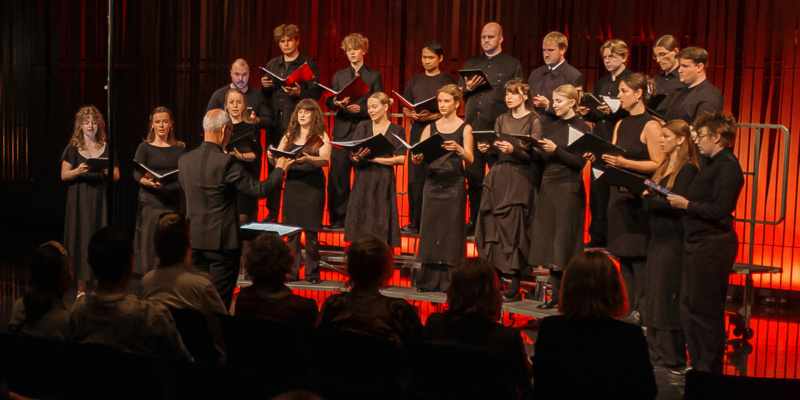
The standout of a concert titled ‘Between Words and Breath’, given by chamber choir Det Unge VokalEnsemble (aka DUVE), came from Veronika Voetmann, in the first performance of Historien om Phaethon. On the one hand, there was the all-too-usual festival handicap of not being provided with the text, yet the drama of the narrative was unmistakable. Drones led into overtone singing; friction against the drones unexpectedly became lyrical, even chant-like. Whispers set up a recurring rhythmic figure, bringing to mind folk music in its patterns and repetitions (particularly Estonian regilaul), yet here too expectations were defied as Voetmann expanded the music into a huge climax. While the music language of the work definitely had generic elements, Historien om Phaethon was nonetheless a striking and memorable piece that i’d be keen to hear again – but with the words.
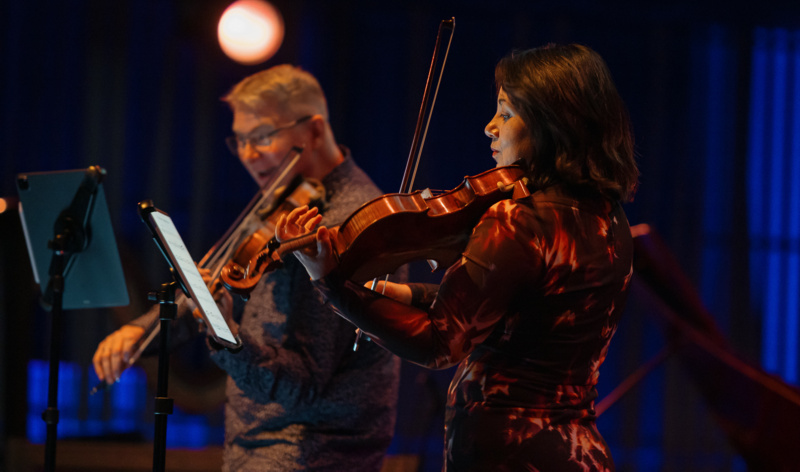
Another concert, under the heading ‘National Parks Mashup’, theoretically contained nothing but contemporary music, though the majority of it was so basic and simple that it hardly qualified. Given by the Miller-Porfiris Duo (who for some reason opted to present the concert as if to an audience of children), only two of the seven works they performed were noteworthy. Hildigunnur Rúnarsdóttir‘s Snæfellsjökulsþjóðgarður was dance-like in character, yet also often dronal, all driven by tremolandos, giving the fascinating impression that the entire music was in a permanent state of shiver. More ambitious, and the only genuinely inventive work on the programme, was Vatn by Canada-born, Iceland-based composer Veronique Vaka. The music was essentially a line, though one constantly subject to a shifting focus: glistening, tremors, harmonics, single pitch fixation, evaporating into breath-like figurations, exploring tension against a drone, and navigating points of timbral instability. This constant state of evolution ended somewhere magical, in a sustained whisper.
One of the concerts, featuring Elja ensemble, took as its theme ‘Popular Songs’, exploring a variety of music existing in varying kinds of engagement with the audience. The inclusion of Erik Satie‘s Musique d’ameublement and Vexations – just short excerpts, obvs – was a nicely mischievous touch, arguably tapping into the opposite of engagement, at least from the composer’s perspective. An important part of the programme were songs arranged by other composers, including Schubert and Luigi Denza via Schoenberg, and Kurt Weill and the Beatles via Berio. But most striking of all were two arrangements where sopranos Harpa Ósk Björnsdóttir and Kristín Einarsdóttir Mäntylä had nothing to do, both by Hans Abrahamsen. His instrumental setting of Bach’s Befiehl du deine Wege was achingly soft and intimate, its gentle lines fresh and luminous though also sounding as if they were emerging through a layer of gauze. The counterpoint was all present and correct, yet felt uncannily transformed, somewhat dreamy. A particularly nice touch were occasional moments when phrases ended in lower registers, introducing just a touch of shadow. Even more effective was Abrahamsen’s reworking of four of Schoenberg’s 6 Kleine Klavierstücke, Op. 19. In the first, the orchestration was just lovely, with clear klangfarbenmelodie at times, giving off radiance. The second was cheeky but with enigmatic streaks running through it, while the third inhabited a lovely low-key, free atonal lyrical world. The fourth was all gentle sustained chords, dark and strange yet warm, as if coming from some in-between space. Magical.
‘Durations in Space’ was the enticing title of a late evening concert given by cellist Nina Vanhoenacker and pianist Ann-Kristin Sofroniou, featuring four very different works that each in their own way played with perceptions of time. The most simple of them was by Messiaen, whose ‘Louange à l’éternité de Jésus’ (from the Quatuor pour la fin du temps) suggested in its unceasing piano repetitions the idea of a small portion of time looping round on itself, thereby making Vanhoenacker’s slow, soaring line feel outside time altogether. By contrast, Arvo Pärt‘s simplistic Bach-Messiaen rip-off Spiegel im Spiegel just made time slow to a crawl in the most tedious way imaginable. Music from György Kurtág‘s Játékok raised a key question concerning the piano part: were its notes connected? They seemed almost like points of pitch hanging in space, teasing but defying continuity. It fell to the cello to provide the missing link, introducing time to this timeless material, becoming the music’s connective tissue. The effect was transformative; by the time Sofroniou ended alone, her part now felt cohesive, connected within itself.
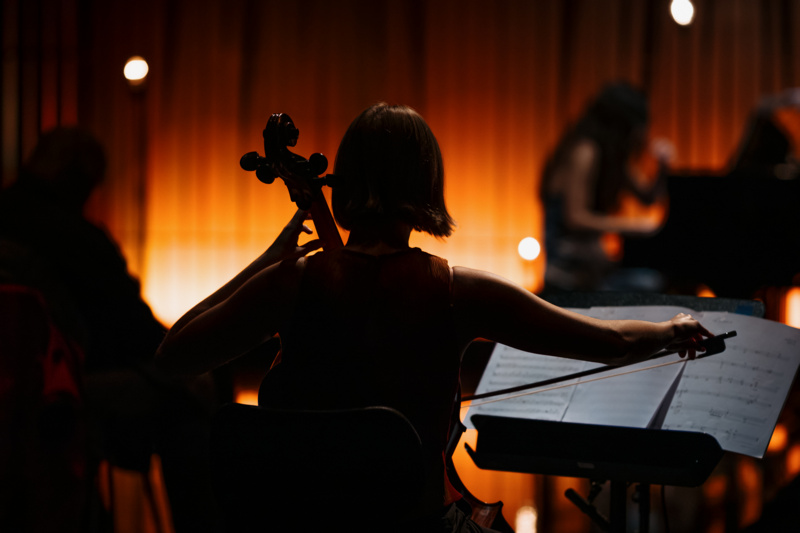
Throughout the concert Vanhoenacker had progressed from being initially adjacent to Sofroniou, to the middle of the space, and for the final piece, Morton Feldman‘s Durations II, she moved to the back of the hall, behind the audience. Literal durations in space. Despite its distance – or perhaps because of it? – her cello part was riveting: cool, stable yet unpredictable, like an enigmatic stream of consciousness. Sofroniou’s piano was more rich in tone but elusive, at a distance in a difference sense. Time now turned uncanny: not slowed, not looping, yet not flowing normally either. As the duo enunciated sustained tones together, quiet, peaceful, arresting, time seemed to have become entirely irrelevant.
There was another frustrating programming change in the highlight of this year’s Seigla, a concert by Elja and DUVE conducted by Hjörtur Páll Eggertsson, focusing on the music of Julius Eastman. It was originally planned as a portrait event, to include both The Holy Presence of Joan d’Arc and its untitled, solo vocal Prelude, alongside Joy Boy and Stay On It. In the end, the concert became ‘A Detour Through Julius Eastman’, dropping both Joan d’Arc pieces and inserting in the middle a new work from Pétur Eggertsson titled Krókaleið [detour]. It wasn’t a detour, it was a shambling, noodling mess, what the composer called “an ecosystem of sounds” turning out to be a tedious slog through a dismal process – not one player looked interested in what they were doing – lacking scope, spontaneity and imagination. Its way overlong duration was the product of pure indulgence rather than need – and to think two Eastman works for dropped for this.
As it was, Julius Eastman’s music resonated loud and proud – all the more so as the concert was happily taking place during Reykjavík Pride, on the day when the Pride Parade passed through the packed streets of the city. Joy Boy was delicious, its delicate music all trills and repetitions (often suggesting the electricity of Boulez’s Derive), the ensemble as one following a shared quasi-diatonic melodic sense. Even when assertive accents started to appear these were effortlessly absorbed into the texture, continuing with a beauty that bordered on impressionistic. Stay On It is such a funny piece, in every sense. Elja started out their performance with what seemed to be naïve exuberance, the ensemble a marching rhythmic mass. Within a few minutes, though, a guitar tremolando had threatened the focus, and a secondary rhythmic idea suggested seven beats in a bar as being preferable to the old faithful of four. Yet the main idea persisted, and this felt in no small part due to DUVE’s enthusiastic fixation on the title – “Stay on it!” – repeating as a slogan, a mantra, a necessity.
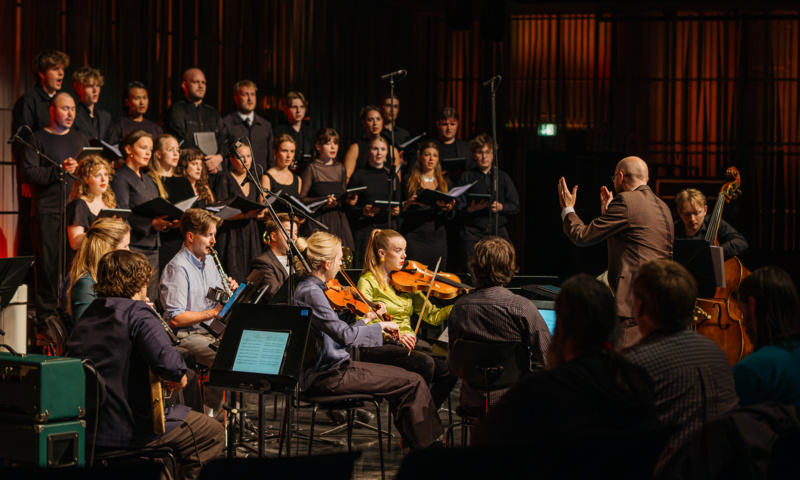
Over time, Eastman takes more liberties and risks with the stability of the music, tilting into weirdness, leaving only vestiges of whence we came. Perhaps there was never any real jeopardy; perhaps that’s beside the point, the work’s bursts of frenzy, fun, frivolity seeming now to emanate from (rather than countering) the main idea and its underlying energy. In their performance, Elja made that idea akin to the Mahler thread running through the delirious third movement of Berio’s Sinfonia – now present, now lost, but never forgotten and always returning when one least expected it. Even when the music seemed to sag and slump into seemingly total enervation – “Stay on it!” – yet even now the rhythmic impulse was kept alive spreading and growing. The title took on a new connotation: no longer just about principal musical idea but more generally – nicely connecting to Seigla’s own meaning – about persistence, tenacity, resilience in the face of opposition, keeping going at all costs. And so it did, even when reduced, subdued but potent, dwindling to a lone piano, continuing on with flourishes, finally collapsing into the bass … exploding … stopping … only to continue as a solitary tambourine, proving the point one final conclusive time by wildly accelerating to the end. Indefatigable to the last; Eastman would surely have been proud.

