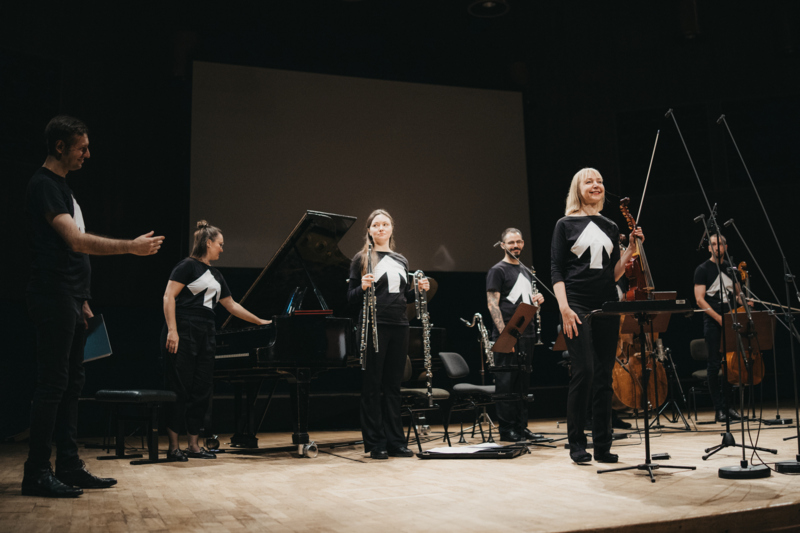
Of all the festivals i attend each year, Warsaw Autumn has come to seem the most ambitious, the biggest in terms of scope and diversity, and therefore the most excitingly daunting. As if to prove that point during its opening weekend, almost the entirety of Sunday was filled with two concert marathons. The first occupied the morning and afternoon, taking place in the Krytyka Polityczna Social Cultural Institution building, under the heading ‘House of Music’. This mainly comprised short solo recitals dispersed across various rooms, each of which could hold no more than around a dozen people, so they all felt extremely intimate.
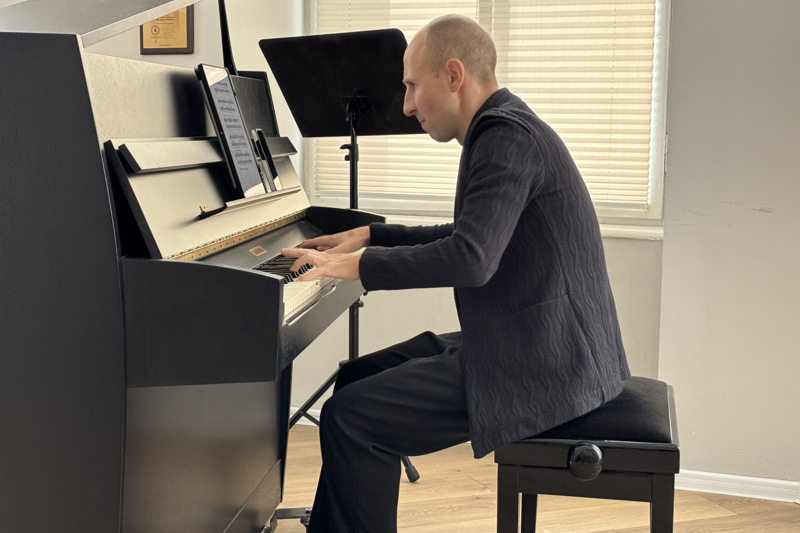
A selection of Bogusław Schaeffer‘s Mazurkas were performed by Kuba Sokołowski on an upright piano. That instrument, with its somewhat harsh timbre, seemed to suit the tone of Schaeffer’s music perfectly, having a consistently playful language, leaning both toward and away from dance conventions. This was reinforced by a distinct undercurrent of flamboyance running through them (despite Sokołowski’s matter-of-fact reading), making the tension more interesting: tethered to a waltz-like foundation, yet always pulling at the leash. The Mazurkas had a curious harmonic and structural language too, following their own inscrutable logic, to the extent that at times the music seemed not to be flowing forward but sideways, a nicely odd perception.
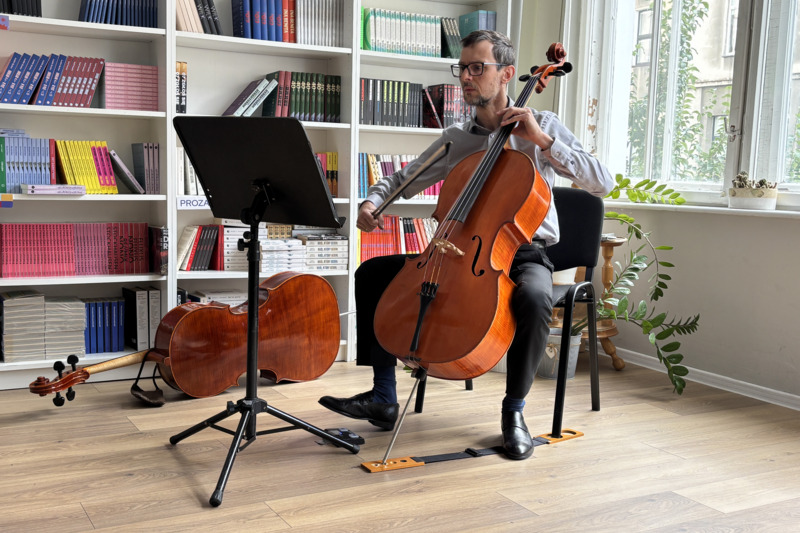
Violist Aleksandra Demowska-Madejska made short work of Garth Knox‘s No Pitch, no problem, a playful amuse-bouche carefully avoiding obvious pitch focus. Then came the main course, Spiral XI by Cambodian composer Chinary Ung. A forceful primary melodic line unexpectedly split to produce a vocal strand, a mix of song and timbrally varied vocalise, sometimes embellishing the viola but elsewhere becoming the primary voice (literally). Despite being something of a stream of consciousness it nonetheless felt focused and purposeful. Cellist Mikołaj Pałosz also explored two works, both of which side-stepped conventional musical language. Raven Chacon‘s Quiver took the form of an intriguing collection of utterances, each very different from the last. They would sing, squeal, croak, squeak, wail, turn static, move glacially, notes barely speaking. An exotic kind of litany, or a list? Lost Style by Ge Gan-ru was more earnest, treating the instrument percussively and with emphatic bowing. Going beyond the bridge, Pałosz elicited a wild, grinding chorus which, in conjunction with pizzicatos, seemed less to be reconfiguring a new mode of expression than rediscovering an ancient one. Ge treated the instrument not as a ‘cello’ but as a physical blank object – a large wooden box with strings attached, and an accompanying wood and hair implement – giving the music a naive, exploratory quality that was refreshing. Yet more than mere exploration, the piece was expressive, its articulation encompassing lively rhythmic sequences, striking and stroking the instrument in various ways, and rapid plucked notes, extending to foot stamps later, ultimately demonstrating a strange but sophisticated form of ‘grammar’.
The most striking performances – no pun intended – came from percussionist Hubert Zemler, who was featured twice. First, in the largest room (for some reason named Czyściec, ‘purgatory’) he was the counterpart to House of Music curator Michał Mendyk in Tom Johnson‘s Music and Questions. Not so much a composition as an extended sequence of questions encouraging the listener to reflect on what was happening – in terms of both words and music, and their relationship – Zemler followed each question with a pattern of gong strikes. i say pattern, but as far as i could tell the rules were simple: of the four available gongs, strike three of them once, and one of them twice, but never successively (e.g. 12343 or 41324). Together they established an atmosphere of calm contemplation, Zemler’s notes acting to confirm the conclusion of the question, become an abstract response to it (not unlike the alien communication in Close Encounters of the Third Kind), and an invitation to us to consider it. It was more restful than deep, but its 25-minute duration passed surprisingly quickly.
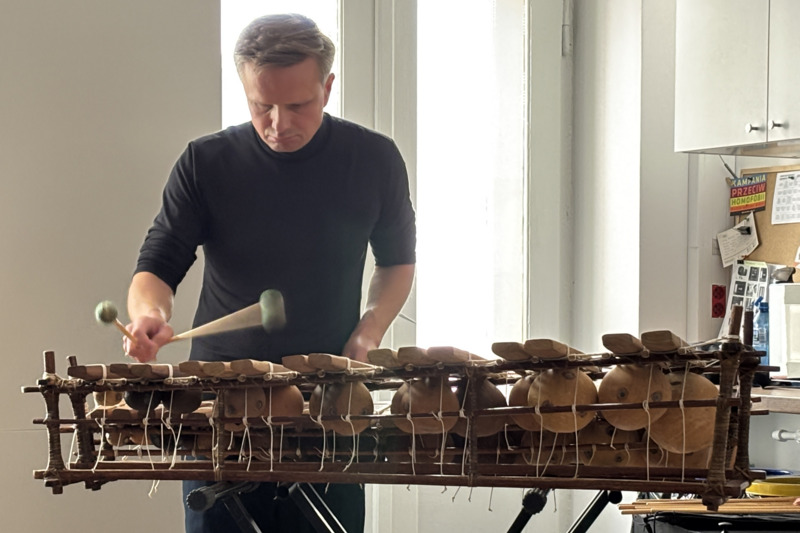
Zemler was much more impressive when he moved from ‘purgatory’ into the kitchen (hardly an inappropriate space for a percussionist) where he gave an improvisation on a chromatic balafon. This was special, it spoke with a language of tremor, his tremolandi so constant and rapid they became a total pitch blur. Isolated notes accented out, clarifying into dancing rhythmic patterns – sounding now as if two or even four players were involved – moving up the instrument, arpeggiating, moving down again, becoming subdued. Things turned playful through a superfast florid texture, glissandi and clatter starting to infiltrate the music, exacerbated by Zemler switching from soft to hard mallets, gear-shifting the balafon from marimba- to xylophone-like. Notes pattered like raindrops after a downpour, Zemler reverting now to even softer mallets to conjure plunking tones sounding like gongs made of wood, hitting the resonators and the case too as the improvisation died back, became erratic, briefly acrobatic, before resting on a low, slow repeating note. Utterly marvellous.
The second marathon, literally titled ‘Marathon’, took place through the evening in the warehouse-like space of the Creative Industries Institute. This was a decidedly mixed bag, the most taxing parts of which were Zafraan Ensemble’s performance, with the composer as narrator, of two hour-long chunks from François Sarhan‘s Log Book. There’s self-indulgent, and there’s this. Words and music at their most lytdybr, a conveyor belt of the most prosaic, uninteresting occurrences from the composer’s life scrutinised and memorialised with pointless, forgettable accompaniment (for want of a much better word; the ensemble often seemed entirely disconnected). Few people in their right mind want to read someone else’s diary entries, and even fewer want to actively share them. With good reason; Sarhan’s obsessive attempt to make a virtue out of such numbing mundanity was as tedious as it was narcissistic.
Thankfully, the rest of the Marathon contained several highlights, most of which involved pianist Małgorzata Walentynowicz. Kelley Sheehan‘s Brainzaps, for flexible trio, tape, and video, pulsated everywhere with life and vitality. This was echoed in its time-lapse visuals of plant life, part of an audiovisual world that for all its glitched volatility was strikingly elegant.
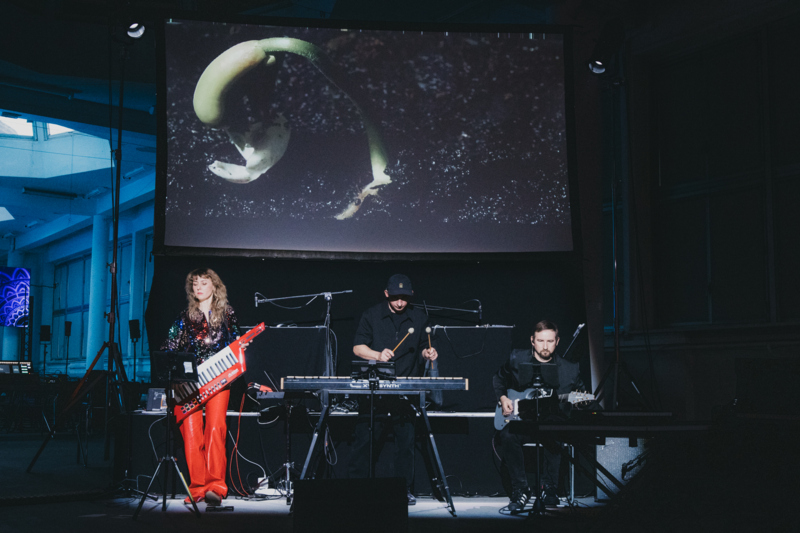
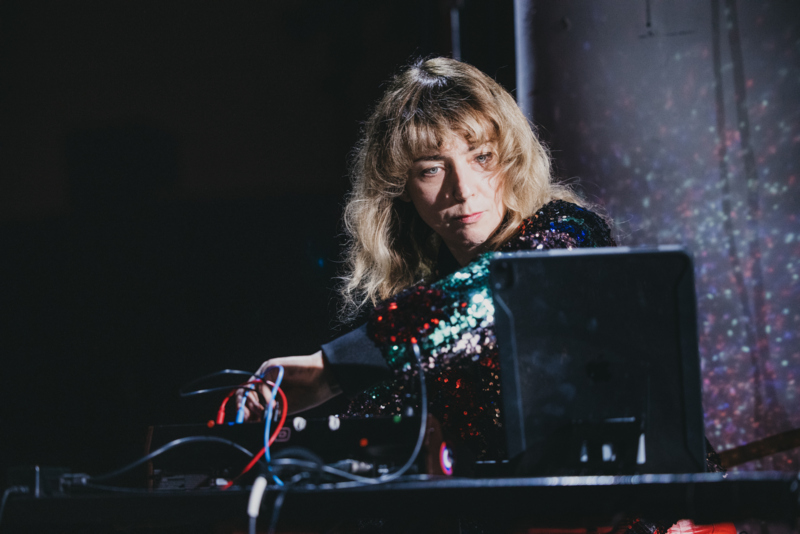
On the one hand, it’s hard not to shake the feeling Alex Paxton is stuck in a kind of manic, one trick pony rut (emphatically confirmed by his trying latest album, Candyfolk Space Drum), yet there was plenty to enjoy in the joyous chop-and-change rhapsodising of his 2021 keyboard piece Car-Pig. As expected it went on for too long, but Walentynowicz’s performance was perfect, facilitating but not actively trying to embody the crazy. Best of all was Annesley Black‘s Hurry up the machine. I HAVE STRUCK A BIG BONANZA for synthesizer. In the best sense it was like a literal work in progress, Walentynowicz evidently engaged in some real-time R&D trial-and-error experimentation. As if testing sounds – both on their own terms as well as their possibilities in a broader context – it was an interesting, highly entertaining work, and a true celebration of the noble art of knob twiddling.
It felt slightly discombobulating to be seeing Ensemble for New Music Tallinn in action somewhere other than Estonia. It was in many ways a frustrating concert. Liisa Hirsch‘s Code “Liiv” had left me baffled at its première last year, and hearing it a second time left me none the wiser. Klaus Lang‘s corium was all generic filmic ‘melancholy’ book-ending empty dronal blah, whereas Jan Martin Smørdal‘s All Play, responding to a video performance of Daniel Meyer Grønvold, just left me desperately wanting to focus on Grønvold instead, as what he was doing sonically was so much more interesting. Sharveh was yet another instance of Arash Yazdani indulging nothing but the most basic, primitive ideas, on this occasion a kind of fucked-up unison that just boringly blared at us. Insufferably retarded stuff.
It fell to Wojciech Błażejczyk to heroically save the day in his new work Sympatheticality for viola d’amore and ensemble, receiving its première with soloist Talvi Nurgamaa. The title was apt: the ensemble was occupied with imitating, echoing, answering and embellishing, all of their actions inspired by the viola d’amore. The work’s development was organic, spontaneous but cogent, sometimes breaking into a groove and working it hard, along the way encountering gathering points, often around a deep bass note, acting as a grounding, a fundamental, a reference point – landmarks in uncharted territory. In real time, though, Błażejczyk went beyond – or expanded, redefined – the territory’s confines, a florid piano moment leading to a staccato network that magically conjured up a harmonic field. And in time, a semi-focused lyrical strain emerged in the strings, the soloist both part of it but also a thoughtful presence at its periphery. There was a sense that Ensemble for New Music Tallinn weren’t letting rip in a way that the material suggested, making it sound held back (ironic, considering Yazdani was conducting), yet that didn’t restrain the potency of the work, concluding with complex chords and harmonics, mysteriously aligning in its closing moments as a calm rhythmic repetition.