
Accordionfest is a week-long, annual festival in Tallinn created by accordionist Momir Novakovic. Born in Serbia, Novakovic has been based in Estonia for many years, teaching accordion at the city’s Academy of Music and Theatre. The festival is designed to educate audiences, composers, aspiring accordionists – everyone really – about the instrument and its capabilities. For the 2026 festival, its sixth iteration, Novakovic particularly wanted both to showcase the diversity and potential of the instrument while also challenging preconceptions. Under the heading “Forwards!”, Novakovic summarised this as “not simply a direction. It is an attitude. It means refusing to see the accordion as an instrument confined to a particular repertoire, tradition, or musical context. It means continuing to question what the instrument can be, where it can belong, and whom it can reach.”

To that end, the six concerts that made up this year’s Accordionfest were all highly distinctive in terms of their approach, as well as being very different from each other. A couple of them were weak, including one given by the Latvian duo Anta & Vija, comprising Anta Pukite on accordion and percussionist Vija Moore, who focused on the African balafon. Apropos: Moore had been hoping to perform on a chromatic balafon (a wonderful instrument i heard in action last month in Poland), but events conspired resulting in her being limited to a diatonic instrument. i’m curious how things would have gone differently, as the duo’s performance – taking traditional African and Baltic tunes as a starting point for basic, minimalistic noodling – felt as though diatonicism was fundamental rather than accidental. As it was, allowing for all the repetitions, their 55-minute concert felt like it consisted of around 25 minutes of actual music. Maybe the chromatic instrument would have made a difference, but less generic, much more imaginative ideas would surely have made a bigger one.
The festival’s opening concert had quite a discrepancy between what it promised and what was delivered. The prospect was fascinating, inspired by aspects of Commedia dell’Arte, combining accordionist Manca Dornik and cellist Ema Grčman, with pantomime from Katja Štefanič and live painting taking place by Anhelina Shevchenko. In practice the painting turned out to be impossible to engage with, as it was positioned at the back of the space where no-one could actually see it. The narrative, such as it was, revolved around Štefanič, whose emotional trajectory was unstable. She periodically referred to the consequences arising from “If I think for a bit too long …”, both positive and negative. Her movements and her appearance illustrated something of this, from energetic to enervated, muscular to fragile, forcing smiles and hiding behind masks from time to time.
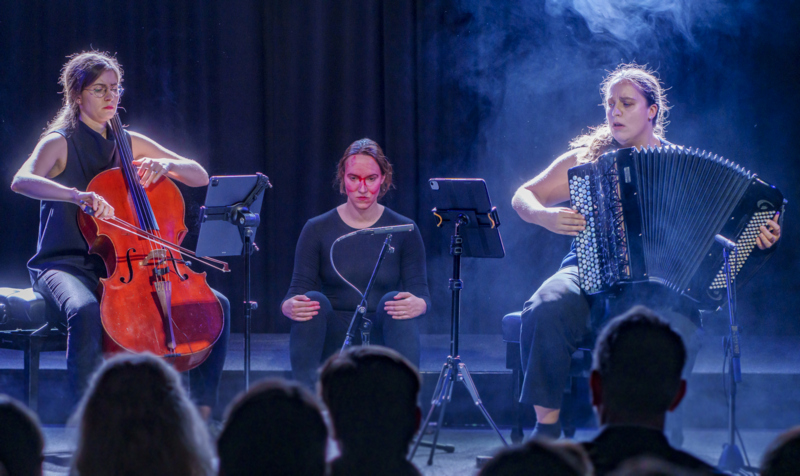
Yet while her presence throughout the concert was potent, she was absent for long stretches, during which Dornik and Grčman worked their way through a sequence of Pergolesi, Stravinsky, Schnittke and Ravel. ‘Worked’ seems the right word; there was a notable flatness to their delivery – dynamically rather inert – and an increasing sense that a lot more practice beforehand wouldn’t have gone amiss. Coordination was strong, intonation not so much (particularly Grčman), making the whole feel more like a work in progress than a fully figured-out bit of music theatre. Two improvised sequences – one of which got the concert up and running, the other nicely disrupting the flow through the final works – were the most engaging music of the evening, and it would have been nice if there could have been more. In hindsight, with their emotionally-charged distortion and erosion of pitch, this was also the closest the music got to reflecting something of the acute darkness permeating Štefanič‘s performance.
The recital given by Polish accordionist Albert Woelke was an evening of old and new, contrasting Baroque and 20th Century music. It was like a compositional smackdown, with counterpoint and texture going head-to-head. As if to ensure things stayed polite, slow movements from harpsichord concertos by C. P. E. Bach and J. S. Bach book-ended the proceedings, father and son creating a context of refined elegance, Woelke being joined on stage by a string quartet. The counterpoint was represented by two sonatas by Domenico Scarlatti and a longer work by Joseph-Nicolas-Pancrace Royer. Woelke’s performances of the Scarlatti were marvellous, on the one hand meticulous and precise, on the other allowing extensive rubato to give expressive shape to the music’s contours and cadences. Royer’s La Marche des Scythes was fascinating, a cross between a rondo and what often sounded like the product of mathematical permutations. Woelke was dazzling here, melody and accompaniment moving at what seemed like different tempi yet fitting together, before entering a stodgy, laboured arpeggiated sequence with deep chords below, that proved genuinely mesmerising.
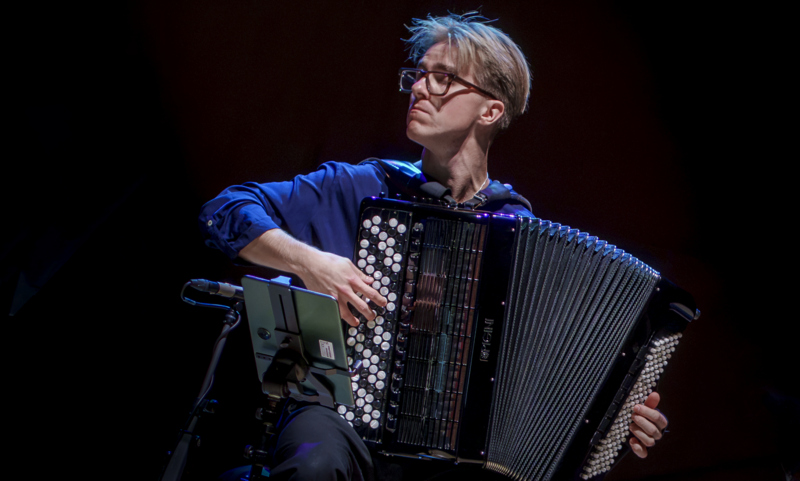
New music was represented solely by Stephen Montague, in four works each of which in this context felt like it took the Baroque contrapuntal clarity and blurred it. Midnight Sun began from rapidity but had stillness at its core, a slow contemplation surrounded by a minimalistic texture, possibly shaping it, possibly enclosing it. In Mirabella, light dancing patterns alternated with instances of reverie, its playful but focused attitude suggesting reminiscence, whereas Chugging Furies came and went doing lots of the former, not so much of the latter. The concert ended segueing from Bach in Montague’s Eine kleine Klangfarben Gigue, Woelke surrounded not just by the quartet again but also, unexpectedly, bassoon and live electronics. Woelke was stuck in a loop, while the ensemble pulled out notes from his rapid figuration, forming a messy cloud-like formation around him. It continued for rather too long, but was certainly fun.
Something of a counterpart to Woelke’s recital was one given by Serbian Aleksandar Radović, who had designed it less as about direct contrasts than a journey through very different stylistic attitudes. The first big shift came after opening music by Couperin and J. S. Bach, when we encountered Finnish composer Sampo Haapamäki‘s Power. Rapid material tumbling up and down the instrument, forced into chordal ‘good behaviour’, subsequently reduced to miniature trills and filigree seemingly in order to escape and start tumbling around again. The energy in the work was compelling, while some of its smaller-scale moments were really effective in their emphasis on tiny details. Staffan Mossenmark‘s Water Spirit was too meandering and minimal to gain any traction, whereas the ‘Presto’ movement from Sonata No. 1 “Ultra”, by fellow Finn Paavo Korpijaakko, gave Radović the opportunity to show off different perceptions of speed. First, when passing through a tremulous episode, he and his instrument physically shaking together, but even more so in a sequence of note repetitions later, which Radović executed stunningly fast.
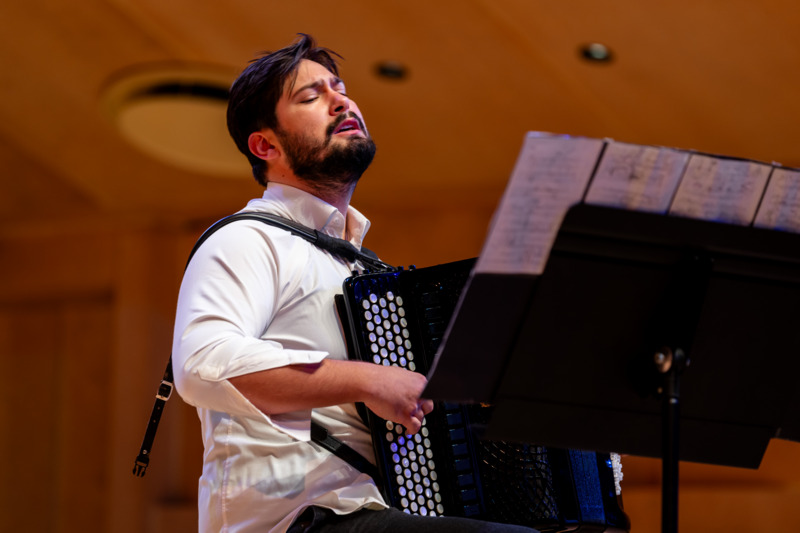
Some effervescent Mendelssohn led to a fitting extension of the Haapamäki in the form of ‘Varlaam’s Drinking Song’ from Mussorgsky‘s opera Boris Godunov. Now the material did more than just tumble, staggering, lolloping and swaggering with a tone of pure bullish merriment, the accordion practically dripping with alcohol-fuelled testosterone. Both of these had been arranged for accordion by Yuri Shishkin, but while Saint-Saëns‘ Danse macabre is brilliant and versatile enough to withstand transcription (particularly Edwin Lemare’s outstanding organ version), his approach here took too many liberties. Though superbly performed by Radović, Shishkin’s reworking and restructuring of the work destroyed its dramatic accumulation, reducing it to a confusing collection of ‘best bits’ bolted together. Not so much Saint-Saëns as Frankenstein.
Tuesday evening’s event took place in the grand setting of Tallinn’s historic Kadriorg Palace, given by Polish duo Karolina & Iwo, a.k.a. Karolina Mikolajczyk (violin) and Iwo Jedynecki (accordion). i saw them in action at the 2024 Istanbul Music Festival, where they gave a lively concert of late Romantic and early 20th century repertoire. On this occasion their programme was more meditative, designed as an hour-long journey through contemporary Polish, Ukrainian and Baltic music, interspersed with semi-improvised, atmospheric interludes and passages of poetry read by actor Mirjam Äkke.
While they worked as contrasting episodes, works by Pēteris Vasks and Gorecki were drearily empty, like staring at small portions of desert. An Intermezzo by Valentin Silvestrov was stronger, a curious combination of simple, almost bland lyricism and askew sequences. Mysterious and odd, it felt like music that could not be trusted, especially when unexpectedly (and implausibly) ending on a bright triad. More certainty came in Dariusz Przybylski‘s Up for solo violin, which began the concert. As its title implied, the music seemed subject to an upward pull, sometimes fast, sometimes slow, but Mikolajczyk wasn’t fighting it. Instead, she was like a bird navigating thermals and currents, using the force to form elaborate flight patterns, dropping dramatically only to rise again, veering sideways into what seemed like a horizontal air tunnel, built upon pizzicatos and and an extended pedal point, before emerging to energetically rise again. The duo did the opposite in Ligeti‘s ‘Tempo di Valse’ from Musica ricercata, creating the distinct feeling the violin’s upper music was tethered to the accordion’s dronal waltz. But it remained playful, using rubato flexing in a way that felt like it was coordinated with breathing in and out.
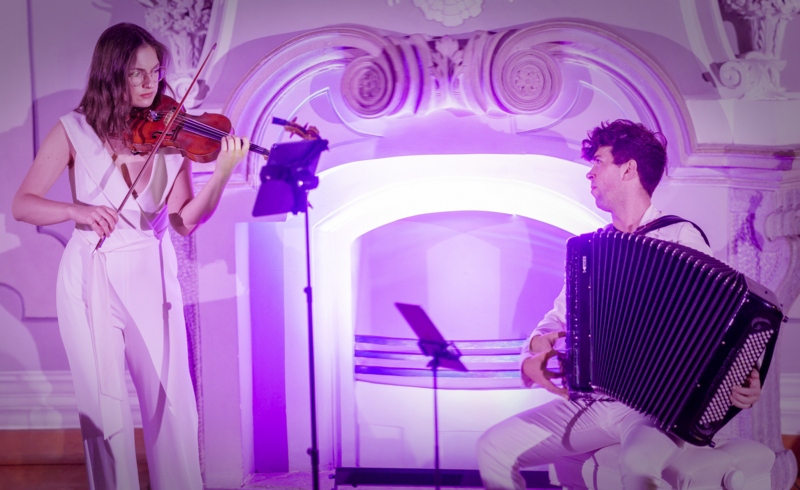
The highlights of the concert came from Erkki-Sven Tüür and Justė Janulytė. In Tüür’s Conversio (originally for violin and piano), the composer’s mercurial approach was felt in the way the music suggested we were in for an extended period of one central idea, metric clarity punctuated by cheeky irregularities. Even as this idea took shape, though, an obliqueness was already present, most audibly in glancing chords from the accordion seemingly trying to distract the violin from staying harmonically focused. But its second half was transformed, continually halting and breaking up, hitting accents that seemed to stall the music’s engine, the continuity much more complex, Mikolajczyk and Jedyneckilike now apparently engaged in a struggle. Its conclusion was mischievously inconclusive: a slow mix of messy clusters and quasi-lyricism. Janulytė’s Aria was mesmerising in the way melody was inseparable from the surrounding tissue, though embedded such that, as it moved, the tissue slowly and subtly reformed around it. This had continual implications, non-diatonic, non-tonal, recreating its harmonic references on the fly as it progressed, always unpredictable, always right. Caught between tension and resolution, this was made yet more effective by the locus of the melody at times being hard to make out. A wonderful performance of an extraordinary piece.
The most overtly contemporary concert during Accordionfest 2026 was given by Italian-Lithuanian Mantas Leonardo Lizzi, who didn’t merely surround but practically encased his accordion (and himself) in electronics. Like Mikolajczyk and Jedynecki, Lizzi structured the concert as a single, unbroken span, but aesthetically the four works he performed – Pierre Jodlowski‘s Something out of Apocalypse, Aurelio Edler-Copes‘ Cantiga, Gabriel Ledoux‘s Music for Alim and Jorge Gregorio García Moncada‘s Un amor puro e incondicional – had much in common and were superbly aligned. Less about specific ideas than larger-scale behaviours and states, this is one of the only concerts i can remember where it felt appropriate not to focus on when each piece began and ended, but simply to become immersed in the whole. Jodlowski’s piece, which began the concert, was well-named as we were plunged into a heightened, (in)tense, foreboding environment. The bellows on Lizzi’s accordion seemed infeasibly enormous as, in conjunction with the electronics, they conjured up immense walls of sound. They greatly expanded but instead of becoming mere noise, fast filigree materialised, like zooming in on the music’s surface. As the performance continued one felt that, despite being volatile and erratic, its level of threat, though considerable was in fact due to the music existing in its own internal state of emergency, rather than being directed out toward us. As such, Lizzi – covered by cables and wires – now took on the appearance of a research subject, having experiments carried out upon him, producing waves, jolts, clusters, burbling streams, blips, scattershot bullet-rhythms and extended laser beam pitches.
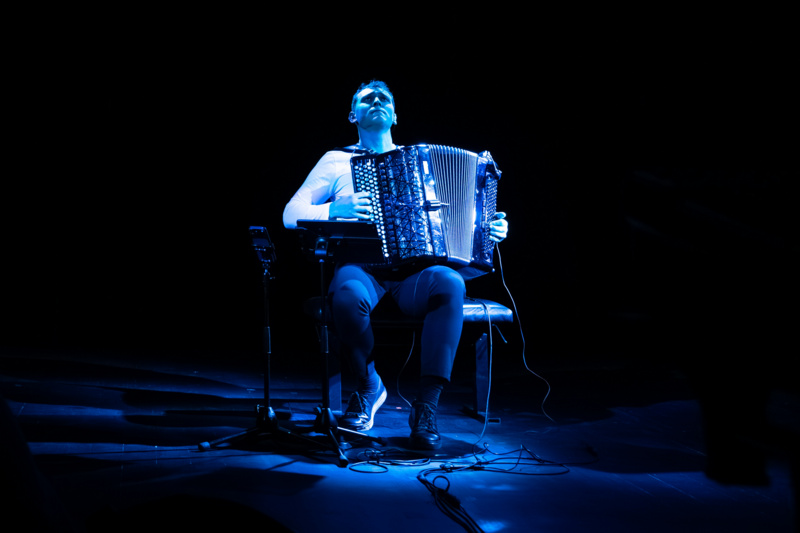
Despite becoming overwhelmed, Lizzi continued, and eventually the overload subsided. Voices entered the space, the accordion switching to slow tones and a more ambient sensibility. Seemingly on a whim he opted for something jaunty, but the electronics turned ominous, everything ending up in a stop-start, rumbling and wobbling soundscape of noise. By this stage it seemed that accordion and electronics were working together, and the atmosphere for the first time began to relax, Lizzi even playing on his own for a time. As Moncada’s music about unconditional love took over, i found myself wondering if the tussles and the tension hadn’t been more stimulating. Neutrality appeared to take over, things became more vague … yet it wasn’t so: weight and intensity returned, and whether due to them or in spite of them, the music became ecstatic, climaxing in a final surging drone of glory.

